
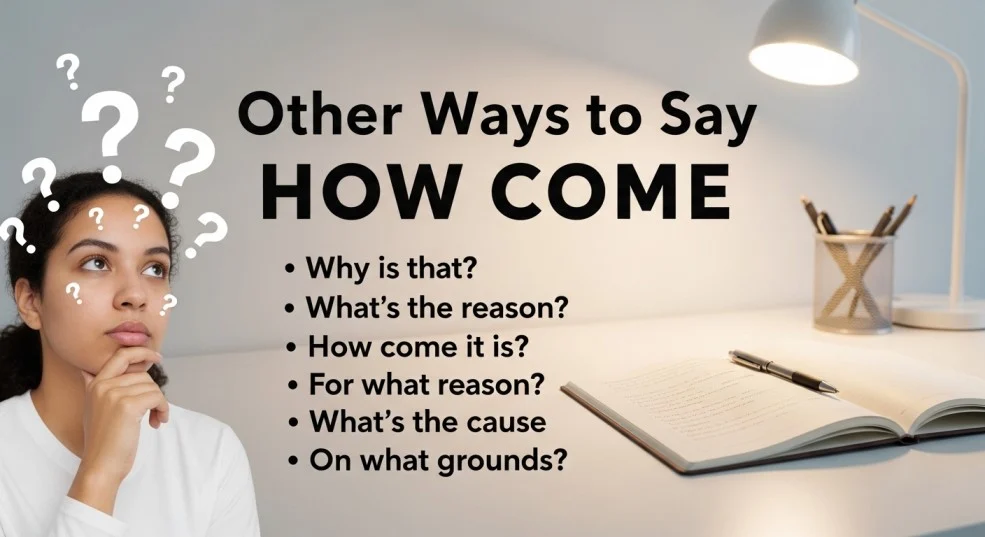
Quick Ans: If you’re searching for other ways to say “how come,” you can use: why is that, what’s the reason, how did that happen, why did that occur, what caused that. These alternatives help you sound clearer, more natural, and more appropriate in both formal and casual English.
The phrase “how come” is commonly used to ask for reasons or explanations. It is simple and conversational, but it often sounds too informal in professional or academic settings.
That’s why learning alternatives to how come is important. It helps you ask questions more precisely while improving tone and fluency.
Using different expressions also allows you to express curiosity in English in a more polished and confident way.
“The way you ask questions can make your English sound smarter and more professional.”
Quick Categories Section
Formal Alternatives to “How Come”
- Why is that
- What is the reason
- For what reason
- How did this occur
Pro Tip: Use these in academic writing, formal emails, or presentations.
Casual Alternatives
- Why is that
- What happened
- What’s going on
- How did that happen
Pro Tip: Perfect for everyday conversations with friends.
Professional Alternatives
- Could you explain why
- What is the cause
- Can you clarify the reason
- What led to this
Pro Tip: Use these in meetings, reports, and workplace communication.
Informal Expressions
- What’s up with that
- How so
- What’s the deal
- Why’s that
Pro Tip: Use only in relaxed or friendly situations.
“Clear questions lead to clear answers.”
Common Mistakes Section
- Using it in formal writing
Incorrect: How come the report is late?
Better: Why is the report late? - Using incomplete structure
Incorrect: How come this?
Better: How come this happened? - Overusing the phrase
Incorrect: Repeating “how come” frequently
Better: Use varied alternatives - Using casual tone in business settings
Incorrect: How come you missed the meeting?
Better: Could you explain why you missed the meeting? - Wrong tone in serious discussions
Incorrect: How come this error occurred?
Better: What caused this error?
What Does “How Come” Mean?
Definition:
It is an informal way to ask “why” or request an explanation for something.
Grammar Note:
Unlike “why,” it is usually followed by a subject + verb without inversion.
Example:
How come you didn’t call me?
When to Use “How Come”
- Casual conversations
- Asking simple questions
- Friendly discussions
- Informal spoken English
Spoken vs Written: Mostly spoken
Formal vs Informal: Informal
Is It Professional or Polite to Say “How Come”?
- Polite? ✔️ Yes
- Professional? ❌ Not usually
Business Example:
Could you explain why the deadline was missed?
“Professional English favors clarity and structure over casual phrases.”
Pros and Cons of Using “How Come”
Pros
- Easy to use
- Common in speech
- Friendly tone
- Natural conversation
Cons
- Too informal for work
- Limited use in writing
- Can sound vague
- Not suitable for formal settings
Other Ways to Say “How Come” (With Examples)
These alternatives will help you sound more fluent, confident, and natural when asking questions.
Use them based on tone, audience, and situation.
1. Why is that
Meaning: Asking for a reason
Explanation: Simple and widely accepted
Example Sentence: Why is that happening?
Best Use: General
Worst Use: None
Tone: Neutral
Context Variability: casual / professional
2. What is the reason
Meaning: Asking for explanation
Explanation: More formal phrasing
Example Sentence: What is the reason for this delay?
Best Use: Formal
Worst Use: Casual chat
Tone: Formal
Context Variability: professional
3. How did that happen
Meaning: Asking about cause
Explanation: Focus on event
Example Sentence: How did that happen?
Best Use: Casual
Worst Use: Formal writing
Tone: Curious
Context Variability: casual
4. Why did that occur
Meaning: Asking about reason formally
Explanation: Professional tone
Example Sentence: Why did that occur in the system?
Best Use: Workplace
Worst Use: Friendly talk
Tone: Formal
Context Variability: professional
5. What caused that
Meaning: Asking about cause
Explanation: Direct and clear
Example Sentence: What caused that issue?
Best Use: Technical
Worst Use: Casual chat
Tone: Direct
Context Variability: professional
6. Could you explain why
Meaning: Polite request for reason
Explanation: Professional tone
Example Sentence: Could you explain why this happened?
Best Use: Work
Worst Use: Casual
Tone: Polite
Context Variability: professional
7. What led to this
Meaning: Asking about sequence of events
Explanation: Analytical tone
Example Sentence: What led to this outcome?
Best Use: Reports
Worst Use: Casual
Tone: Formal
Context Variability: professional
8. Can you clarify the reason
Meaning: Request explanation
Explanation: Very professional
Example Sentence: Can you clarify the reason for this change?
Best Use: Workplace
Worst Use: Informal talk
Tone: Formal
Context Variability: professional
9. Why is this the case
Meaning: Asking deeper reasoning
Explanation: Analytical question
Example Sentence: Why is this the case?
Best Use: Academic
Worst Use: Casual
Tone: Formal
Context Variability: professional
10. What’s the reason behind this
Meaning: Asking for explanation
Explanation: Semi-formal
Example Sentence: What’s the reason behind this decision?
Best Use: Work
Worst Use: Slang
Tone: Neutral
Context Variability: professional
11. How so
Meaning: Asking for clarification
Explanation: Short informal phrase
Example Sentence: How so?
Best Use: Conversation
Worst Use: Formal writing
Tone: Informal
Context Variability: casual
12. What’s going on
Meaning: Asking situation
Explanation: Casual curiosity
Example Sentence: What’s going on here?
Best Use: Casual
Worst Use: Formal
Tone: Informal
Context Variability: casual
13. Why’s that
Meaning: Short form of why is that
Explanation: Informal speech
Example Sentence: Why’s that?
Best Use: Friends
Worst Use: Work
Tone: Casual
Context Variability: casual
14. What’s the cause
Meaning: Asking for cause
Explanation: Direct tone
Example Sentence: What’s the cause of this issue?
Best Use: Work
Worst Use: Casual
Tone: Neutral
Context Variability: professional
15. What explains this
Meaning: Asking for explanation
Explanation: Analytical
Example Sentence: What explains this result?
Best Use: Academic
Worst Use: Casual
Tone: Formal
Context Variability: professional
16. Why did this happen
Meaning: Asking reason
Explanation: Common neutral phrase
Example Sentence: Why did this happen?
Best Use: All contexts
Worst Use: None
Tone: Neutral
Context Variability: general
17. What’s behind this
Meaning: Asking hidden cause
Explanation: Slightly informal
Example Sentence: What’s behind this change?
Best Use: Work
Worst Use: Slang
Tone: Neutral
Context Variability: professional
18. What brought this about
Meaning: Asking origin
Explanation: Formal tone
Example Sentence: What brought this about?
Best Use: Formal
Worst Use: Casual
Tone: Formal
Context Variability: professional
19. For what reason
Meaning: Formal “why”
Explanation: Very formal usage
Example Sentence: For what reason was this done?
Best Use: Academic
Worst Use: Casual
Tone: Very formal
Context Variability: professional
20. What’s the explanation
Meaning: Asking for reasoning
Explanation: Direct and neutral
Example Sentence: What’s the explanation for this?
Best Use: Work
Worst Use: Casual
Tone: Neutral
Context Variability: professional
21. Why did you do that
Meaning: Asking personal reason
Explanation: Direct question
Example Sentence: Why did you do that?
Best Use: Conversation
Worst Use: Formal writing
Tone: Direct
Context Variability: casual
22. What made that happen
Meaning: Asking cause
Explanation: Slightly informal
Example Sentence: What made that happen?
Best Use: Casual
Worst Use: Formal
Tone: Informal
Context Variability: casual
23. Can you explain this
Meaning: Request explanation
Explanation: Neutral tone
Example Sentence: Can you explain this?
Best Use: Work
Worst Use: Slang
Tone: Neutral
Context Variability: professional
24. Why is this happening
Meaning: Asking ongoing reason
Explanation: Present situation
Example Sentence: Why is this happening right now?
Best Use: All contexts
Worst Use: None
Tone: Neutral
Context Variability: general
25. What’s the issue
Meaning: Asking about problem
Explanation: Direct informal
Example Sentence: What’s the issue here?
Best Use: Casual/work
Worst Use: Formal writing
Tone: Semi-formal
Context Variability: professional
26. What’s the problem
Meaning: Asking reason/problem
Explanation: Direct tone
Example Sentence: What’s the problem?
Best Use: Conversation
Worst Use: Polite situations
Tone: Direct
Context Variability: casual
27. Why is that so
Meaning: Asking reasoning
Explanation: Slightly formal
Example Sentence: Why is that so?
Best Use: Academic
Worst Use: Casual
Tone: Formal
Context Variability: professional
28. What accounts for this
Meaning: Asking explanation
Explanation: Formal/analytical
Example Sentence: What accounts for this change?
Best Use: Reports
Worst Use: Casual
Tone: Formal
Context Variability: professional
29. What’s the logic behind this
Meaning: Asking reasoning
Explanation: Analytical tone
Example Sentence: What’s the logic behind this decision?
Best Use: Work
Worst Use: Casual
Tone: Professional
Context Variability: professional
30. Why would that happen
Meaning: Asking possibility reason
Explanation: Curious tone
Example Sentence: Why would that happen?
Best Use: Discussion
Worst Use: Formal writing
Tone: Curious
Context Variability: casual
“Asking better questions leads to better understanding.”
Mini Quiz / Self-Check
1. Which is most formal?
A. What’s going on
B. For what reason
C. Why’s that
Answer: B
2. Which is best for workplace email?
A. What’s up with that
B. Could you explain why
C. How so
Answer: B
3. Which is most casual?
A. What accounts for this
B. What’s the problem
C. For what reason
Answer: B
Comparison Table: Top Alternatives
| Phrase | Tone | Best Use |
|---|---|---|
| Why is that | Neutral | General |
| Could you explain why | Professional | Work |
| What caused that | Direct | Technical |
| What led to this | Formal | Reports |
| How did that happen | Casual | Conversation |
| What’s the reason | Formal | Writing |
| What’s going on | Informal | Daily talk |
| For what reason | Very formal | Academic |
| What accounts for this | Formal | Analysis |
| Why did this happen | Neutral | All contexts |
FAQs
1. What are other ways to say how come?
You can say why is that, what caused that, or could you explain why.
2. Is “how come” formal?
No, it is informal and mostly used in spoken English.
3. What is the best professional alternative?
Could you explain why is the most suitable for workplace use.
4. Can I use it in emails?
It’s better to use formal alternatives in professional emails.
5. Why learn alternatives?
They improve tone, clarity, and communication skills.
Conclusion
Learning other ways to say how come helps you ask questions more clearly and professionally. It also improves your ability to adjust tone depending on context.
Practice these alternatives to sound more confident and fluent in English.
See also: Other Ways to Say “Why”
See also: Professional Question Phrases for Workplace Communication
CTA: Try replacing casual questions with professional ones in your next conversation.
Discover More:-
- Other Ways to Say Happy Mothering Sunday (30+ Examples)
- Other Ways to Say Happy Friday (40+ Examples)



Pingback: Other Ways to Say Hello All (35+ Examples)