
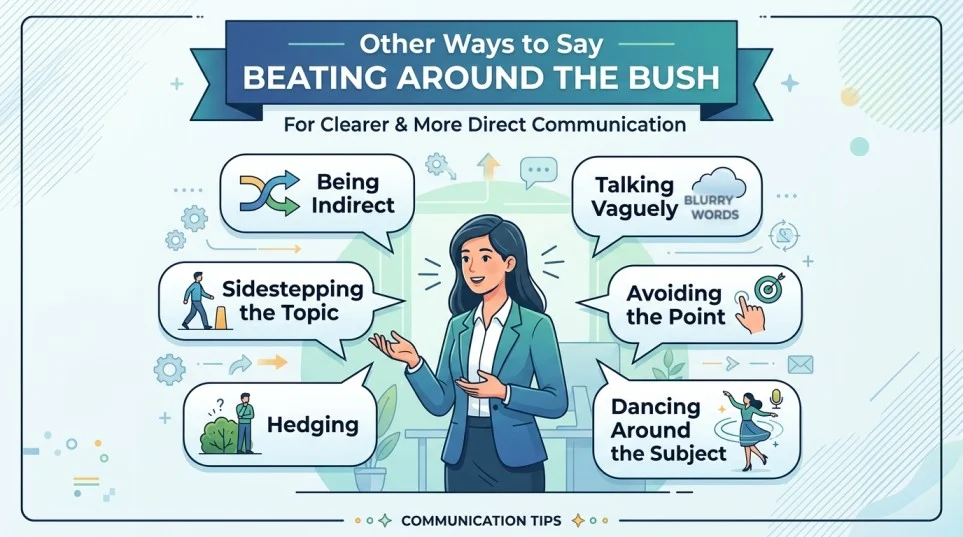
Quick Ans: If you’re looking for other ways to say “beating around the bush,” try: avoiding the point, being indirect, not getting to the point, speaking vaguely, dodging the issue. These alternatives help you communicate more clearly and appropriately in different situations.
The phrase “beating around the bush” means avoiding the main topic or not speaking directly. It is commonly used when someone is being unclear, indirect, or hesitant to address the real issue.
However, relying on one phrase repeatedly can limit your expression. Learning alternatives to beating around the bush helps you communicate more precisely and effectively.
These expressions are especially useful when you want to express clarity in English and improve both professional and everyday communication.
“Clear communication always beats vague language.”
Quick Categories Section
Formal Alternatives to “Beating Around the Bush”
- Avoiding the main point
- Speaking in an indirect manner
- Not addressing the issue directly
- Providing vague responses
Pro Tip: Use these in professional writing and formal discussions.
Casual Alternatives
- Not getting to the point
- Going in circles
- Talking around it
- Dragging the conversation
Pro Tip: Great for everyday conversations and informal speech.
Professional Alternatives
- Lacking clarity in communication
- Being non-direct
- Not being concise
- Failing to address key issues
Pro Tip: Ideal for workplace feedback and communication.
Informal Expressions
- Rambling on
- Dodging the question
- Talking nonsense
- Skipping the point
Pro Tip: Use these carefully, only in relaxed settings.
“Direct language builds trust and confidence.”
Common Mistakes Section
- Using the phrase in formal reports
Incorrect: The speaker was beating around the bush.
Better: The speaker avoided the main point. - Using it too frequently
Repeating the same idiom reduces clarity
Better: Use varied alternatives - Using informal tone in professional settings
Incorrect: Stop beating around the bush
Better: Please be more direct - Misunderstanding the meaning
Incorrect: Using it for long conversations
Better: Use only when someone avoids the point - Using it in a rude way
Incorrect: You’re beating around the bush
Better: Could you clarify your point?
What Does “Beating Around the Bush” Mean?
Definition:
It means avoiding the main topic and not speaking directly about the issue.
Grammar Note:
It is an idiomatic expression used in informal English.
Example:
Stop beating around the bush and tell me what happened.
When to Use This Expression
- When someone is being unclear
- During discussions or debates
- Giving feedback
- Casual conversations
Spoken vs Written: Mostly spoken
Formal vs Informal: Informal
Is It Professional or Polite to Use This Phrase?
- Polite? ✔️ Sometimes
- Professional? ❌ Not usually
Business Example:
Instead of saying the idiom, say: “Let’s address the main issue directly.”
“Professional communication values clarity over idioms.”
Pros and Cons of Using This Phrase
Pros
- Easy to understand
- Common in everyday English
- Expresses frustration clearly
- Simple to use
Cons
- Too informal for work
- Can sound rude
- Not suitable for formal writing
- Limited tone flexibility
Other Ways to Say “Beating Around the Bush” (With Examples)
These alternatives will help you sound more fluent, confident, and direct in different situations.
Use them based on tone, audience, and context.
1. Avoiding the point
Meaning: Not addressing the main idea
Explanation: Clear and commonly used alternative
Example Sentence: He kept avoiding the point during the discussion.
Best Use: Work
Worst Use: Slang
Tone: Neutral
Context Variability: professional
2. Being indirect
Meaning: Not speaking clearly
Explanation: Formal and polite phrasing
Example Sentence: She was being indirect instead of clear.
Best Use: Professional
Worst Use: Casual jokes
Tone: Formal
Context Variability: professional
3. Not getting to the point
Meaning: Taking too long to explain
Explanation: Casual and common
Example Sentence: He is not getting to the point.
Best Use: Conversation
Worst Use: Formal writing
Tone: Casual
Context Variability: casual
4. Speaking vaguely
Meaning: Not giving clear details
Explanation: Formal expression
Example Sentence: The report was speaking vaguely.
Best Use: Work
Worst Use: Casual
Tone: Formal
Context Variability: professional
5. Dodging the issue
Meaning: Avoiding a problem
Explanation: Slightly informal but clear
Example Sentence: She is dodging the issue.
Best Use: Discussion
Worst Use: Formal report
Tone: Neutral
Context Variability: casual
6. Going in circles
Meaning: Repeating without progress
Explanation: Informal expression
Example Sentence: We are going in circles.
Best Use: Casual talk
Worst Use: Formal
Tone: Informal
Context Variability: casual
7. Talking around the topic
Meaning: Not addressing directly
Explanation: Neutral phrasing
Example Sentence: He keeps talking around the topic.
Best Use: General
Worst Use: Slang
Tone: Neutral
Context Variability: general
8. Being unclear
Meaning: Lacking clarity
Explanation: Simple and direct
Example Sentence: Your explanation is unclear.
Best Use: Professional
Worst Use: Casual jokes
Tone: Neutral
Context Variability: professional
9. Avoiding the main issue
Meaning: Not discussing the key problem
Explanation: Formal alternative
Example Sentence: They are avoiding the main issue.
Best Use: Work
Worst Use: Informal
Tone: Formal
Context Variability: professional
10. Not being straightforward
Meaning: Not direct
Explanation: Polite expression
Example Sentence: He is not being straightforward.
Best Use: Workplace
Worst Use: Slang
Tone: Polite
Context Variability: professional
11. Rambling on
Meaning: Talking too much without clarity
Explanation: Informal tone
Example Sentence: He kept rambling on.
Best Use: Casual
Worst Use: Formal
Tone: Informal
12. Not being clear
Meaning: Lack of clarity
Example Sentence: You are not being clear.
Best Use: Work
Worst Use: Casual jokes
Tone: Neutral
13. Avoiding direct answers
Meaning: Not answering properly
Example Sentence: She is avoiding direct answers.
Best Use: Professional
Worst Use: Slang
Tone: Formal
14. Being evasive
Meaning: Avoiding giving information
Example Sentence: He is being evasive.
Best Use: Formal
Worst Use: Casual
Tone: Formal
15. Talking too much without purpose
Meaning: Speaking without focus
Example Sentence: He talks too much without purpose.
Best Use: Casual
Worst Use: Professional
Tone: Informal
16. Not addressing the question
Meaning: Ignoring the main question
Example Sentence: She is not addressing the question.
Best Use: Work
Worst Use: Casual jokes
Tone: Formal
17. Avoiding clarity
Meaning: Not being clear
Example Sentence: The speaker is avoiding clarity.
Best Use: Formal
Worst Use: Casual
Tone: Professional
18. Skipping the main point
Meaning: Ignoring key idea
Example Sentence: He is skipping the main point.
Best Use: Casual
Worst Use: Formal
Tone: Informal
19. Not being concise
Meaning: Using too many words
Example Sentence: You are not being concise.
Best Use: Professional
Worst Use: Casual
Tone: Formal
20. Dragging the conversation
Meaning: Making discussion long
Example Sentence: Stop dragging the conversation.
Best Use: Casual
Worst Use: Formal
Tone: Informal
21. Speaking without clarity
Meaning: Not clear
Example Sentence: He is speaking without clarity.
Best Use: Work
Worst Use: Casual
Tone: Formal
22. Avoiding the truth
Meaning: Not telling truth directly
Example Sentence: She is avoiding the truth.
Best Use: General
Worst Use: Formal
Tone: Neutral
23. Giving vague answers
Meaning: Not specific
Example Sentence: He is giving vague answers.
Best Use: Work
Worst Use: Slang
Tone: Neutral
24. Not coming to the point
Meaning: Delaying main idea
Example Sentence: You are not coming to the point.
Best Use: Casual
Worst Use: Formal
Tone: Informal
25. Being long-winded
Meaning: Using too many words
Example Sentence: His explanation is long-winded.
Best Use: Work
Worst Use: Casual
Tone: Formal
26. Avoiding the question
Meaning: Not answering directly
Example Sentence: She is avoiding the question.
Best Use: Professional
Worst Use: Slang
Tone: Neutral
27. Talking without direction
Meaning: No clear purpose
Example Sentence: He is talking without direction.
Best Use: Casual
Worst Use: Formal
Tone: Informal
28. Being unclear in explanation
Meaning: Not explaining well
Example Sentence: The explanation is unclear.
Best Use: Work
Worst Use: Casual
Tone: Neutral
29. Not being direct
Meaning: Indirect communication
Example Sentence: You are not being direct.
Best Use: Professional
Worst Use: Slang
Tone: Formal
30. Avoiding the topic
Meaning: Not discussing subject
Example Sentence: He is avoiding the topic.
Best Use: General
Worst Use: Casual jokes
Tone: Neutral
“Clear and direct communication improves understanding instantly.”
Mini Quiz / Self-Check
1. Which is most formal?
A. Rambling on
B. Being evasive
C. Going in circles
Answer: B
2. Which is most casual?
A. Avoiding clarity
B. Going in circles
C. Being indirect
Answer: B
3. Best for workplace feedback?
A. Stop rambling
B. Not being concise
C. Talking nonsense
Answer: B
Comparison Table: Top Alternatives
| Phrase | Tone | Best Use |
|---|---|---|
| Avoiding the point | Neutral | Work |
| Being indirect | Formal | Business |
| Not getting to the point | Casual | Daily talk |
| Speaking vaguely | Formal | Reports |
| Dodging the issue | Neutral | Discussion |
| Being evasive | Formal | Professional |
| Not being concise | Formal | Work |
| Going in circles | Informal | Casual |
| Giving vague answers | Neutral | Work |
| Avoiding the question | Neutral | General |
FAQs
1. What are other ways to say beating around the bush?
You can say avoiding the point, being indirect, or speaking vaguely.
2. Is this phrase professional?
No, it is better to use formal alternatives in professional settings.
3. What is the best formal alternative?
Being indirect or avoiding the main issue.
4. Can I use this phrase at work?
It is better to avoid it and use polite alternatives.
5. Why learn alternatives?
It improves clarity, professionalism, and communication skills.
Conclusion
Learning other ways to say beating around the bush helps you communicate more clearly and effectively. It also improves your ability to adjust tone depending on the situation.
Practice these alternatives to become more confident and direct in English.
See also: Other Ways to Say “Be Honest”
See also: Professional Communication Phrases Guide
CTA: Try using 3 new alternatives in your next conversation to sound more clear and confident.
Discover More:-