
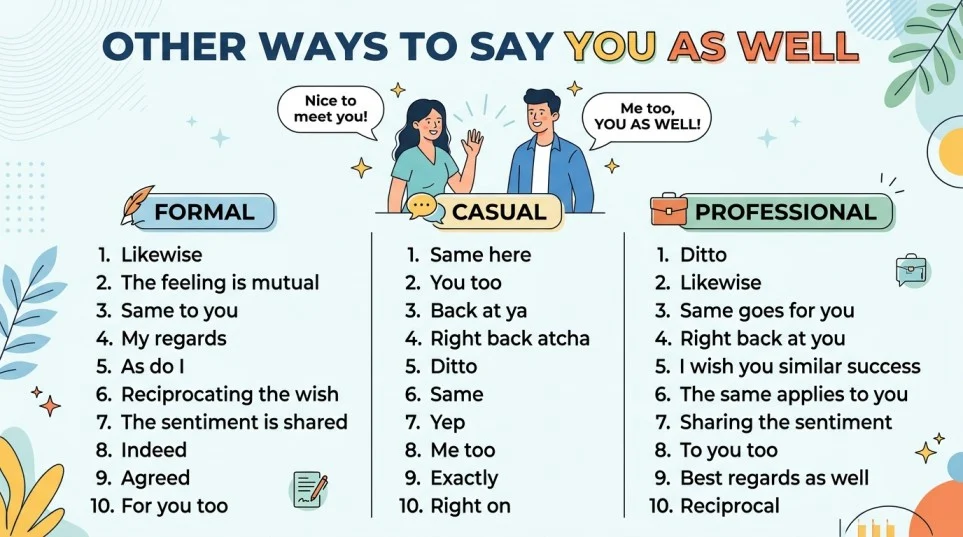
Quick Ans: If you’re looking for other ways to say “you as well,” try: same to you, likewise, right back at you, you too, wishing you the same. These options help you respond naturally, politely, and confidently in English.
The phrase “you as well” is a common reply used when someone wishes you something positive, like “Have a great day.” It’s simple, polite, and widely understood.
However, relying on one phrase can sound repetitive. Learning alternatives to “you as well” helps you sound more fluent and expressive in conversations.
It also improves your ability to express responses in English in both casual and professional situations.
“Small phrases can make a big difference in how natural your English sounds.”
Quick Categories Section
Formal Alternatives to “You As Well”
- Likewise
- I wish you the same
- The same to you
- Wishing you the same
Pro Tip: Use these in professional emails and formal conversations.
Casual Alternatives
- You too
- Same to you
- Back at you
- Right back at you
Pro Tip: Perfect for everyday conversations with friends.
Professional Alternatives
- Likewise, best wishes
- Wishing you the same
- The same applies to you
- I extend the same to you
Pro Tip: Keep your tone polite and concise in workplace communication.
Informal Expressions
- Same here
- Ditto
- You too, buddy
- Backatcha
Pro Tip: Use these only in relaxed, friendly contexts.
“Fluency comes from variety, not repetition.”
Common Mistakes Section
- Using informal phrases in formal emails
Incorrect: Backatcha!
Better: Likewise. - Repeating the same phrase every time
Incorrect: Always saying you as well
Better: Mix different alternatives - Using incomplete responses
Incorrect: Same
Better: Same to you - Using slang in professional settings
Incorrect: Ditto!
Better: Wishing you the same. - Wrong tone in serious context
Incorrect: Right back at you!
Better: I wish you the same.
What Does “You As Well” Mean?
Definition:
It is a polite response used to return a wish or greeting to the speaker.
Grammar Note:
It is an elliptical expression, meaning the full sentence is implied: “I wish the same for you as well.”
Example:
“Have a great day!” — “You as well!”
When to Use “You As Well”
- Responding to greetings
- Replying to good wishes
- Ending conversations politely
- Social and workplace interactions
Spoken vs Written: Both
Formal vs Informal: Neutral
Is It Professional or Polite to Say “You As Well”?
- Polite? ✔️ Yes
- Professional? ✔️ Yes
Business Example:
Thank you, and I wish you success in your project as well.
“Professional English values polite and complete responses.”
Pros and Cons of Using “You As Well”
Pros
- Simple and clear
- Polite and respectful
- Easy to use
- Widely understood
Cons
- Can sound repetitive
- Lacks variety
- Less engaging
- Not very expressive
Other Ways to Say “You As Well” (With Examples)
These alternatives will help you sound more natural, confident, and fluent in conversations.
Use them depending on tone, context, and audience.
1. Same to you
Meaning: Returning the same wish
Explanation: Very common and natural reply
Example Sentence: “Have a nice day!” — “Same to you!”
Best Use: Everyday
Worst Use: Formal letters
Tone: Friendly, neutral
Context Variability: casual
2. You too
Meaning: Returning the same wish
Explanation: Short and widely used
Example Sentence: “Enjoy your weekend!” — “You too!”
Best Use: Daily talk
Worst Use: Formal writing
Tone: Casual
Context Variability: casual
3. Likewise
Meaning: The same applies
Explanation: Formal and concise
Example Sentence: “Nice to meet you.” — “Likewise.”
Best Use: Professional
Worst Use: Slang chat
Tone: Formal, polite
Context Variability: professional
4. Right back at you
Meaning: Same feeling or wish
Explanation: Slightly playful tone
Example Sentence: “Good luck!” — “Right back at you!”
Best Use: Friends
Worst Use: Business emails
Tone: Friendly, playful
Context Variability: casual
5. Back at you
Meaning: Returning the same sentiment
Explanation: Informal variation
Example Sentence: “Take care!” — “Back at you!”
Best Use: Casual
Worst Use: Formal
Tone: Relaxed
Context Variability: casual
6. I wish you the same
Meaning: Formal return of wish
Explanation: Complete and polite sentence
Example Sentence: I wish you the same success.
Best Use: Professional
Worst Use: Slang
Tone: Formal
Context Variability: professional
7. Wishing you the same
Meaning: Polite return wish
Explanation: Slightly softer tone
Example Sentence: Wishing you the same happiness.
Best Use: Emails
Worst Use: Casual slang
Tone: Polite
Context Variability: professional
8. The same to you
Meaning: Returning the same greeting
Explanation: Neutral and polite
Example Sentence: “Happy holidays!” — “The same to you!”
Best Use: General
Worst Use: Slang
Tone: Neutral
Context Variability: general
9. I extend the same to you
Meaning: Formal return
Explanation: Very professional tone
Example Sentence: I extend the same wishes to you.
Best Use: Business
Worst Use: Casual
Tone: Formal
Context Variability: professional
10. Same here
Meaning: Sharing same feeling
Explanation: Slightly different usage (agreement)
Example Sentence: “I hope it goes well.” — “Same here.”
Best Use: Casual
Worst Use: Formal reply
Tone: Informal
Context Variability: casual
11. Ditto
Meaning: Same as said
Explanation: Informal and brief
Example Sentence: “Have a great trip!” — “Ditto!”
Best Use: Friends
Worst Use: Workplace
Tone: Casual
12. You as well, thank you
Meaning: Polite extended reply
Explanation: Adds gratitude
Example Sentence: You as well, thank you for your wishes.
Best Use: Professional
Worst Use: Slang
Tone: Polite
13. Same goes for you
Meaning: Same applies
Example Sentence: Take care — same goes for you.
Best Use: Casual
Worst Use: Formal
Tone: Neutral
14. And to you
Meaning: Short return greeting
Example Sentence: Happy holidays — and to you!
Best Use: Semi-formal
Worst Use: Slang
Tone: Polite
15. I wish the same for you
Meaning: Complete formal response
Example Sentence: I wish the same for you and your family.
Best Use: Professional
Worst Use: Casual
Tone: Formal
16. Same wishes to you
Meaning: Returning wishes
Example Sentence: Same wishes to you this season.
Best Use: Cards
Worst Use: Slang
Tone: Polite
17. Sending the same to you
Meaning: Returning message
Example Sentence: Sending the same good vibes to you.
Best Use: Social
Worst Use: Formal reports
Tone: Warm
18. You as well, my friend
Meaning: Friendly reply
Example Sentence: Take care — you as well, my friend.
Best Use: Informal
Worst Use: Business
Tone: Warm
19. Back to you as well
Meaning: Returning greeting
Example Sentence: Best wishes back to you as well.
Best Use: Semi-formal
Worst Use: Casual slang
Tone: Neutral
20. I hope the same for you
Meaning: Expressing similar hope
Example Sentence: I hope the same for you.
Best Use: Professional
Worst Use: Slang
Tone: Polite
21. Same blessings to you
Meaning: Religious tone
Example Sentence: Same blessings to you this Easter.
Best Use: Religious
Worst Use: Corporate
Tone: Spiritual
22. You too, take care
Meaning: Caring response
Example Sentence: Take care — you too, take care.
Best Use: Casual
Worst Use: Formal
Tone: Warm
23. Same energy to you
Meaning: Matching vibe
Example Sentence: Good vibes — same energy to you!
Best Use: Informal
Worst Use: Professional
Tone: Trendy
24. All the same to you
Meaning: Returning wish
Example Sentence: All the same to you and your family.
Best Use: Formal
Worst Use: Casual
Tone: Polite
25. Wishing you that as well
Meaning: Returning sentiment
Example Sentence: Wishing you that as well.
Best Use: Professional
Worst Use: Slang
Tone: Neutral
26. Same right back to you
Meaning: Emphasized return
Example Sentence: Same right back to you!
Best Use: Casual
Worst Use: Formal
Tone: Friendly
27. You as well, take care
Meaning: Caring response
Example Sentence: Goodbye — you as well, take care.
Best Use: General
Worst Use: Slang
Tone: Warm
28. I return the same wish
Meaning: Formal response
Example Sentence: I return the same wish to you.
Best Use: Formal
Worst Use: Casual
Tone: Formal
29. The same applies to you
Meaning: Same situation applies
Example Sentence: The same applies to you.
Best Use: Professional
Worst Use: Casual
Tone: Neutral
30. And the same to you
Meaning: Simple return
Example Sentence: Best wishes — and the same to you.
Best Use: General
Worst Use: Slang
Tone: Polite
“Mastering small responses makes your English sound natural and confident.”
Mini Quiz / Self-Check
1. Which is most formal?
A. Ditto
B. Likewise
C. Back at you
Answer: B
2. Which is most casual?
A. I extend the same to you
B. You too
C. I return the same wish
Answer: B
3. Best for workplace email?
A. Right back at you
B. Likewise
C. Same energy
Answer: B
Comparison Table: Top Alternatives
| Phrase | Tone | Best Use |
|---|---|---|
| Likewise | Formal | Work |
| You too | Casual | Daily talk |
| Same to you | Neutral | General |
| Right back at you | Informal | Friends |
| I wish you the same | Formal | Emails |
| The same to you | Neutral | General |
| Back at you | Casual | Friends |
| I extend the same to you | Formal | Business |
| Ditto | Informal | Friends |
| And the same to you | Polite | General |
FAQs
1. What are other ways to say you as well?
You can say same to you, likewise, or you too.
2. Is “you as well” formal?
It is neutral and acceptable in both casual and professional settings.
3. What is the most formal alternative?
Likewise or I wish you the same.
4. Can I use “ditto” in professional emails?
No, it is too informal.
5. Why learn alternatives?
It improves fluency and makes your English sound more natural.
Conclusion
Learning other ways to say “you as well” helps you sound more fluent, natural, and confident. It also allows you to adjust your tone depending on the situation.
Practice these alternatives daily to improve your conversational and professional English.
See also: Other Ways to Say “Take Care”
See also: Professional English Responses Guide
CTA: Try using 3 new alternatives in your next conversation.
Discover More:-



Pingback: Other Ways to Say Please Let Me Know If You Need Anything Else (30 Examples)
Pingback: Other Ways to Say I Was Referred to You By (35 Examples)