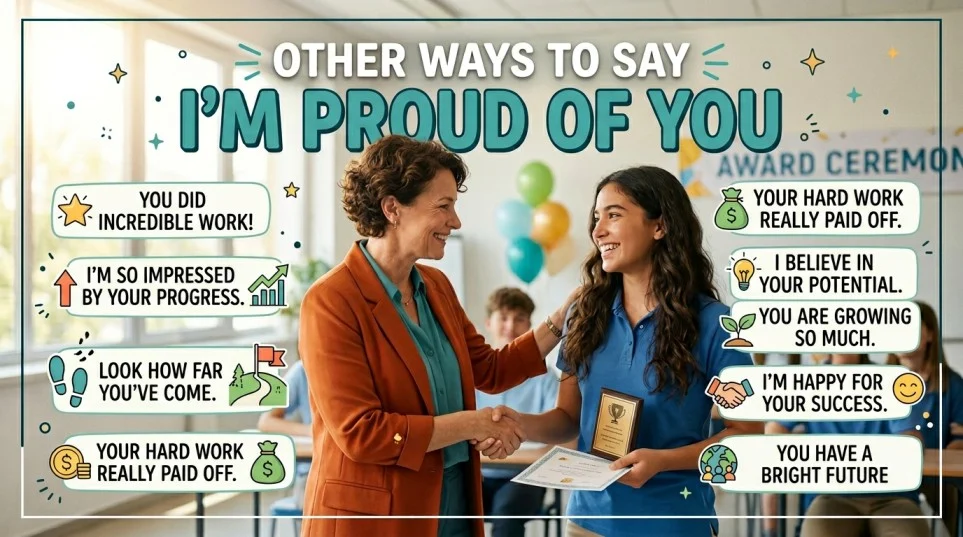
Quick Ans: If you’re looking for other ways to say “I’m proud of you,” try: You did an amazing job, I admire your effort, You should be proud of yourself, I’m impressed with you, That’s a great achievement. These alternatives help you express appreciation in a more natural and meaningful way.
The phrase “I’m proud of you” is used to show appreciation, admiration, and emotional support. It’s commonly said when someone achieves something or makes progress.
However, using different expressions instead of repeating the same phrase makes your communication more engaging. Learning alternatives to I’m proud of you allows you to express encouragement with more variety and impact.
It also helps you express excitement in English and appreciation in both personal and professional situations.
“The right words can make encouragement more powerful and memorable.”
Quick Categories Section
Formal Alternatives to “I’m Proud of You”
- I truly admire your accomplishment
- Your achievement is commendable
- You have done exceptionally well
- I appreciate your dedication
Pro Tip: Use these in professional or academic settings.
Casual Alternatives
- Great job
- That’s awesome
- You did great
- I’m really happy for you
Pro Tip: Perfect for friends and everyday conversations.
Professional Alternatives
- Your work is impressive
- You handled that very well
- That’s a remarkable achievement
- I appreciate your effort
Pro Tip: Ideal for workplace feedback and recognition.
Informal Expressions
- You nailed it
- That’s incredible
- You smashed it
- So proud of you
Pro Tip: Use these in relaxed and friendly contexts.
“Encouragement sounds stronger when it feels specific and genuine.”
Common Mistakes Section
- Being too generic
Incorrect: Good.
Better: You did an amazing job. - Overusing one phrase
Incorrect: Repeating the same sentence
Better: Use varied alternatives - Using informal phrases in professional settings
Incorrect: You smashed it!
Better: You handled that very well. - Not being specific
Incorrect: Nice work.
Better: Your presentation was excellent. - Sounding insincere
Incorrect: Over-exaggerated praise
Better: Keep it genuine and relevant
What Does “I’m Proud of You” Mean?
Definition:
It expresses admiration, respect, or happiness for someone’s effort, progress, or achievement.
Grammar Note:
It uses the structure be proud of + person to show emotional approval.
Example:
I’m proud of you for completing the project successfully.
When to Use “I’m Proud of You”
- Celebrating achievements
- Encouraging someone
- Giving feedback
- Showing emotional support
Spoken vs Written: Both
Formal vs Informal: Neutral
Is It Professional or Polite to Say “I’m Proud of You”?
- Polite? ✔️ Yes
- Professional? ✔️ Sometimes (context matters)
Business Example:
Your performance has been excellent, and your efforts are highly appreciated.
“Professional praise focuses on effort and results, not just emotion.”
Pros and Cons of Using “I’m Proud of You”
Pros
- Positive and encouraging
- Easy to understand
- Builds confidence
- Widely used
Cons
- Can feel repetitive
- Sometimes too emotional for work
- Lacks specificity
- Not always suitable in formal writing
Other Ways to Say “I’m Proud of You” (With Examples)
These alternatives will help you sound more expressive, supportive, and confident in different situations.
Use them based on tone, context, and audience.
1. You did an amazing job
Meaning: Strong praise for effort
Explanation: Common and versatile expression
Example Sentence: You did an amazing job on the project.
Best Use: General
Worst Use: Formal reports
Tone: Positive, encouraging
Context Variability: casual / professional
2. I admire your effort
Meaning: Appreciation for hard work
Explanation: Focuses on effort rather than result
Example Sentence: I admire your effort and dedication.
Best Use: Work/education
Worst Use: Slang
Tone: Respectful
Context Variability: professional
3. You should be proud of yourself
Meaning: Encouraging self-recognition
Explanation: Motivates confidence
Example Sentence: You should be proud of yourself for this achievement.
Best Use: Personal growth
Worst Use: Formal reports
Tone: Supportive
Context Variability: general
4. I’m impressed with you
Meaning: Strong admiration
Explanation: Expresses positive surprise
Example Sentence: I’m impressed with how you handled that.
Best Use: Work or personal
Worst Use: Formal writing
Tone: Positive
Context Variability: general
5. That’s a great achievement
Meaning: Recognition of success
Explanation: Highlights accomplishment
Example Sentence: That’s a great achievement—well done.
Best Use: Professional
Worst Use: Casual jokes
Tone: Formal
Context Variability: professional
6. Well done
Meaning: Simple praise
Explanation: Short and clear
Example Sentence: Well done on finishing your task.
Best Use: General
Worst Use: Detailed feedback
Tone: Neutral
Context Variability: general
7. You handled that very well
Meaning: Praise for performance
Explanation: Focuses on execution
Example Sentence: You handled that situation very well.
Best Use: Workplace
Worst Use: Casual slang
Tone: Professional
Context Variability: professional
8. That’s impressive
Meaning: Shows admiration
Explanation: Short and impactful
Example Sentence: That’s impressive work.
Best Use: General
Worst Use: Formal reports
Tone: Positive
Context Variability: general
9. I’m really happy for you
Meaning: Emotional support
Explanation: Focuses on feelings
Example Sentence: I’m really happy for you.
Best Use: Personal
Worst Use: Workplace
Tone: Warm
Context Variability: casual
10. You’ve done exceptionally well
Meaning: High-level praise
Explanation: Formal tone
Example Sentence: You’ve done exceptionally well this quarter.
Best Use: Work
Worst Use: Slang
Tone: Formal
Context Variability: professional
11. That’s outstanding work
Meaning: Excellent performance
Explanation: Strong professional praise
Example Sentence: That’s outstanding work on the report.
Best Use: Workplace
Worst Use: Casual talk
Tone: Formal
12. I appreciate your hard work
Meaning: Gratitude for effort
Explanation: Focuses on dedication
Example Sentence: I appreciate your hard work.
Best Use: Professional
Worst Use: Slang
Tone: Respectful
13. You’ve made great progress
Meaning: Improvement recognition
Example Sentence: You’ve made great progress this year.
Best Use: Learning context
Worst Use: Casual slang
Tone: Encouraging
14. That’s a remarkable achievement
Meaning: High praise
Example Sentence: That’s a remarkable achievement.
Best Use: Formal
Worst Use: Informal jokes
Tone: Formal
15. You’re doing a fantastic job
Meaning: Ongoing praise
Example Sentence: You’re doing a fantastic job.
Best Use: General
Worst Use: Reports
Tone: Positive
16. I respect your dedication
Meaning: Admiration for commitment
Example Sentence: I respect your dedication to this work.
Best Use: Workplace
Worst Use: Casual chat
Tone: Formal
17. That’s something to be proud of
Meaning: Encouragement
Example Sentence: That’s something to be proud of.
Best Use: Personal
Worst Use: Formal
Tone: Supportive
18. You’ve exceeded expectations
Meaning: Performance above standard
Example Sentence: You’ve exceeded expectations.
Best Use: Work
Worst Use: Casual talk
Tone: Professional
19. You did brilliantly
Meaning: Excellent performance
Example Sentence: You did brilliantly in the exam.
Best Use: Casual
Worst Use: Formal
Tone: Positive
20. That’s a job well done
Meaning: Completed task successfully
Example Sentence: That’s a job well done.
Best Use: General
Worst Use: Detailed feedback
Tone: Neutral
21. I’m proud of your growth
Meaning: Recognizing improvement
Example Sentence: I’m proud of your growth.
Best Use: Personal
Worst Use: Formal
Tone: Emotional
22. You’ve come a long way
Meaning: Progress over time
Example Sentence: You’ve come a long way.
Best Use: Encouragement
Worst Use: Reports
Tone: Warm
23. That’s incredible work
Meaning: Strong admiration
Example Sentence: That’s incredible work.
Best Use: Casual
Worst Use: Formal
Tone: Energetic
24. You’ve earned this success
Meaning: Deserved achievement
Example Sentence: You’ve earned this success.
Best Use: Professional
Worst Use: Casual slang
Tone: Respectful
25. I’m amazed by your effort
Meaning: Strong admiration
Example Sentence: I’m amazed by your effort.
Best Use: Personal
Worst Use: Formal
Tone: Emotional
26. You’ve done a great job
Meaning: General praise
Example Sentence: You’ve done a great job.
Best Use: General
Worst Use: Detailed report
Tone: Positive
27. That’s truly impressive
Meaning: High admiration
Example Sentence: That’s truly impressive.
Best Use: Work
Worst Use: Casual slang
Tone: Formal
28. I admire your progress
Meaning: Respect improvement
Example Sentence: I admire your progress.
Best Use: Professional
Worst Use: Slang
Tone: Respectful
29. You’ve done something amazing
Meaning: Strong praise
Example Sentence: You’ve done something amazing.
Best Use: Personal
Worst Use: Formal
Tone: Emotional
30. Keep up the great work
Meaning: Encouragement to continue
Example Sentence: Keep up the great work.
Best Use: Work
Worst Use: Casual jokes
Tone: Motivational
“Specific praise builds stronger confidence than generic compliments.”
Mini Quiz / Self-Check
1. Which is most professional?
A. You smashed it
B. You’ve exceeded expectations
C. That’s awesome
Answer: B
2. Which is most casual?
A. Outstanding work
B. You did brilliantly
C. I respect your dedication
Answer: B
3. Best for workplace feedback?
A. You nailed it
B. You handled that very well
C. That’s cool
Answer: B
Comparison Table: Top Alternatives
| Phrase | Tone | Best Use |
|---|---|---|
| You did an amazing job | Positive | General |
| I admire your effort | Respectful | Work |
| You’ve exceeded expectations | Professional | Workplace |
| Well done | Neutral | General |
| That’s impressive | Positive | Daily use |
| Outstanding work | Formal | Work |
| I appreciate your hard work | Professional | Office |
| You’ve made great progress | Encouraging | Learning |
| Keep up the great work | Motivational | Work |
| That’s a great achievement | Formal | Recognition |
FAQs
1. What are other ways to say I’m proud of you?
You can say You did an amazing job, I admire your effort, or That’s impressive.
2. Is “I’m proud of you” professional?
Sometimes, but professional alternatives are better in workplace communication.
3. What is the best formal alternative?
Your achievement is commendable or You’ve exceeded expectations.
4. Can I use informal praise at work?
It’s better to use professional phrases instead.
5. Why should I learn alternatives?
It improves fluency, tone control, and communication impact.
Conclusion
Learning other ways to say I’m proud of you helps you express appreciation more clearly and effectively. It also allows you to adapt your tone for different situations.
Practice these phrases to become more confident and expressive in English communication.
See also: Other Ways to Say “Good Job”
See also: Professional Praise Phrases for Work
CTA: Try using 3 new praise expressions today in your conversations.
Discover More:-
- Other Ways to Say Good Morning (30+ Examples)
- Other Ways to Say I Hope Everything Is Going Well (30 Examples)


Pingback: Other Ways to Say Thank You Too (35+ Examples)