
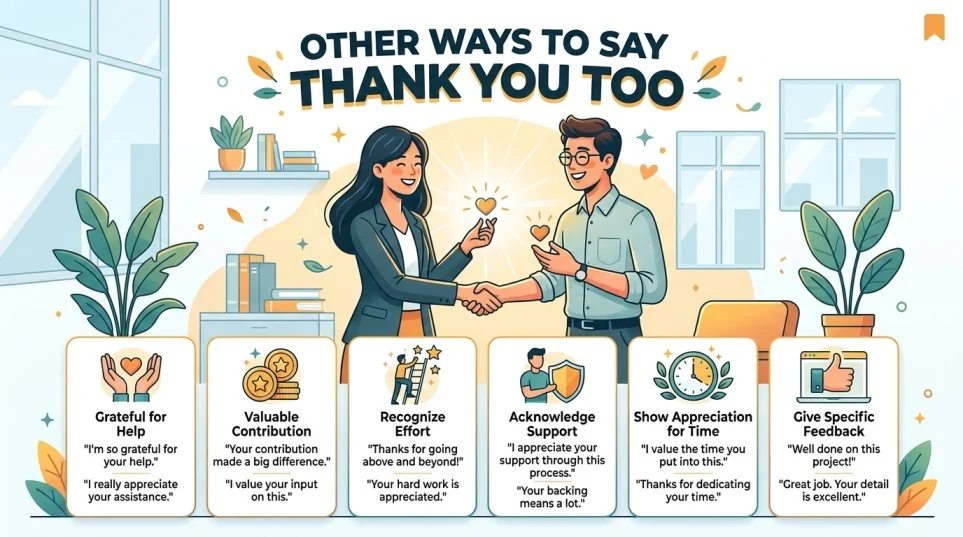
Quick Ans: If you want alternatives to “thank you too,” you can say: you’re welcome as well, same to you, I appreciate you too, thanks to you as well, likewise thank you. These options help you respond more naturally and appropriately in different situations.
The phrase “thank you too” is often used as a polite reply when someone thanks you first. It shows mutual appreciation, but it can sometimes sound repetitive or limited.
That’s why learning alternatives to thank you too is useful. It helps you respond more naturally and sound more fluent in both casual and professional conversations.
Using different expressions also helps you express appreciation in English with better tone and variety.
“Simple responses become powerful when you vary your language.”
Quick Categories Section
Formal Alternatives to “Thank You Too”
- I appreciate you as well
- Thank you as well
- My thanks to you too
- I’m grateful to you as well
Pro Tip: Use these in emails, formal replies, or professional settings.
Casual Alternatives
- Same to you
- You too
- Thanks to you as well
- Right back at you
Pro Tip: Best for everyday conversations and friendly replies.
Professional Alternatives
- I appreciate your efforts as well
- Thank you for your support too
- Much appreciated on your end as well
- I value your contribution as well
Pro Tip: Ideal for workplace communication.
Informal Expressions
- Back at you
- Cheers to you too
- Thanks right back
- Appreciate it, you too
Pro Tip: Use only in relaxed or friendly conversations.
“The right reply reflects both politeness and personality.”
Common Mistakes Section
- Repeating the same phrase every time
Incorrect: Always saying thank you too
Better: Use varied expressions - Using casual phrases in formal emails
Incorrect: Back at you
Better: I appreciate you as well - Sounding unnatural
Incorrect: Thank you too also
Better: Thank you as well - Using incorrect tone in workplace
Incorrect: Cheers bro
Better: Much appreciated - Not matching context
Incorrect: Overly formal reply in casual chat
Better: Adjust tone based on situation
What Does “Thank You Too” Mean?
Definition:
It is a polite response used to return gratitude when someone thanks you first.
Grammar Note:
“Too” is used to show inclusion or mutual feeling.
Example:
Thanks for your help!
Thank you too!
When to Use It
- When someone thanks you first
- In conversations showing mutual appreciation
- Friendly or polite exchanges
- Workplace communication (informal level)
Spoken vs Written: Both
Formal vs Informal: Mostly informal to neutral
Is It Professional or Polite to Say “Thank You Too”?
- Polite? ✔️ Yes
- Professional? ❌ Limited (better alternatives exist)
Business Example:
I appreciate your support as well.
“Professional English replaces simple phrases with more specific expressions.”
Pros and Cons
Pros
- Simple and polite
- Easy to understand
- Widely used
- Quick response
Cons
- Repetitive
- Not very professional
- Lacks depth
- Limited expression
Other Ways to Say “Thank You Too” (With Examples)
These alternatives will help you sound more natural, confident, and expressive in different situations.
Use them based on tone, audience, and context to express appreciation clearly.
1. You’re welcome as well
Meaning: Mutual acknowledgment
Explanation: Polite and balanced response
Example Sentence: You’re welcome as well, I appreciate your help too.
Best Use: polite replies
Worst Use: slang chat
Tone: polite, neutral
Context Variability: professional
2. Same to you
Meaning: Returning the same feeling
Explanation: Short and very common
Example Sentence: Thanks for your support—same to you!
Best Use: casual
Worst Use: formal writing
Tone: friendly
Context Variability: casual
3. I appreciate you too
Meaning: Mutual appreciation
Explanation: Slightly more personal
Example Sentence: I appreciate you too for your effort.
Best Use: personal/work
Worst Use: sarcastic tone
Tone: warm
Context Variability: general
4. Thanks to you as well
Meaning: Sharing gratitude
Explanation: Clear and polite
Example Sentence: Thanks to you as well for your contribution.
Best Use: work
Worst Use: slang
Tone: polite
Context Variability: professional
5. Likewise, thank you
Meaning: Equal appreciation
Explanation: Formal and structured
Example Sentence: Likewise, thank you for your support.
Best Use: professional
Worst Use: casual jokes
Tone: formal
Context Variability: professional
6. I’m grateful to you as well
Meaning: Expressing gratitude
Explanation: Stronger appreciation
Example Sentence: I’m grateful to you as well for your help.
Best Use: formal
Worst Use: casual chat
Tone: formal
Context Variability: professional
7. Much appreciated on your end too
Meaning: Acknowledging both sides
Explanation: Workplace-friendly
Example Sentence: Much appreciated on your end too.
Best Use: office
Worst Use: informal slang
Tone: professional
Context Variability: professional
8. Appreciate it, you too
Meaning: Casual gratitude
Explanation: Relaxed tone
Example Sentence: Appreciate it, you too!
Best Use: friends
Worst Use: formal email
Tone: informal
Context Variability: casual
9. Right back at you
Meaning: Returning appreciation
Explanation: Friendly expression
Example Sentence: Thanks! Right back at you.
Best Use: casual
Worst Use: business email
Tone: playful
Context Variability: casual
10. Back at you
Meaning: Same appreciation returned
Explanation: Short informal reply
Example Sentence: Back at you!
Best Use: casual
Worst Use: formal writing
Tone: informal
Context Variability: casual
11. I value your effort as well
Meaning: Recognizing contribution
Explanation: Professional tone
Example Sentence: I value your effort as well in this project.
Best Use: workplace
Worst Use: casual talk
Tone: formal
12. Thank you for your support too
Meaning: Shared appreciation
Example Sentence: Thank you for your support too.
Best Use: work
Worst Use: slang
Tone: polite
13. Cheers to you too
Meaning: Friendly gratitude
Example Sentence: Cheers to you too!
Best Use: casual
Worst Use: formal
Tone: informal
14. Much appreciated
Meaning: Acknowledging thanks
Example Sentence: Much appreciated—same to you.
Best Use: work
Worst Use: jokes
Tone: professional
15. I appreciate that, and you too
Meaning: Balanced appreciation
Example Sentence: I appreciate that, and you too.
Best Use: general
Worst Use: sarcasm
Tone: polite
16. Thanks right back
Meaning: Returning thanks
Example Sentence: Thanks right back!
Best Use: casual
Worst Use: formal
Tone: informal
17. Same here, thank you
Meaning: Mutual gratitude
Example Sentence: Same here, thank you for everything.
Best Use: general
Worst Use: slang
Tone: neutral
18. I appreciate it as well
Meaning: Formal gratitude
Example Sentence: I appreciate it as well.
Best Use: professional
Worst Use: jokes
Tone: formal
19. Likewise
Meaning: Same feeling returned
Example Sentence: Likewise, I appreciate it.
Best Use: professional
Worst Use: casual jokes
Tone: formal
20. Thanks, same to you
Meaning: Returning thanks
Example Sentence: Thanks, same to you!
Best Use: casual
Worst Use: formal
Tone: friendly
21. I feel the same way, thank you
Meaning: Shared appreciation
Example Sentence: I feel the same way, thank you.
Best Use: emotional context
Worst Use: quick chat
Tone: warm
22. Appreciate you as well
Meaning: Acknowledging person
Example Sentence: Appreciate you as well for your help.
Best Use: casual/work
Worst Use: formal writing
Tone: friendly
23. Thank you kindly, same to you
Meaning: Polite return
Example Sentence: Thank you kindly, same to you.
Best Use: polite
Worst Use: slang
Tone: formal
24. My thanks to you too
Meaning: Formal gratitude
Example Sentence: My thanks to you too.
Best Use: formal
Worst Use: casual
Tone: formal
25. Much obliged to you as well
Meaning: Deep appreciation
Example Sentence: Much obliged to you as well.
Best Use: formal
Worst Use: casual
Tone: formal
26. Appreciate your help too
Meaning: Acknowledging effort
Example Sentence: Appreciate your help too.
Best Use: work
Worst Use: jokes
Tone: neutral
27. Thank you, I appreciate it too
Meaning: Mutual thanks
Example Sentence: Thank you, I appreciate it too.
Best Use: general
Worst Use: slang
Tone: polite
28. Same appreciation to you
Meaning: Balanced gratitude
Example Sentence: Same appreciation to you.
Best Use: formal
Worst Use: casual
Tone: formal
29. Grateful for you as well
Meaning: Emotional gratitude
Example Sentence: Grateful for you as well.
Best Use: personal
Worst Use: formal email
Tone: warm
30. Thanks, I feel the same
Meaning: Shared feeling
Example Sentence: Thanks, I feel the same.
Best Use: casual
Worst Use: formal
Tone: friendly
“Variety in language makes your communication sound natural and confident.”
Mini Quiz / Self-Check
1. Which is most formal?
A. Back at you
B. Likewise
C. Cheers
Answer: B
2. Which is casual?
A. I appreciate it as well
B. Same to you
C. Much obliged
Answer: B
3. Best for workplace?
A. Right back at you
B. I value your effort as well
C. Cheers
Answer: B
Comparison Table: Top Alternatives
| Phrase | Tone | Best Use |
|---|---|---|
| Likewise | Formal | Work |
| Same to you | Casual | Friends |
| I appreciate you too | Warm | General |
| Thank you as well | Formal | |
| Right back at you | Informal | Friends |
| Much appreciated | Professional | Work |
| Back at you | Casual | Chat |
| I value your effort | Professional | Workplace |
| Cheers to you too | Informal | Social |
| Appreciate it, you too | Casual | Conversation |
FAQs
1. What are alternatives to thank you too?
You can say same to you, likewise, or I appreciate you as well.
2. Is “thank you too” professional?
It is polite but not ideal for formal workplace communication.
3. What is the best professional alternative?
I appreciate your efforts as well is a strong professional option.
4. Can I use casual phrases at work?
It’s better to use formal alternatives in professional settings.
5. Why learn alternatives?
It improves fluency, tone control, and communication skills.
Conclusion
Learning other ways to say thank you too helps you sound more natural, expressive, and professional. It also allows you to match tone with context effectively.
Practice these phrases daily to improve your English communication.
See also: Other Ways to Say “You’re Welcome”
See also: Professional Ways to Express Gratitude
CTA: Try using 3 new alternatives in your next conversation.
Discover More:-
- Other Ways to Say I’m Proud of You (30+ Examples)
- Other Ways to Say Thank You for Your Cooperation (40 Examples)