
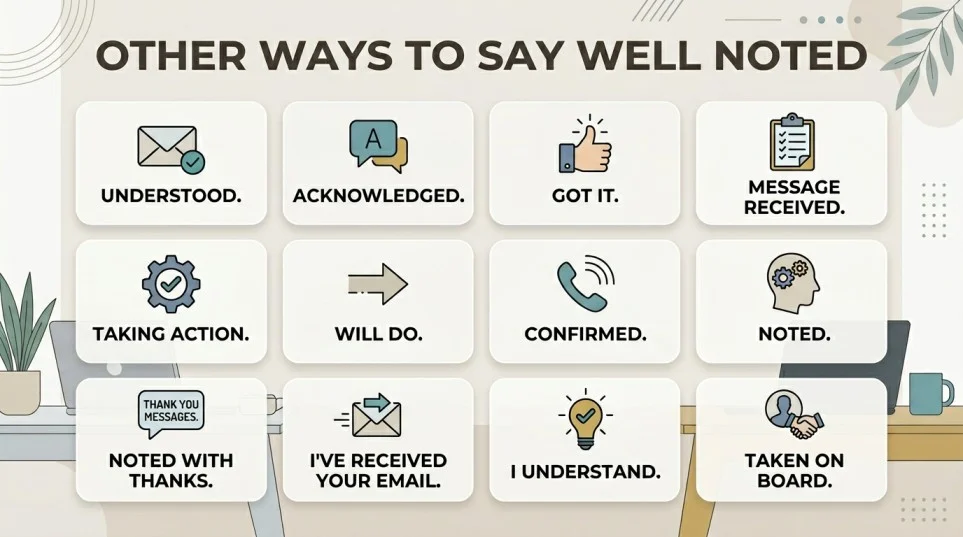
Quick Ans: If you need other ways to say “well noted,” try: duly noted, acknowledged, noted with thanks, understood, message received. These options help you respond more clearly and professionally in different situations.
The phrase “well noted” is often used to confirm that you have received and understood information. While it is common, it can sound repetitive or slightly abrupt in some contexts.
Learning alternatives to well noted helps you communicate more naturally and professionally. It also allows you to adjust tone based on whether you’re speaking casually or writing a formal email.
Expanding your vocabulary with professional reaction phrases improves clarity and confidence, especially in workplace communication.
“Small wording changes can make your communication sound more polished and professional.”
Quick Categories Section
Formal Alternatives to “Well Noted”
- Duly noted
- Acknowledged with thanks
- Your message has been received
- Noted accordingly
Pro Tip: Use these in formal emails and official communication.
Casual Alternatives
- Got it
- Okay, noted
- I see
- Understood
Pro Tip: Best for quick chats and informal conversations.
Professional Alternatives
- Noted with thanks
- Message received
- I have taken note
- This has been recorded
Pro Tip: Ideal for workplace emails and responses.
Informal Expressions
- Got your point
- Sounds good
- Makes sense
- All clear
Pro Tip: Use only in relaxed, friendly contexts.
“Clarity and tone are key in professional English.”
Common Mistakes Section
- Using it too frequently
Incorrect: Repeating “well noted” in every reply
Better: Use varied alternatives - Sounding too blunt in emails
Incorrect: Well noted.
Better: Noted with thanks. - Using it without acknowledgment tone
Incorrect: Well noted (no context)
Better: Your update is duly noted. - Using casual tone in formal communication
Incorrect: Got it
Better: Acknowledged. - Not matching tone with situation
Incorrect: Duly noted (in friendly chat)
Better: Got it, thanks
What Does “Well Noted” Mean?
Definition:
It means you have received, understood, and acknowledged the information.
Grammar Note:
It is a fixed expression often used as a short response in written English.
Example:
Your feedback is well noted.
When to Use “Well Noted”
- Replying to emails
- Confirming instructions
- Acknowledging updates
- Workplace communication
Spoken vs Written: Mostly written
Formal vs Informal: Neutral
Is It Professional or Polite to Say “Well Noted”?
- Polite? ✔️ Yes
- Professional? ✔️ Yes (but can sound repetitive)
Business Example:
Your suggestions are well noted and will be considered.
“Professional English favors variety over repetition.”
Pros and Cons of Using “Well Noted”
Pros
- Simple and clear
- Widely understood
- Quick response
- Professional tone
Cons
- Can sound repetitive
- Slightly blunt
- Lacks warmth
- Overused in emails
Other Ways to Say “Well Noted” (With Examples)
These alternatives will help you sound more fluent, polite, and professional.
Use them depending on tone, context, and audience.
1. Duly noted
Meaning: Properly acknowledged
Explanation: Very formal expression
Example Sentence: Your request has been duly noted.
Best Use: Formal emails
Worst Use: Casual chat
Tone: Formal, precise
Context Variability: professional
2. Acknowledged
Meaning: Confirmed receipt
Explanation: Direct and professional
Example Sentence: Your message is acknowledged.
Best Use: Workplace
Worst Use: Friendly chat
Tone: Neutral, formal
Context Variability: professional
3. Noted with thanks
Meaning: Acknowledged politely
Explanation: Adds warmth
Example Sentence: Noted with thanks for the update.
Best Use: Emails
Worst Use: Casual talk
Tone: Polite
Context Variability: professional
4. Understood
Meaning: Fully comprehended
Explanation: Simple and clear
Example Sentence: Understood, I will proceed.
Best Use: Work chats
Worst Use: Formal reports
Tone: Neutral
Context Variability: general
5. Message received
Meaning: Confirmation of receipt
Explanation: Direct communication
Example Sentence: Message received, thank you.
Best Use: Workplace
Worst Use: Casual
Tone: Professional
Context Variability: professional
6. I have taken note
Meaning: Acknowledged carefully
Explanation: Slightly formal
Example Sentence: I have taken note of your feedback.
Best Use: Formal writing
Worst Use: Slang
Tone: Formal
Context Variability: professional
7. This is noted
Meaning: Information recorded
Explanation: Passive formal tone
Example Sentence: This is noted for future reference.
Best Use: Reports
Worst Use: Casual
Tone: Formal
Context Variability: professional
8. Noted accordingly
Meaning: Recorded with action
Explanation: Professional tone
Example Sentence: The changes are noted accordingly.
Best Use: Office communication
Worst Use: Informal
Tone: Formal
Context Variability: professional
9. I understand
Meaning: Comprehension confirmed
Explanation: Friendly tone
Example Sentence: I understand your point.
Best Use: General
Worst Use: Formal reports
Tone: Neutral
Context Variability: casual
10. Got it
Meaning: Informal acknowledgment
Explanation: Casual and quick
Example Sentence: Got it, thanks!
Best Use: Chat
Worst Use: Formal emails
Tone: Informal
Context Variability: casual
11. I see
Meaning: Realization or understanding
Explanation: Soft and conversational
Example Sentence: I see what you mean.
Best Use: Conversation
Worst Use: Reports
Tone: Casual
12. All noted
Meaning: Everything acknowledged
Example Sentence: All noted, thank you.
Best Use: Work
Worst Use: Casual
Tone: Neutral
13. Your point is taken
Meaning: Agreement or understanding
Example Sentence: Your point is taken.
Best Use: Discussion
Worst Use: Informal chat
Tone: Professional
14. I acknowledge this
Meaning: Formal confirmation
Example Sentence: I acknowledge this update.
Best Use: Formal
Worst Use: Casual
Tone: Formal
15. Consider it noted
Meaning: Confirmed
Example Sentence: Consider it noted for action.
Best Use: Work
Worst Use: Friendly chat
Tone: Semi-formal
16. Noted, thank you
Meaning: Polite acknowledgment
Example Sentence: Noted, thank you for the update.
Best Use: Emails
Worst Use: Casual
Tone: Polite
17. I’ve made a note of it
Meaning: Recorded information
Example Sentence: I’ve made a note of it.
Best Use: General
Worst Use: Formal reports
Tone: Neutral
18. Received and understood
Meaning: Clear acknowledgment
Example Sentence: Received and understood.
Best Use: Work
Worst Use: Casual
Tone: Professional
19. This has been recorded
Meaning: Official acknowledgment
Example Sentence: This has been recorded.
Best Use: Formal
Worst Use: Chat
Tone: Formal
20. I will take this into account
Meaning: Consideration promised
Example Sentence: I will take this into account.
Best Use: Business
Worst Use: Casual
Tone: Professional
21. Got your message
Meaning: Informal receipt
Example Sentence: Got your message, thanks.
Best Use: Casual
Worst Use: Formal
Tone: Informal
22. Sounds good
Meaning: Agreement
Example Sentence: Sounds good to me.
Best Use: Casual
Worst Use: Reports
Tone: Friendly
23. Makes sense
Meaning: Logical understanding
Example Sentence: That makes sense.
Best Use: Conversation
Worst Use: Formal
Tone: Casual
24. All clear
Meaning: No confusion
Example Sentence: All clear, thanks.
Best Use: Chat
Worst Use: Formal
Tone: Informal
25. Noted and understood
Meaning: Clear acknowledgment
Example Sentence: Noted and understood.
Best Use: Work
Worst Use: Casual
Tone: Professional
26. I confirm receipt
Meaning: Formal confirmation
Example Sentence: I confirm receipt of your email.
Best Use: Business
Worst Use: Casual
Tone: Formal
27. Your message is clear
Meaning: Understanding confirmed
Example Sentence: Your message is clear.
Best Use: Work
Worst Use: Casual
Tone: Neutral
28. I’ll keep that in mind
Meaning: Consideration
Example Sentence: I’ll keep that in mind.
Best Use: Conversation
Worst Use: Reports
Tone: Casual
29. Thank you, noted
Meaning: Polite confirmation
Example Sentence: Thank you, noted.
Best Use: Emails
Worst Use: Informal
Tone: Polite
30. I appreciate the update
Meaning: Acknowledgment with appreciation
Example Sentence: I appreciate the update.
Best Use: Professional
Worst Use: Casual chat
Tone: Warm, professional
“Using the right alternative can instantly improve your professional tone.”
Mini Quiz / Self-Check
1. Which is most formal?
A. Got it
B. Duly noted
C. Sounds good
Answer: B
2. Which is most casual?
A. Acknowledged
B. Got it
C. I confirm receipt
Answer: B
3. Best for professional email?
A. Makes sense
B. Noted with thanks
C. All clear
Answer: B
Comparison Table: Top Alternatives
| Phrase | Tone | Best Use |
|---|---|---|
| Duly noted | Formal | Business |
| Acknowledged | Professional | Work |
| Noted with thanks | Polite | |
| Understood | Neutral | General |
| Message received | Professional | Workplace |
| Got it | Casual | Chat |
| I see | Informal | Conversation |
| Noted accordingly | Formal | Office |
| Received and understood | Professional | Work |
| Thank you, noted | Polite |
FAQs
1. What are other ways to say well noted?
You can say duly noted, acknowledged, noted with thanks, or message received.
2. Is “well noted” professional?
Yes, but using varied alternatives sounds more polished.
3. What is the most formal alternative?
Duly noted is the most formal option.
4. Can I use “got it” in emails?
Only in informal or internal communication.
5. Why use alternatives?
They improve tone, clarity, and communication effectiveness.
6.Well noted meaning?
The phrase “well noted” means that a message, piece of information, or feedback has been received, read, and fully understood. It acts as an acknowledgment or confirmation, often assuring the sender that their points will be considered or acted upon.
Conclusion
Learning other ways to say well noted helps you communicate more professionally and naturally. It also prevents repetition and improves tone in different contexts.
Practice these alternatives to enhance your English communication skills.
See also: Other Ways to Say “Understood”
See also: Professional Email Response Phrases
CTA: Try using 3 new alternatives in your next email reply.
Discover More:-
- Other Ways to Say Great Job (30+ Examples)
- Other Ways to Say Thank You for Your Cooperation (40 Examples)