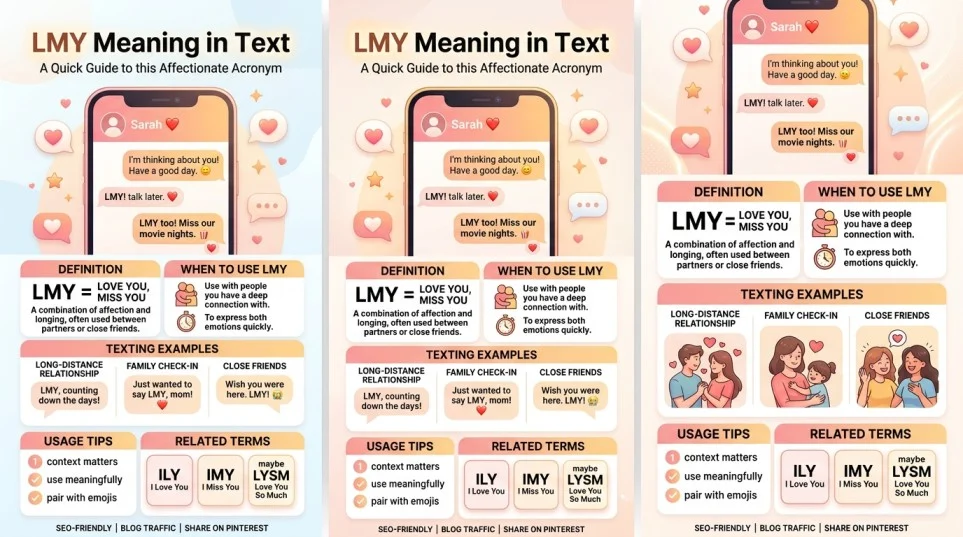
Quick Ans: LMY means “Love You, Miss You” in texting. It is an affectionate abbreviation used to tell a friend, family member, partner, or loved one that you care about them and miss their presence.
Have you ever received a message saying “LMY” and wondered what the sender meant? Texting abbreviations can make conversations quick and convenient, but unfamiliar shortcuts can also create confusion. Since the same three letters may have different meanings in different settings, context matters when interpreting LMY.
In most casual messages, LMY means “Love Miss You” or, more commonly, “Love You, Miss You.” It is usually used between close friends, family members, partners, or people who share an affectionate bond. However, LMY can occasionally have other meanings depending on the conversation.
This guide explains the LMY meaning in text, how it is used, its tone, examples, related abbreviations, alternatives, common mistakes, and answers to frequently asked questions.
LMY Meaning in Text + Definition
LMY usually means “Love You, Miss You” in text messages.
People use it to express affection and let someone know they are thinking about them. In many cases, the abbreviation appears at the end of a message, especially when two people have not spoken or seen each other for some time.
Quick Definition Table
| Term | Meaning |
|---|---|
| LMY | Love You, Miss You |
| Usage | Expresses affection and missing someone |
| Tone | Warm, caring, emotional |
| Common Platforms | Texting, WhatsApp, Snapchat, Instagram, Messenger |
| Best Used With | Friends, family, partners, close connections |
What Does LMY Mean in a Text Message?
When someone sends LMY, they are usually sharing two feelings at once: love and missing someone.
For example, a person may use LMY after a friend moves away, when a family member is traveling, or during a sweet conversation with a partner. Because of this, the abbreviation often feels more emotional than a simple “miss you.”
Depending on the context, LMY can mean:
- Love you and miss you.
- I love you, and I wish you were here.
- Thinking about you.
- I care about you and miss talking to you.
- Sending love because I miss you.
Example
Friend: I wish you were here for the weekend.
You: LMY. We need to meet soon.
In this example, LMY expresses affection while also showing that the sender misses the other person.
The Origin of LMY
Like many modern texting abbreviations, LMY developed through casual digital communication.
As texting became more popular, people started shortening emotional phrases to make messages faster and easier to type. Consequently, phrases such as “Love You,” “Miss You,” and “Thinking of You” were often turned into short forms.
LMY likely grew from the same texting culture that created abbreviations such as:
- LY — Love You
- LUV U — Love You
- MY — Miss You
- XOXO — Hugs and kisses
- ILY — I Love You
- IMY — I Miss You
Although LMY is less common than ILY or IMY, it is still used in personal conversations where the sender wants to sound warm and affectionate.
How LMY Is Used Today
Today, LMY is mostly used in private chats and personal messages. Unlike some abbreviations that work in almost every setting, this one is best suited for people who already have a close relationship.
1. Text Messaging
Text messages are one of the most common places where LMY appears.
Someone may send it after a long conversation, before going to sleep, or when they want to show affection quickly.
Example:
“LMY. Call me when you get home.”
2. Social Media Messages
LMY can also appear in Instagram DMs, Snapchat messages, WhatsApp chats, and Facebook Messenger conversations.
For instance, friends may use it after sharing an old photo or remembering a fun time together.
Example:
“Just saw our old pictures. LMY so much.”
3. Long-Distance Relationships
In long-distance relationships, LMY may be used to express emotional closeness despite physical distance.
Example:
“Wish you were here tonight. LMY.”
4. Family Conversations
Family members may use LMY when someone is away for school, work, travel, or other reasons.
Example:
“Have a safe trip. LMY already.”
Examples of LMY in Text Conversations
Seeing LMY in different conversations makes its meaning easier to understand.
Friendly Examples
| Situation | Example |
|---|---|
| Friend moved away | “LMY. We need a catch-up call soon.” |
| Missing a friend | “I was thinking about you today. LMY.” |
| After a reunion | “It was so nice seeing you. LMY already.” |
| Birthday message | “Hope you have the best day. LMY.” |
Romantic Examples
| Situation | Example |
|---|---|
| Long-distance relationship | “I wish you were here. LMY.” |
| After a call | “That call made my day. LMY.” |
| Before sleeping | “Goodnight. LMY.” |
| Travel message | “Safe flight. LMY so much.” |
Family Examples
| Situation | Example |
|---|---|
| Parent and child | “Take care at college. LMY.” |
| Siblings | “The house feels quiet without you. LMY.” |
| Relative traveling | “Have fun on your trip. LMY.” |
Tone of LMY in Texting
LMY usually has a warm, caring, and emotional tone. It often sounds more personal than common abbreviations such as BRB, IDK, or FYI.
The abbreviation can communicate:
- Affection
- Emotional closeness
- Missing someone
- Care and support
- A desire to reconnect
However, the exact tone depends on the relationship between the people texting.
Friendly Tone
“LMY. We should plan something soon.”
This feels caring and relaxed between close friends.
Romantic Tone
“LMY so much tonight.”
In a romantic conversation, the phrase can sound intimate and emotional.
Family Tone
“LMY. Stay safe and call when you can.”
This version feels loving and protective.
LMY Examples by Context
The meaning stays similar, but the relationship between the sender and receiver changes the feeling behind the message.
Texting a Friend
Friend: I miss our late-night talks.
You: Same. LMY. We should call this week.
Family Conversation
Sibling: I’m leaving for university tomorrow.
You: I’m going to miss you. LMY.
Dating Conversation
Them: I wish you were here with me.
You: Me too. LMY.
Long-Distance Relationship
Partner: Only two more weeks until we see each other.
You: I can’t wait. LMY every day.
Social Media Message
Friend: Found this photo from our trip.
You: That was such a good time. LMY.
Why People Use LMY
Several reasons explain why people use LMY instead of writing the full phrase.
Saves Time
First, it lets someone express a meaningful feeling with only three letters.
Feels Personal
Additionally, the abbreviation can feel more casual and intimate than a long message.
Works in Emotional Moments
When someone is busy, emotional, or unsure what to say, LMY offers a quick way to show care.
Fits Casual Chats
Finally, it works naturally in private conversations where both people understand the meaning.
LMY vs Similar Texting Abbreviations
LMY is related to several other affectionate abbreviations. However, each one has a slightly different meaning.
| Abbreviation | Meaning | Usage |
|---|---|---|
| LMY | Love You, Miss You | Shows affection and missing someone |
| ILY | I Love You | Expresses love |
| IMY | I Miss You | Expresses missing someone |
| LY | Love You | Casual expression of affection |
| XOXO | Hugs and kisses | Friendly or romantic sign-off |
| TTYL | Talk To You Later | Ends a conversation politely |
LMY vs ILY
LMY
- Combines love and missing someone.
- Often feels more emotional because it includes distance or absence.
ILY
- Focuses only on love.
- Can be used even when the person is nearby.
Example:
“ILY. Have a great day.”
“LMY. I wish you were here.”
LMY vs IMY
LMY
- Means love and miss you.
- Usually sounds warmer and more affectionate.
IMY
- Means only “I miss you.”
- Can be used with friends, family, or partners.
Example:
“IMY. It has been too long.”
“LMY. I really wish we could meet soon.”
Alternative Ways to Say LMY
Sometimes you may want to use a full phrase instead of an abbreviation. Fortunately, there are many options depending on the tone you want.
Casual Alternatives
- Love you and miss you.
- Miss you so much.
- Thinking of you.
- Wish you were here.
- Sending you love.
- I miss hanging out with you.
- Hope to see you soon.
Romantic Alternatives
- I love and miss you.
- I wish I could be with you right now.
- You have been on my mind.
- I cannot wait to see you again.
- Missing you more than usual today.
Family-Friendly Alternatives
- Love you. Take care.
- Missing you already.
- Call when you get time.
- Thinking about you.
- Hope to see you soon.
When Should You Use LMY?
LMY works best when you are talking to someone you know well. Since it is affectionate, using it with the wrong person may feel too personal or confusing.
Good Situations
- Texting a close friend
- Talking to a partner
- Messaging family members
- Sending a long-distance message
- Responding to an emotional conversation
- Ending a caring chat
Situations to Avoid
- Formal work emails
- Messages to clients
- Conversations with strangers
- Academic writing
- Professional reports
- Early conversations with someone you do not know well
Therefore, consider the relationship and setting before using LMY.
Does LMY Have Other Meanings?
In texting, LMY usually means “Love You, Miss You.”
However, abbreviations can sometimes have other meanings in business names, organizations, gaming communities, or internal workplace terms. Still, those meanings are uncommon in everyday messages.
When LMY appears in a personal text, social media message, or chat, it almost always refers to affection and missing someone.
Common Mistakes When Using LMY
Although LMY is simple, a few mistakes can lead to confusion.
Assuming Everyone Knows It
LMY is less common than abbreviations such as LOL, ILY, or BRB. Therefore, some people may not understand it immediately.
Using It in Formal Settings
Because LMY is personal and emotional, it is not suitable for professional communication.
Instead of writing:
“LMY. Please review the document.”
Write:
“Please review the document when you have time.”
Sending It to Someone You Do Not Know Well
Since LMY can sound affectionate or romantic, it may feel awkward in a new friendship or casual conversation.
Using It Without Context
A short message like “LMY” may be sweet for a close friend or partner. However, it can feel unclear if the relationship is not established.
FAQ About LMY Meaning in Text
1. What does LMY mean in texting?
LMY usually means “Love You, Miss You.” It is used to show affection and tell someone that you miss them.
2. Is LMY romantic?
It can be romantic, especially when used between partners. However, close friends and family members may also use it.
3. What should I reply to LMY?
You can reply with:
- LMY too.
- Love and miss you too.
- Miss you so much.
- We need to see each other soon.
- Thinking of you too.
4. Is LMY the same as ILY?
Not exactly. ILY means “I Love You,” while LMY adds the feeling of missing someone.
5. Is LMY the same as IMY?
No. IMY means “I Miss You,” while LMY means “Love You, Miss You.”
6. Can friends use LMY?
Yes. Close friends may use LMY to show that they care about each other and miss spending time together.
7. Can I use LMY at work?
No, not in most professional situations. It is better suited for personal conversations.
8. Is LMY commonly used on social media?
Yes. It can appear in private messages, comments, captions, and chats on social media platforms.
Conclusion
Understanding the LMY meaning in text is easy once you know the context. In most messages, LMY means “Love You, Miss You” and is used to show affection, care, and emotional closeness.
Whether you are messaging a close friend, a family member, or a romantic partner, LMY can be a short but meaningful way to say that someone matters to you. At the same time, it is important to use the abbreviation in the right setting because it can sound personal or romantic.
The next time you see LMY in a message, you will know that it usually carries a warm message of love and missing someone.
Discover More:-
- STSU Meaning in Text: Definition, Uses, Examples & How to Reply
- FRL Meaning in Text: Definition, Uses, Examples & How to Reply