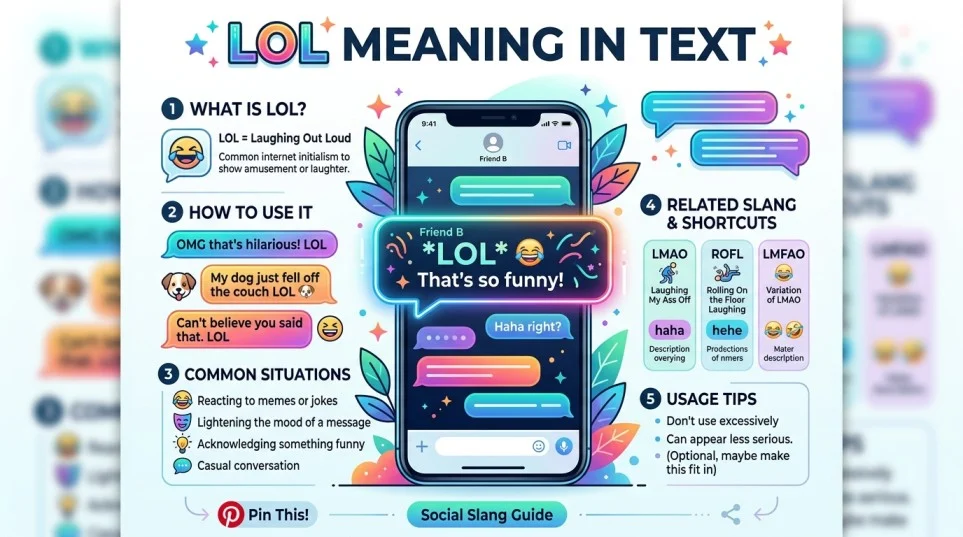
Quick Ans: LOL means “Laughing Out Loud.” It is a popular internet abbreviation used in texting, social media, and online chats to express laughter, amusement, or friendliness during a conversation.
Have you ever received a message that simply said “LOL” and wondered what it actually meant? Chances are you’ve seen this abbreviation countless times in text messages, social media comments, online chats, and even emails. In fact, LOL is one of the most widely recognized internet abbreviations in the world.
Despite its popularity, many people still use LOL in different ways. Sometimes it expresses genuine laughter, while other times it softens a message, shows friendliness, or fills an awkward silence in a conversation.
In this guide, you’ll learn the LOL meaning in text, where it came from, how it’s used today, examples in different contexts, similar abbreviations, alternative expressions, and answers to common questions. By the end, you’ll understand exactly what LOL means and when to use it naturally.
LOL Meaning in Text + Definition
LOL stands for “Laughing Out Loud.”
People use LOL in text messages and online conversations to show that they find something funny, amusing, entertaining, or lighthearted.
Quick Definition Table
| Term | Meaning |
|---|---|
| LOL | Laughing Out Loud |
| Usage | Express laughter or amusement |
| Tone | Friendly, humorous, casual |
| Common Platforms | Texting, WhatsApp, Snapchat, Instagram, Facebook, Discord |
| Popularity | One of the most used internet abbreviations |
What Does LOL Mean in a Text Message?
When someone sends LOL, they’re usually reacting to something they find funny or entertaining.
However, LOL doesn’t always mean a person is literally laughing out loud. Over time, the abbreviation has evolved and is often used simply to make conversations feel friendlier and more relaxed.
Depending on the situation, LOL can mean:
- That’s funny.
- I’m laughing.
- That amused me.
- I’m joking.
- I’m being friendly.
- This conversation is lighthearted.
Example
Friend: I accidentally wore two different shoes to work today.
You: LOL that’s hilarious.
In this example, LOL expresses amusement and laughter.
The Origin of LOL
LOL originated during the early days of internet communication.
As online chat rooms, forums, and instant messaging became popular in the 1980s and 1990s, users started creating abbreviations to communicate more quickly. Consequently, common expressions were shortened into acronyms.
“Laughing Out Loud” became LOL because it was short, easy to type, and instantly understandable.
Over time, LOL spread across:
- Internet forums
- Online gaming communities
- Instant messaging apps
- Text messages
- Social media platforms
Today, LOL is recognized globally and remains one of the most popular pieces of internet slang.
How LOL Is Used Today
Although LOL originally meant actual laughter, its usage has expanded significantly.
1. Expressing Genuine Laughter
This is the most traditional use of LOL.
Example:
“LOL, that joke made my day.”
2. Reacting to Something Funny
People often use LOL when they find a story, meme, or comment amusing.
Example:
“LOL, I can’t believe that happened.”
3. Making a Message Friendlier
Sometimes LOL isn’t about laughter at all. Instead, it softens the tone of a message.
Example:
“I completely forgot about the meeting LOL.”
Here, LOL makes the message feel less serious.
4. Showing You’re Joking
Adding LOL can signal that a statement isn’t meant to be taken too seriously.
Example:
“Guess I’m becoming a professional procrastinator LOL.”
5. Avoiding Awkwardness
Many people use LOL to keep conversations comfortable and relaxed.
Example:
“That was awkward LOL.”
Examples of LOL in Text Conversations
Looking at examples helps show how flexible LOL can be.
Friendly Examples
| Situation | Example |
|---|---|
| Funny story | “LOL that’s actually hilarious.” |
| Joke | “LOL good one.” |
| Meme | “LOL I can’t stop laughing.” |
| Friend’s mistake | “LOL we’ve all done that.” |
Casual Examples
| Situation | Example |
|---|---|
| Embarrassing moment | “LOL that was so awkward.” |
| Random event | “LOL what are the chances?” |
| Funny coincidence | “LOL that’s interesting.” |
Lighthearted Examples
| Situation | Example |
|---|---|
| Teasing a friend | “LOL you’re impossible.” |
| Self-deprecating joke | “LOL I’m such a mess today.” |
| Silly situation | “LOL that explains everything.” |
Tone of LOL in Texting
The tone of LOL depends on how it’s used.
Generally, it creates a friendly and relaxed atmosphere.
Friendly Tone
“LOL that’s amazing.”
This sounds positive and cheerful.
Playful Tone
“LOL you’re funny.”
This feels lighthearted and casual.
Awkward Tone
“Yeah… LOL.”
Sometimes LOL is used to ease tension or awkwardness.
Sarcastic Tone
“LOL sure.”
In certain situations, LOL can sound sarcastic depending on the context.
Because tone is important, it’s always helpful to consider the surrounding conversation.
LOL Examples by Context
Texting a Friend
Friend: I locked myself out of the house.
You: LOL how did you manage that?
Family Conversation
Sibling: I burned the toast again.
You: LOL not surprised.
Social Media Comment
Post: Cat jumps into a box and gets stuck.
Comment: LOL this made my day.
Group Chat
Friend: I just realized today’s not Friday.
Everyone: LOL.
Dating Conversation
Them: I spent ten minutes looking for my phone while holding it.
You: LOL that’s something I’d do too.
Why People Use LOL
LOL remains popular for several reasons.
Quick and Easy
Typing three letters is faster than writing a full reaction.
Widely Recognized
Most internet users immediately understand what LOL means.
Adds Personality
LOL makes messages feel warmer and more conversational.
Reduces Seriousness
Adding LOL can make statements sound less harsh or formal.
Keeps Conversations Engaging
People often use LOL to maintain a positive and friendly tone.
LOL vs Similar Texting Abbreviations
Many abbreviations express laughter, but they aren’t identical.
| Abbreviation | Meaning | Usage |
|---|---|---|
| LOL | Laughing Out Loud | General laughter |
| LMAO | Laughing My Ass Off | Strong laughter |
| ROFL | Rolling On the Floor Laughing | Extreme laughter |
| LMFAO | Laughing My Freaking Ass Off | Very strong laughter |
| HAHA | Written laughter | Casual reaction |
| XD | Laughing face expression | Playful reaction |
Example
- “LOL that’s funny.”
- “LMAO that’s hilarious.”
- “ROFL I can’t stop laughing.”
Each abbreviation indicates a different level of amusement.
Alternative Ways to Say LOL
Sometimes you may want to use a different expression.
Casual Alternatives
- Haha
- Hahaha
- That’s funny
- Good one
- That’s hilarious
- Cracking me up
Stronger Reactions
- LMAO
- ROFL
- I’m dying
- That’s priceless
- I’m crying laughing
Professional Alternatives
In professional communication, it’s often better to write:
- That’s amusing.
- That’s funny.
- I enjoyed that.
- That made me laugh.
Does LOL Have Other Meanings?
While Laughing Out Loud is by far the most common meaning, LOL has occasionally been used for other phrases in specific communities or industries.
Some less common meanings include:
- Lots of Love
- Little Old Lady
However, in modern texting and online communication, LOL almost always means Laughing Out Loud.
Common Mistakes When Using LOL
Using It in Serious Situations
LOL may appear insensitive during serious conversations.
Example:
“I’m sorry for your loss LOL.”
This would be inappropriate.
Overusing It
Using LOL in every sentence can make messages feel repetitive.
Example:
“LOL I woke up LOL then LOL went to work LOL.”
Misreading the Tone
Sometimes LOL can be interpreted as sarcasm depending on the context.
Because of this, it’s important to pay attention to the overall conversation.
FAQ About LOL Meaning in Text
1. What does LOL mean in texting?
LOL stands for “Laughing Out Loud.”
2. Is LOL still popular?
Yes. Despite newer slang terms appearing regularly, LOL remains one of the most widely used internet abbreviations.
3. Does LOL mean someone is actually laughing?
Not always. Many people use LOL simply to sound friendly or casual.
4. What is the difference between LOL and LMAO?
LOL indicates laughter, while LMAO suggests a much stronger reaction.
5. Can LOL be sarcastic?
Yes. Depending on context, LOL can sometimes express sarcasm.
6. Is LOL appropriate in professional emails?
Generally, no. Professional communication usually benefits from more formal language.
7. What should I reply to LOL?
You can respond naturally with:
- Haha
- Glad you liked it
- Right?
- I know!
8. What does LOL mean on social media?
On social media, LOL typically expresses amusement, laughter, or a friendly reaction to content.
Conclusion
Understanding the LOL meaning in text is important because it’s one of the most common abbreviations used online. LOL stands for “Laughing Out Loud” and is used to express amusement, humor, friendliness, or a lighthearted reaction during conversations.
Whether you’re texting friends, commenting on social media, participating in group chats, or chatting online, LOL helps make communication feel more relaxed and engaging. Additionally, it can soften messages, show appreciation for humor, and keep conversations flowing naturally.
The next time you see LOL in a message, you’ll know that it usually signals laughter, amusement, or a friendly tone.
Discover More:-
- What Does FN Mean on TikTok? Complete FN Meaning TikTok Guide
- IIRC Meaning in Text: What It Means, How to Use It, and Why People Still Say It Online