
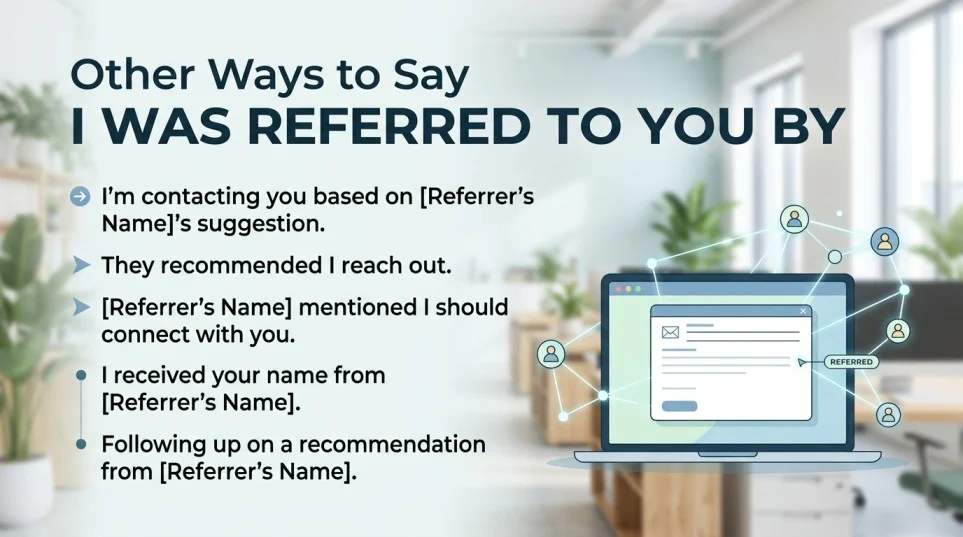
Quick Ans: If you’re searching for other ways to say “I was referred to you by,” try: I was recommended by, I was directed to you by, I received your contact from, I was introduced to you through, I was advised to reach out by. These options sound more polished, natural, and professional.
The phrase “I was referred to you by” is commonly used in professional communication when mentioning a connection or recommendation. It helps establish trust and context at the start of a conversation.
However, relying on the same phrase repeatedly can sound repetitive. Learning alternatives to I was referred to you by allows you to communicate more confidently and professionally.
Using varied expressions also helps you express connections in English more naturally in emails, networking, and business conversations.
“Strong introductions create strong professional impressions.”
Quick Categories Section
Formal Alternatives to “I Was Referred to You By”
- I was recommended by
- I was directed to you by
- I was introduced to you by
- I was advised to contact you by
Pro Tip: Use these in formal emails and official communication.
Casual Alternatives
- Someone told me to reach out to you
- I heard about you from
- I got your name from
- A friend suggested I contact you
Pro Tip: Best for informal networking or friendly conversations.
Professional Alternatives
- I received your contact from
- I was connected to you through
- I was put in touch with you by
- I came across your name via
Pro Tip: Ideal for LinkedIn messages and workplace emails.
Informal Expressions
- I got referred your way by
- Someone pointed me to you
- I was sent your way
- I heard your name through
Pro Tip: Use only in relaxed or conversational contexts.
“The way you introduce yourself sets the tone for the entire conversation.”
Common Mistakes Section
- Forgetting to mention the referrer clearly
Incorrect: I was referred to you.
Better: I was referred to you by John Smith. - Using overly casual tone in business emails
Incorrect: Someone told me about you
Better: I was recommended by… - Overexplaining the connection
Incorrect: Long story about how you got the contact
Better: Keep it short and direct - Spelling or grammar errors in names
Incorrect: Wrong spelling of referrer
Better: Always double-check names - Using the phrase repeatedly in the same message
Better: Use varied alternatives
What Does “I Was Referred to You By” Mean?
Definition:
It means someone recommended or introduced you to another person.
Grammar Note:
Passive voice structure commonly used in formal communication.
Example:
I was referred to you by Mr. Ahmed regarding this opportunity.
When to Use This Phrase
- Writing professional emails
- Networking introductions
- Job inquiries
- Business communication
Spoken vs Written: Both
Formal vs Informal: Mostly formal
Is It Professional or Polite to Use This Phrase?
- Polite? ✔️ Yes
- Professional? ✔️ Yes
Business Example:
I was referred to you by Sarah Khan regarding your services.
“Professional communication values clarity, brevity, and credibility.”
Pros and Cons
Pros
- Builds trust instantly
- Clear context
- Widely accepted
- Professional tone
Cons
- Can sound repetitive
- Overused in emails
- Limited variation
- Slightly formal
Other Ways to Say “I Was Referred to You By” (With Examples)
These alternatives will help you sound more fluent, confident, and professional.
Use them based on tone, context, and audience.
1. I was recommended by
Meaning: Someone suggested you
Explanation: Direct and professional
Example Sentence: I was recommended by Ali Khan to contact you.
Best Use: Business email
Worst Use: Casual chat
Tone: Professional, clear
Context Variability: professional
2. I was directed to you by
Meaning: Someone guided you to contact
Explanation: Slightly formal
Example Sentence: I was directed to you by my manager.
Best Use: Workplace
Worst Use: Informal talk
Tone: Formal
Context Variability: professional
3. I received your contact from
Meaning: Got details through someone
Explanation: Neutral and common
Example Sentence: I received your contact from a colleague.
Best Use: Emails
Worst Use: Slang
Tone: Neutral
Context Variability: professional
4. I was introduced to you by
Meaning: Someone connected you
Explanation: Polite and formal
Example Sentence: I was introduced to you by Mr. Hassan.
Best Use: Networking
Worst Use: Casual
Tone: Professional
Context Variability: professional
5. I was advised to contact you by
Meaning: Someone suggested reaching out
Explanation: Formal and respectful
Example Sentence: I was advised to contact you by my supervisor.
Best Use: Office
Worst Use: Informal
Tone: Formal
Context Variability: professional
6. I was put in touch with you by
Meaning: Someone connected you directly
Explanation: Common professional phrase
Example Sentence: I was put in touch with you by Sara.
Best Use: Business
Worst Use: Slang
Tone: Professional
Context Variability: professional
7. I was connected to you through
Meaning: Indirect introduction
Explanation: Good for networking
Example Sentence: I was connected to you through LinkedIn.
Best Use: Networking
Worst Use: Casual
Tone: Neutral
Context Variability: professional
8. I came across your name via
Meaning: Found through someone/source
Explanation: Slightly formal
Example Sentence: I came across your name via a colleague.
Best Use: Emails
Worst Use: Casual
Tone: Formal
Context Variability: professional
9. I heard about you from
Meaning: Learned about someone
Explanation: Casual but acceptable
Example Sentence: I heard about you from a friend.
Best Use: Casual networking
Worst Use: Formal report
Tone: Casual
Context Variability: casual
10. A colleague suggested I reach out
Meaning: Recommendation
Explanation: Natural and professional
Example Sentence: A colleague suggested I reach out to you.
Best Use: Workplace
Worst Use: Informal chat
Tone: Professional
Context Variability: professional
11. I got your name from
Meaning: Received contact info
Explanation: Informal but clear
Example Sentence: I got your name from a mutual contact.
Best Use: Casual
Worst Use: Formal email
Tone: Informal
Context Variability: casual
12. I was referred your way by
Meaning: Sent toward you
Explanation: Slightly informal
Example Sentence: I was referred your way by Ahmed.
Best Use: Semi-formal
Worst Use: Formal report
Tone: Semi-formal
Context Variability: casual
13. Someone recommended I contact you
Meaning: Suggestion from someone
Explanation: Neutral phrasing
Example Sentence: Someone recommended I contact you regarding this.
Best Use: Emails
Worst Use: Slang
Tone: Neutral
Context Variability: professional
14. I was guided to you by
Meaning: Directed by someone
Explanation: Formal tone
Example Sentence: I was guided to you by my supervisor.
Best Use: Formal
Worst Use: Casual
Tone: Formal
Context Variability: professional
15. I was pointed in your direction by
Meaning: Someone directed you
Explanation: Slightly informal
Example Sentence: I was pointed in your direction by a colleague.
Best Use: Semi-formal
Worst Use: Formal report
Tone: Neutral
Context Variability: casual
16. I learned about you through
Meaning: Discovered via someone
Explanation: General phrase
Example Sentence: I learned about you through a friend.
Best Use: Casual/professional
Worst Use: Technical
Tone: Neutral
Context Variability: general
17. I was encouraged to reach out by
Meaning: Strong recommendation
Explanation: Positive tone
Example Sentence: I was encouraged to reach out by my manager.
Best Use: Workplace
Worst Use: Slang
Tone: Professional
Context Variability: professional
18. I was connected through a mutual contact
Meaning: Shared connection
Explanation: Networking phrase
Example Sentence: I was connected through a mutual contact.
Best Use: LinkedIn
Worst Use: Casual
Tone: Professional
Context Variability: professional
19. I found your details through
Meaning: Contact discovery
Explanation: Neutral
Example Sentence: I found your details through a colleague.
Best Use: Email
Worst Use: Slang
Tone: Neutral
Context Variability: professional
20. I came to know about you from
Meaning: Learned about someone
Explanation: Slightly formal
Example Sentence: I came to know about you from a friend.
Best Use: Semi-formal
Worst Use: Slang
Tone: Neutral
Context Variability: general
21. I was introduced through a colleague
Meaning: Connected via colleague
Explanation: Professional
Example Sentence: I was introduced through a colleague at work.
Best Use: Business
Worst Use: Casual
Tone: Professional
Context Variability: professional
22. I got your contact through
Meaning: Received info
Explanation: Casual-neutral
Example Sentence: I got your contact through a mutual friend.
Best Use: Semi-formal
Worst Use: Formal report
Tone: Neutral
Context Variability: general
23. I was recommended to you by
Meaning: Suggested to reach out
Explanation: Passive structure
Example Sentence: I was recommended to you by my mentor.
Best Use: Formal
Worst Use: Casual
Tone: Formal
Context Variability: professional
24. I heard your name from
Meaning: Learned about someone
Explanation: Informal
Example Sentence: I heard your name from a colleague.
Best Use: Casual
Worst Use: Formal
Tone: Informal
Context Variability: casual
25. A mutual contact referred me
Meaning: Shared connection
Explanation: Professional
Example Sentence: A mutual contact referred me to you.
Best Use: Networking
Worst Use: Slang
Tone: Professional
Context Variability: professional
26. I was connected by
Meaning: Direct connection
Explanation: Short and clear
Example Sentence: I was connected by my manager.
Best Use: Workplace
Worst Use: Casual
Tone: Formal
Context Variability: professional
27. I got introduced to you via
Meaning: Through someone
Explanation: Semi-formal
Example Sentence: I got introduced to you via LinkedIn.
Best Use: Networking
Worst Use: Slang
Tone: Neutral
Context Variability: professional
28. I was informed about you by
Meaning: Learned formally
Explanation: Formal tone
Example Sentence: I was informed about you by my supervisor.
Best Use: Formal
Worst Use: Casual
Tone: Formal
Context Variability: professional
29. I was sent your contact by
Meaning: Someone shared contact
Explanation: Direct phrasing
Example Sentence: I was sent your contact by a colleague.
Best Use: Email
Worst Use: Slang
Tone: Neutral
Context Variability: professional
30. I was asked to contact you by
Meaning: Directed to reach out
Explanation: Instruction-based
Example Sentence: I was asked to contact you by my manager.
Best Use: Workplace
Worst Use: Casual
Tone: Professional
Context Variability: professional
“A strong introduction builds instant credibility.”
Mini Quiz / Self-Check
1. Most formal option?
A. I got your name from
B. I was advised to contact you by
Answer: B
2. Best for LinkedIn?
A. I was connected through
B. I heard your name
Answer: A
3. Best for casual talk?
A. I was informed about you
B. I got your name from
Answer: B
Comparison Table: Top Alternatives
| Phrase | Tone | Best Use |
|---|---|---|
| I was recommended by | Professional | Business |
| I received your contact from | Neutral | |
| I was introduced to you by | Formal | Networking |
| I was put in touch with you by | Professional | Workplace |
| I came across your name via | Formal | |
| I heard about you from | Casual | Friends |
| I was advised to contact you by | Formal | Office |
| I was connected to you through | Professional | |
| A colleague suggested I reach out | Professional | Work |
| I got your name from | Informal | Casual |
FAQs
1. What are other ways to say I was referred to you by?
You can say I was recommended by, I was introduced to you by, or I received your contact from.
2. Is this phrase professional?
Yes, it is widely used in professional communication.
3. What is the best alternative for emails?
I was recommended by or I received your contact from.
4. Can I use casual alternatives at work?
It’s better to stick with professional phrases in workplace communication.
5. Why learn alternatives?
It improves fluency and avoids repetition in professional writing.
Conclusion
Learning other ways to say I was referred to you by helps you sound more polished, confident, and professional. It also allows you to adapt your tone depending on context.
Practice these alternatives to improve your communication in emails, networking, and business interactions.
See also: Other Ways to Say “Looking Forward to Hearing From You”
See also: Professional Email Opening Lines Guide
CTA: Try using 3 different alternatives in your next email introduction.
Discover More:-
- Other Ways to Say You As Well (30+ Examples)
- Other Ways to Say Thank You for Letting Me Know (30 Examples)