
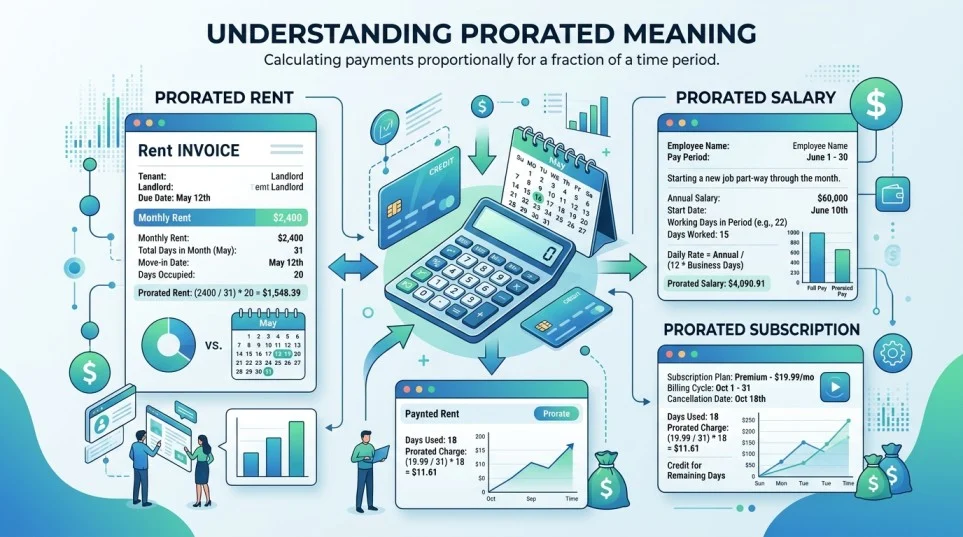
Prorated Meaning: Complete Guide to Prorated Charges, Payments, Rent, Salary, and Billing
If you’ve ever moved into an apartment mid-month, canceled a subscription early, or started a new job halfway through a pay period, you’ve probably encountered a prorated charge or prorated payment.
Many people see the word “prorated” on invoices and billing statements without fully understanding it. At first glance, the term sounds technical. However, the concept is surprisingly simple.
In plain English, prorated meaning refers to dividing a cost, payment, salary, or fee proportionally based on actual usage, time, or service received.
Instead of paying the full amount, you only pay for the portion you used.
That’s the heart of prorating.
Whether you are dealing with rent, payroll, utilities, SaaS subscriptions, insurance premiums, or telecom services, prorated calculations help create fair and accurate billing.
This guide breaks everything down in simple words. You’ll learn:
- What prorated means
- How prorated calculations work
- Real-world billing examples
- Prorated rent meaning
- Prorated salary meaning
- Prorated subscription billing
- Prorated refunds and charges
- Common mistakes to avoid
- Practical formulas anyone can use
By the end, you’ll understand prorated pricing like a pro.
What Does Prorated Mean?
The meaning of prorated is simple:
A prorated amount is a partial payment calculated according to the time, usage, or portion received.
The term comes from the Latin phrase “pro rata.”
“Pro rata” means:
“In proportion.”
That means a bill, salary, fee, or refund gets divided fairly according to actual use rather than charging the full amount.
Prorated Meaning in Simple Words
Imagine you rent an apartment that costs $1,500 per month.
You move in on the 16th instead of the 1st.
Should you still pay the full month’s rent?
Probably not.
Instead, the landlord calculates the amount based on the days you actually live there.
That partial amount is called the prorated rent.
The same idea applies to:
- Salaries
- Memberships
- Streaming services
- Insurance
- Utilities
- SaaS plans
- Phone bills
- Internet services
Whenever a payment gets adjusted proportionally, it becomes prorated.
Prorated Definition
Here’s a clean and accurate prorated definition:
| Term | Definition |
|---|---|
| Prorated | An amount adjusted proportionally according to time, usage, or allocation |
| Pro rata | Latin phrase meaning “in proportion” |
| Proration | The process of dividing costs fairly |
| Prorated charge | Partial fee based on actual use |
| Prorated payment | Adjusted payment for a portion of service |
Define Prorated With a Simple Example
Let’s say a streaming service costs:
- $30 per month
- Billing cycle = 30 days
You subscribe halfway through the month and use the service for 15 days.
Instead of paying the full $30, the company charges you:
3030×15=15
Your prorated amount becomes $15.
That’s a classic prorated payment meaning example.
Why Businesses Use Proration
Companies use prorated pricing because it creates fairness.
Without prorating, customers would pay for services they never used.
That would frustrate users quickly.
Businesses use prorated calculations to:
- Improve customer satisfaction
- Align billing cycles
- Reduce disputes
- Handle partial usage periods
- Create accurate invoices
- Simplify payroll adjustments
- Calculate refunds properly
Proration also helps companies maintain cleaner accounting records.
How Prorated Works
Understanding how prorated works becomes easy once you know the core formula.
Basic Prorated Calculation Formula
Most prorated calculations follow this structure:
Prorated Amount=Total Time PeriodTotal Cost×Time Used
This formula applies to:
- Rent
- Salary
- Subscription fees
- Utilities
- Insurance premiums
- Memberships
- SaaS billing
Step-by-Step Prorated Calculation
Here’s the exact process companies use.
Determine the Full Amount
Start with the total monthly, yearly, or billing-cycle cost.
Example:
- Monthly internet bill = $90
Identify the Billing Period
Determine how many days are included.
Example:
- 30-day month
Calculate Daily Cost
Divide total cost by total days.
3090=3
Daily rate = $3.
Multiply by Days Used
If the customer used the service for 10 days:
3×10=30
Final prorated charge = $30.
Prorated Meaning in Billing
The phrase prorated meaning in billing usually refers to adjusted charges based on partial service periods.
Billing systems commonly use prorating when:
- Customers join mid-cycle
- Plans change before renewal
- Services get canceled early
- Upgrades happen during active subscriptions
Common Billing Adjustments
| Situation | Prorated Outcome |
|---|---|
| Mid-month signup | Partial first bill |
| Early cancellation | Partial refund |
| Service upgrade | Additional prorated fee |
| Service downgrade | Account credit |
| Employee resignation | Partial paycheck |
Prorated billing keeps charges proportional.
Prorated Charges Meaning
A prorated charge is a reduced fee based on actual use.
Instead of charging a fixed full amount, businesses calculate a fair share payment.
What Is a Prorated Charge?
A prorated charge means:
- You pay only for the days used
- Charges reflect partial service
- Costs divide proportionally
For example:
If cable TV costs $120 monthly and you use it for 10 days:
30120×10=40
Your prorated charge becomes $40.
Prorated Payment Meaning
A prorated payment refers to a partial payment adjusted according to time or usage.
This commonly appears in:
- Payroll
- Leasing
- Insurance
- Subscription platforms
- Membership services
Real-World Examples
| Service | Prorated Payment Example |
|---|---|
| Rent | Pay only for days occupied |
| Salary | Paid for actual days worked |
| Streaming | Charged for partial month |
| Insurance | Refund for unused coverage |
| Gym membership | Adjusted joining fee |
Prorated Amount Meaning
The prorated amount meaning refers to the final calculated partial payment after adjustment.
It is not random.
Companies use formulas to calculate it accurately.
What Impacts a Prorated Amount?
Several factors influence the result:
- Number of days used
- Total billing period
- Contract terms
- Daily rate calculation
- Service type
- Billing policies
Prorated Rent Meaning
One of the most common uses of prorating happens in real estate.
What Is Prorated Rent?
Prorated rent meaning refers to partial rent charged when a tenant occupies a property for only part of a month.
Instead of paying the full monthly rent, the tenant pays proportionally.
How Prorated Rent Works
Let’s say:
- Monthly rent = $2,000
- Month length = 30 days
- Move-in date = 11th
- Days occupied = 20
Daily rent:
302000=66.67
Prorated rent:
66.67×20=1333.40
The tenant pays approximately $1,333.40.
Why Landlords Use Prorated Rent
Landlords use prorated pricing because it keeps leasing fair.
Without it:
- Tenants would overpay
- Lease disputes would increase
- Move-in flexibility would shrink
Proration benefits both landlords and renters.
Partial Month Rent Calculation Methods
Different landlords use different approaches.
Actual Days Method
Uses exact calendar days.
Most accurate method.
30-Day Standard Method
Assumes every month has 30 days.
Simplifies accounting.
Business-Day Method
Less common in residential leases.
Mostly used commercially.
Common Prorated Rent Mistakes
Many tenants misunderstand lease calculations.
Frequent Errors
- Counting wrong move-in dates
- Ignoring move-out dates
- Misreading lease clauses
- Assuming all landlords use 30-day calculations
- Forgetting utility adjustments
Always request a written calculation.
Prorated Salary Meaning
The prorated salary meaning refers to salary adjusted for partial work periods.
Employees rarely work perfect yearly cycles.
People:
- Start jobs mid-month
- Leave before year-end
- Take unpaid leave
- Switch from full-time to part-time
That’s where salary proration enters.
What Is a Prorated Salary?
A prorated salary means:
An employee receives payment proportional to actual work performed.
Employers use payroll adjustment systems to calculate fair compensation.
How Employers Calculate Prorated Salary
Most companies calculate salaries using:
- Workdays
- Calendar days
- Pay periods
- Hourly conversion rates
Basic Salary Formula
Prorated Salary=Work Days Per YearAnnual Salary×Days Worked
Prorated Salary Example
Suppose:
- Annual salary = $72,000
- Workdays per year = 260
- Days worked = 20
Daily salary:
26072000=276.92
Prorated paycheck:
276.92×20=5538.40
Employee receives approximately $5,538.40.
Prorated Salary vs Hourly Pay
Many people confuse these terms.
They are not identical.
| Feature | Prorated Salary | Hourly Pay |
|---|---|---|
| Base structure | Annual salary | Hourly wage |
| Payment adjustment | Partial periods | Hours worked |
| Typical users | Salaried employees | Contractors or hourly workers |
| Payroll complexity | Higher | Lower |
Prorated Billing Meaning
The prorated billing meaning involves adjusting invoices based on partial service periods.
Subscription companies rely heavily on prorated billing systems.
Industries Using Prorated Billing
- SaaS software
- Telecom companies
- Streaming platforms
- Cloud hosting
- Internet providers
- Utility companies
SaaS Prorated Billing Explained
Software companies often bill monthly.
Customers may:
- Upgrade mid-cycle
- Downgrade plans
- Add extra users
- Cancel early
Prorated billing ensures fair pricing.
Subscription Adjustment Example
Imagine:
- Basic plan = $50/month
- Premium plan = $90/month
- Upgrade occurs halfway through cycle
Difference:
90−50=40
Half-month adjustment:
3040×15=20
Additional prorated charge = $20.
Prorated Subscription Meaning
A prorated subscription means you pay only for the portion of the service you actually use.
This model dominates digital services today.
Common Subscription Services Using Proration
- Netflix-style streaming
- Cloud software
- Gym memberships
- Learning platforms
- Phone plans
- Business software
Prorated Price Meaning
The prorated price meaning refers to a reduced or adjusted fee calculated proportionally.
It is not necessarily a discount.
That distinction matters.
Prorated Price vs Discount
| Prorated Price | Discount |
|---|---|
| Based on time/usage | Based on promotion |
| Formula-driven | Marketing-driven |
| Proportional | Arbitrary percentage |
| Usage-focused | Sales-focused |
A prorated amount reflects fairness rather than promotional savings.
Prorated Cost Meaning
The prorated cost meaning involves dividing total costs proportionally.
Businesses commonly prorate:
- Shared utilities
- Insurance premiums
- Office expenses
- Subscription plans
- Payroll benefits
Prorated Refund Meaning
A prorated refund occurs when customers receive money back for unused service time.
Common Refund Situations
- Canceling insurance early
- Ending subscriptions
- Leaving a lease early
- Membership cancellation
Prorated Refund Example
Suppose:
- Annual subscription = $240
- Used for 3 months
- Remaining period = 9 months
Monthly value:
12240=20
Refund:
20×9=180
Prorated refund = $180.
Prorated Insurance Meaning
Insurance companies frequently use prorated calculations.
Why Insurance Gets Prorated
Policies often end early.
Companies adjust premiums based on:
- Coverage duration
- Remaining policy period
- Risk allocation
Telecom Billing Adjustment
Phone companies often apply prorated billing.
Common Telecom Situations
- Mid-month activation
- Early cancellation
- Data plan upgrades
- SIM activation timing
Customers usually notice this on their first bill.
Utility Bill Adjustment
Utility companies also use prorating.
This happens when:
- New tenants move in
- Meter readings change mid-cycle
- Shared buildings divide costs
- Billing periods shift
Membership Fee Adjustment
Gyms and clubs commonly prorate membership fees.
Instead of forcing customers to wait until next month, they charge proportionally.
That flexibility improves customer onboarding.
Pro Rata Meaning vs Prorated Meaning
People often ask whether these terms differ.
The answer:
They are closely related.
| Term | Meaning |
|---|---|
| Pro rata | In proportion |
| Prorated | Adjusted proportionally |
“Pro rata” describes the principle.
“Prorated” describes the calculated result.
Daily Rate Calculation Explained
Most prorated systems depend on daily rates.
Formula for Daily Rate
Daily Rate=Number of DaysTotal Cost
Monthly Charge Breakdown Example
| Item | Amount |
|---|---|
| Monthly internet plan | $120 |
| Days in billing cycle | 30 |
| Daily cost | $4 |
| Days used | 12 |
| Prorated amount | $48 |
Time-Based Pricing Explained
Proration is a form of time-based pricing.
Customers pay according to duration rather than fixed blanket pricing.
This pricing structure appears everywhere today.
Especially in digital subscriptions.
Usage-Based Billing vs Prorated Billing
These terms overlap but differ slightly.
| Usage-Based Billing | Prorated Billing |
|---|---|
| Charges depend on consumption | Charges depend on time |
| Example: paying per GB | Example: paying per day |
| Metered system | Calendar-based system |
Some companies combine both.
Invoice Adjustment Meaning
A prorated invoice adjustment modifies billing totals fairly.
Companies use invoice adjustments for:
- Billing errors
- Mid-cycle upgrades
- Partial refunds
- Plan changes
Contract Payment Adjustment
Contracts often include proration clauses.
These clauses explain:
- Billing methods
- Daily calculation formulas
- Refund rights
- Lease adjustment rules
Always read the contract carefully.
Tiny billing details can affect hundreds of dollars.
Prorated Lease Meaning
Commercial leases frequently use complex prorated structures.
Adjustments may include:
- Shared maintenance
- Utilities
- Parking fees
- Building taxes
- Insurance allocation
Commercial real estate often uses detailed cost allocation systems.
Prorated Vacation Pay
Many companies prorate vacation benefits.
Example
If annual PTO equals:
- 24 days annually
An employee working only half the year receives:
1224×6=12
Prorated vacation = 12 days.
Prorated Benefits Meaning
Employee benefits may also get prorated.
Examples include:
- Bonuses
- PTO
- Retirement contributions
- Insurance eligibility
- Commission structures
Common Industries Using Proration
Proration appears almost everywhere in modern finance.
Industries That Use Prorated Calculations
| Industry | Common Use |
|---|---|
| Real estate | Rent calculations |
| HR and payroll | Salary adjustments |
| Telecom | Billing cycles |
| SaaS | Subscription changes |
| Insurance | Premium refunds |
| Utilities | Shared cost allocation |
| Education | Tuition adjustments |
| Fitness | Membership billing |
Advantages of Prorated Billing
Proration offers several benefits.
Fairness
Customers pay only for what they use.
Flexibility
Users can start services anytime.
Better Customer Experience
People dislike paying for unused periods.
Accurate Accounting
Businesses maintain cleaner financial records.
Disadvantages of Prorated Calculations
Despite the benefits, proration has drawbacks.
Billing Complexity
Calculations sometimes confuse customers.
Rounding Errors
Small decimal differences create disputes.
Inconsistent Methods
Different companies use different formulas.
Contract Confusion
Poorly written billing policies frustrate users.
Common Prorated Calculation Mistakes
Even experienced professionals make errors.
Frequent Problems
- Wrong billing period assumptions
- Ignoring leap years
- Incorrect move-in dates
- Bad rounding methods
- Misreading contract language
- Mixing calendar days with business days
How to Check a Prorated Bill
Never assume the invoice is correct automatically.
Steps to Verify Charges
Review the Billing Period
Check exact start and end dates.
Confirm Daily Rate
Calculate it independently.
Count Actual Usage Days
Use calendar dates carefully.
Compare Contract Terms
Billing methods must match agreements.
Ask for Written Calculations
Transparent companies provide breakdowns.
Prorated Example Scenarios
Real examples make the concept easier.
Prorated Rent Example
| Detail | Value |
|---|---|
| Monthly rent | $1,800 |
| Days in month | 30 |
| Daily rent | $60 |
| Move-in day | 20th |
| Days occupied | 11 |
| Prorated amount | $660 |
Prorated Salary Example
| Detail | Value |
|---|---|
| Annual salary | $84,000 |
| Workdays yearly | 260 |
| Daily rate | $323.08 |
| Days worked | 15 |
| Prorated salary | $4,846.20 |
Prorated Subscription Example
| Detail | Value |
|---|---|
| Monthly software plan | $75 |
| Billing cycle | 30 days |
| Days remaining | 12 |
| Prorated upgrade charge | $30 |
Prorated Insurance Refund Example
| Detail | Value |
|---|---|
| Annual premium | $1,200 |
| Months used | 4 |
| Remaining months | 8 |
| Refund amount | $800 |
Accounting and Finance Perspective
In accounting, prorating ensures accurate allocation of expenses and revenue.
Accountants use proration to:
- Match expenses properly
- Allocate revenue fairly
- Adjust accruals
- Handle deferred income
- Create precise financial statements
Proration in Payroll Systems
Modern payroll software automates prorated calculations.
Systems adjust:
- Sick leave
- PTO
- Bonuses
- Mid-cycle hires
- Resignations
- Hour reductions
Automation reduces manual payroll errors.
Why Customers Often Confuse Prorated Bills
Many invoices lack transparency.
Customers see:
- Unexpected charges
- Credits
- Mid-cycle adjustments
- Split invoices
Without explanations, the bill appears incorrect.
That confusion explains why support teams frequently handle billing disputes.
How Companies Present Prorated Charges
Businesses usually display prorated billing in one of these ways:
| Invoice Style | Description |
|---|---|
| Separate line item | Clearly labeled adjustment |
| Credit and debit system | Offset calculations |
| Partial invoice | Reduced monthly fee |
| Adjustment memo | Manual billing correction |
Billing Cycle Adjustment Explained
A billing cycle adjustment happens when service dates no longer align with the original cycle.
This commonly happens after:
- Plan upgrades
- Schedule changes
- New account activation
- Subscription migration
Mid-Month Billing Explained
Mid-month billing creates the largest number of prorated invoices.
For example:
- A customer joins on the 17th
- Normal billing begins on the 1st
The company bills only for the remaining days.
Then the next invoice resets normally.
Fractional Payment Amount Meaning
A fractional payment amount simply means a payment smaller than the full cycle charge.
It reflects:
- Partial use
- Shared allocation
- Adjusted duration
Fair Share Payment Concept
At its core, proration revolves around fairness.
The principle is simple:
People should pay only for what they actually use.
That philosophy powers modern subscription economies.
Prorated Pricing Explained for Businesses
Businesses benefit from prorated systems because they:
- Increase conversion rates
- Encourage immediate signup
- Reduce cancellation resistance
- Create customer trust
- Improve financial accuracy
Without prorated pricing, many users would delay purchases until new billing cycles begin.
How SaaS Companies Handle Prorated Billing
Software companies often use automated billing engines.
These systems instantly calculate:
- Remaining billing days
- Upgrade costs
- Downgrade credits
- Seat adjustments
- Add-on pricing
Modern SaaS platforms heavily depend on proration logic.
Common Proration Policies
Not every company handles prorating identically.
Common Variations
| Policy Type | Description |
|---|---|
| Daily proration | Most accurate |
| Monthly proration | Simpler accounting |
| No proration | Full charges regardless of use |
| Credit-based proration | Future account credits |
| Refund-based proration | Direct reimbursement |
Always review policy terms carefully.
Legal Considerations of Prorated Charges
Proration itself is legal and widely accepted.
However, disputes arise when companies:
- Hide billing terms
- Apply inconsistent calculations
- Refuse promised refunds
- Misrepresent charges
Transparent contracts reduce legal conflicts significantly.
Tips to Avoid Prorated Billing Surprises
Read Billing Terms Carefully
Never skip payment policy sections.
Ask About Daily Rate Methods
Some companies use 30-day assumptions.
Others use exact calendar days.
Save Billing Statements
Documentation helps resolve disputes.
Request Written Confirmation
Especially for lease agreements and cancellations.
Double-Check First Invoices
Most billing surprises happen initially.
What Is a Prorated Bill?
A prorated bill is an invoice adjusted proportionally for partial service use.
It usually includes:
- Daily calculations
- Partial charges
- Service period adjustments
- Credits or refunds
Easy Definition of Prorated
If you want the simplest explanation possible:
Prorated means paying only for the portion you actually used.
That’s it.
Everything else builds on that single idea.
Prorated Meaning in Finance
In finance, prorating helps allocate money fairly across periods or participants.
Financial professionals use proration for:
- Expense allocation
- Revenue distribution
- Dividend payments
- Investment returns
- Insurance calculations
Prorated Meaning in Payroll
Payroll departments frequently prorate compensation.
Common payroll adjustments include:
- Mid-period hiring
- Leave without pay
- Final paychecks
- Reduced schedules
- Partial bonus calculations
Frequently Asked Questions
What does prorated mean in simple words?
Prorated means paying only for the portion of a service, product, or time period that you actually use.
What is a prorated charge?
A prorated charge is a partial fee calculated according to actual usage or time rather than the full billing amount.
What is prorated rent meaning?
Prorated rent means tenants pay only for the days they occupy a property instead of paying the full monthly rent.
How does prorated billing work?
Prorated billing divides the total cost proportionally according to days used, service duration, or billing adjustments.
Is prorated the same as discounted?
No. A prorated amount adjusts proportionally based on use or time. A discount reduces price for promotional reasons.
What is a prorated payment?
A prorated payment is an adjusted partial payment reflecting actual usage or service duration.
Why do companies use prorated billing?
Companies use prorated billing to create fair charges, improve customer experience, and maintain accurate accounting.
How do you calculate a prorated amount?
Divide the total cost by the total billing period and multiply by actual usage days.
What is a prorated refund?
A prorated refund returns money for unused portions of a service, subscription, insurance policy, or membership.
Can prorated charges apply to salaries?
Yes. Employers often prorate salaries when employees work partial pay periods or partial years.
Final Thoughts on Prorated Meaning
Understanding prorated meaning helps you make smarter financial decisions.
Whether you are reviewing a lease agreement, checking a salary adjustment, analyzing subscription billing, or requesting a refund, proration affects how much money changes hands.
The core idea stays remarkably simple:
Costs divide proportionally according to actual use, time, or allocation.
Once you understand that principle, prorated charges stop looking confusing.
Instead, they become predictable calculations you can verify yourself.
That knowledge matters because billing mistakes happen often.
When you understand prorated calculations, you gain the confidence to:
- Review invoices accurately
- Detect overcharges
- Negotiate billing disputes
- Understand payroll adjustments
- Evaluate subscription costs
- Protect your financial interests
In today’s subscription-driven economy, prorated billing is everywhere.
Knowing how it works gives you a real advantage.
Discover More:-
- Alternative Gaffer Meaning Explained: British Slang, Football, and Film Definitions
- TFTI Meaning Explained: What Does TFTI Mean in Text and Social Media?