
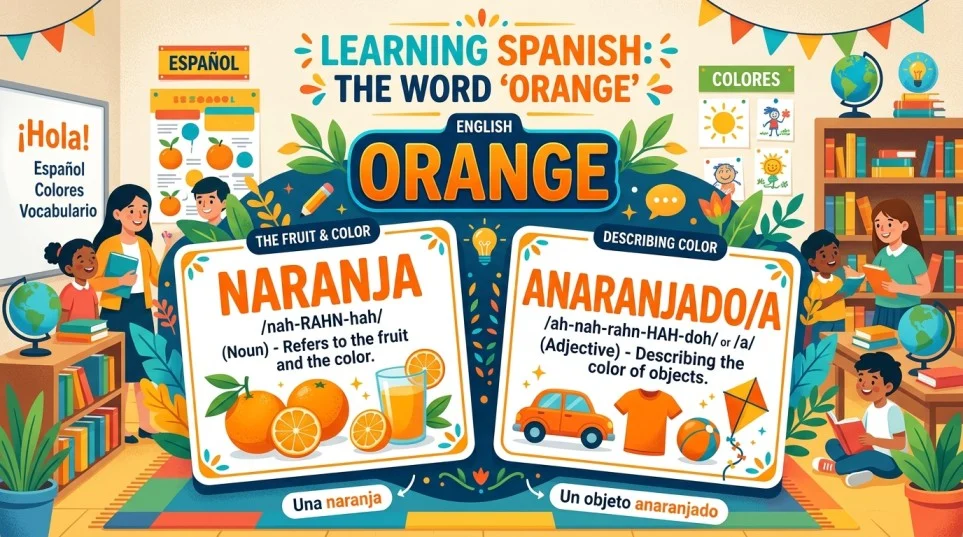
Quick Answer: The word orange in Spanish is usually “naranja.”
- Naranja = orange (the fruit)
- Naranja = orange (the color)
Examples
| English | Spanish |
|---|---|
| Orange fruit | Naranja |
| Orange color | Color naranja |
| Orange juice | Jugo de naranja |
Sometimes Spanish speakers also use “anaranjado” to describe something orange-colored.
Pronunciation
Naranja = nah-RAHN-hah
Quick Example Sentence
Mi camiseta es naranja.
My shirt is orange.
If you are learning Spanish, one of the first color and fruit words you’ll encounter is orange. At first glance, the translation seems simple. However, Spanish uses different words depending on whether you mean the fruit, the color, or a descriptive shade.
That’s where many beginners get confused.
The most common Spanish word for orange is naranja. You’ll hear it in classrooms, restaurants, markets, songs, and daily conversations across Spanish-speaking countries. In some situations, people also use anaranjado when talking about the color orange.
Understanding the difference matters because Spanish vocabulary changes based on grammar, context, and regional speech patterns.
In this detailed guide, you’ll learn:
- The exact orange in Spanish meaning
- How to say orange in Spanish naturally
- The difference between naranja and anaranjado
- Pronunciation tips for beginners
- Spanish examples with translations
- Color vocabulary tables
- Fruit names in Spanish
- Common mistakes learners make
- Conversational phrases using orange in Spanish
By the end, you’ll confidently understand the Spanish meaning of orange in both written and spoken conversations.
What Does Orange Mean in Spanish?
The word orange in Spanish usually translates to:
| English | Spanish | Usage |
|---|---|---|
| Orange | Naranja | Fruit and color |
| Orange-colored | Anaranjado | Descriptive color adjective |
The Spanish word naranja can refer to both:
- The orange fruit
- The orange color
Examples
| English Sentence | Spanish Translation |
|---|---|
| I ate an orange. | Comí una naranja. |
| The car is orange. | El coche es naranja. |
| She likes orange clothes. | A ella le gusta la ropa naranja. |
Spanish speakers often use naranja directly as a color word without changing its form.
That makes it slightly different from English grammar.
How to Say Orange in Spanish
The standard Spanish word for orange is:
Naranja
Pronunciation
nah-RAHN-hah
The stress falls on the middle syllable.
Simple Pronunciation Breakdown
| Part | Sound |
|---|---|
| Na | “nah” |
| Ran | “rahn” |
| Ja | soft “hah” |
The Spanish letter j sounds like a soft English “h.”
For example:
- Jalapeño
- José
- Jugar
All use that same breathy sound.
Orange Translation in Spanish Explained
Many English learners expect one exact translation for every word. Spanish works differently.
The orange translation in Spanish depends on context.
When Talking About the Fruit
Use:
Naranja
Example:
Quiero una naranja.
I want an orange.
When Talking About the Color
You can use:
- Naranja
- Anaranjado
Both are correct in many situations.
Difference Between Naranja and Anaranjado
This is one of the biggest questions in Spanish vocabulary learning.
Naranja
Used as:
- A noun
- A color name
Example:
La camisa es naranja.
The shirt is orange.
Anaranjado
Used mainly as:
- A descriptive adjective
- A shade description
Example:
El cielo anaranjado se veía hermoso.
The orange-colored sky looked beautiful.
Which Word Is More Common?
In everyday speech, naranja is far more common.
Most native speakers simply say:
- coche naranja
- camisa naranja
- flor naranja
Instead of:
- coche anaranjado
However, anaranjado appears more often in:
- Literature
- Art descriptions
- Formal writing
- Detailed color descriptions
Meaning of Naranja in English
The word naranja in English means:
| Spanish Word | English Meaning |
|---|---|
| Naranja | Orange |
It can describe:
- The fruit
- The color
Example Sentences
| Spanish | English |
|---|---|
| La naranja está dulce. | The orange is sweet. |
| El balón es naranja. | The ball is orange. |
| Compré jugo de naranja. | I bought orange juice. |
How Do You Pronounce Naranja?
Many beginners struggle with Spanish pronunciation because Spanish sounds differ from English.
Correct Pronunciation
nah-RAHN-hah
Common Mistakes
| Incorrect | Correct |
|---|---|
| nuh-ran-ja | nah-RAHN-hah |
| نارنجا style hard j | soft h sound |
| na-ran-zha | use “h” sound |
Helpful Tip
Pretend the letter j sounds like a gentle exhale.
That instantly improves your pronunciation.
Orange Color in Spanish
When discussing colors in Spanish, orange usually becomes:
Color Naranja
Example:
Mi color favorito es naranja.
My favorite color is orange.
Color Vocabulary Table
| English Color | Spanish Translation |
|---|---|
| Red | Rojo |
| Blue | Azul |
| Green | Verde |
| Yellow | Amarillo |
| Orange | Naranja |
| Purple | Morado |
| Pink | Rosa |
| Black | Negro |
| White | Blanco |
Fruit Orange in Spanish
The fruit orange in Spanish is:
Naranja
Example Sentences
| English | Spanish |
|---|---|
| Orange juice | Jugo de naranja |
| Orange tree | Árbol de naranja |
| Sweet orange | Naranja dulce |
| Peel the orange | Pela la naranja |
Spanish Word for Orange in Everyday Conversations
Spanish speakers use orange vocabulary naturally in daily life.
At the Grocery Store
¿Cuánto cuesta la naranja?
How much does the orange cost?
Talking About Colors
Me gusta el color naranja.
I like the color orange.
Ordering Juice
Quiero jugo de naranja.
I want orange juice.
Orange in Spanish Language and Grammar Rules
Spanish grammar treats colors differently than English.
Some colors change form based on gender and number.
For example:
| Masculine | Feminine |
|---|---|
| Rojo | Roja |
| Negro | Negra |
However, naranja usually stays the same.
Examples
| Singular | Plural |
|---|---|
| Camisa naranja | Camisas naranja |
| Zapato naranja | Zapatos naranja |
Notice how naranja does not change.
Why Doesn’t Naranja Change?
Because the word originally comes from a noun.
Spanish color nouns often remain unchanged.
Other examples include:
| Color | Translation |
|---|---|
| Rosa | Pink |
| Violeta | Violet |
| Naranja | Orange |
What Does Orange Mean in Spanish Culture?
Colors carry symbolic meaning in many cultures. Spanish-speaking countries also associate orange with different emotions and traditions.
Common Associations of Orange
| Symbolism | Meaning |
|---|---|
| Energy | Excitement |
| Warmth | Happiness |
| Creativity | Imagination |
| Autumn | Seasonal beauty |
| Citrus fruit | Freshness |
Orange often appears during:
- Festivals
- Summer celebrations
- Sports branding
- Food marketing
- Holiday decorations
Anaranjado Meaning in Spanish
The word anaranjado means:
Orange-colored
It works more like a traditional adjective.
Examples
| Spanish | English |
|---|---|
| Un gato anaranjado | An orange-colored cat |
| Un cielo anaranjado | An orange sky |
| Hojas anaranjadas | Orange leaves |
Unlike naranja, the adjective can change form.
Gender Forms of Anaranjado
| Masculine | Feminine | Plural |
|---|---|---|
| Anaranjado | Anaranjada | Anaranjados |
Example Sentences
| Spanish | English |
|---|---|
| El coche anaranjado | The orange car |
| La flor anaranjada | The orange flower |
| Los globos anaranjados | The orange balloons |
Translate Orange to Spanish Correctly
Many translation tools simply show “naranja.”
That works most of the time.
Still, advanced learners should know both forms.
Quick Translation Guide
| English Phrase | Correct Spanish |
|---|---|
| Orange fruit | Naranja |
| Orange color | Naranja |
| Orange-colored object | Anaranjado |
Spanish Pronunciation Guide for Orange Words
Pronunciation matters in Spanish because small changes create different meanings.
Pronunciation Table
| Word | Pronunciation |
|---|---|
| Naranja | nah-RAHN-hah |
| Anaranjado | ah-nah-rahn-HAH-doh |
| Jugo | HOO-goh |
| Color | koh-LOHR |
Common Spanish Phrases Using Orange
Everyday Phrases
| Spanish Phrase | English Meaning |
|---|---|
| Jugo de naranja | Orange juice |
| Color naranja | Orange color |
| Una naranja dulce | A sweet orange |
| Camisa naranja | Orange shirt |
| Flor naranja | Orange flower |
Orange Spanish Translation in Different Situations
Context changes translation choices.
Food Context
Use:
- naranja
Example:
La naranja está fresca.
The orange is fresh.
Art and Design Context
Use:
- anaranjado
Example:
El tono anaranjado combina bien.
The orange shade matches well.
Spanish Vocabulary Colors Every Beginner Should Know
Learning colors speeds up Spanish fluency.
Basic Spanish Color Vocabulary
| English | Spanish |
|---|---|
| Orange | Naranja |
| Red | Rojo |
| Blue | Azul |
| Green | Verde |
| Gray | Gris |
| Brown | Marrón |
| Gold | Dorado |
| Silver | Plateado |
Learn Spanish Colors Faster With Associations
Memory tricks help vocabulary stick.
Easy Associations
| Spanish Word | Memory Hint |
|---|---|
| Naranja | Think “orange” fruit |
| Verde | Green vegetation |
| Azul | Blue azure sky |
| Rojo | Red roses |
Visual learning dramatically improves retention.
Fruits Names in Spanish
Fruit vocabulary helps beginners build practical language skills.
Common Fruits in Spanish
| English | Spanish |
|---|---|
| Apple | Manzana |
| Banana | Banana |
| Orange | Naranja |
| Grapes | Uvas |
| Strawberry | Fresa |
| Mango | Mango |
| Pineapple | Piña |
| Watermelon | Sandía |
Orange Fruit Translation in Spanish
The orange fruit translation in Spanish remains straightforward.
Singular and Plural
| English | Spanish |
|---|---|
| Orange | Naranja |
| Oranges | Naranjas |
Example
Compré tres naranjas.
I bought three oranges.
How Native Speakers Use Orange in Spanish
Native Spanish speakers usually keep things simple.
Instead of complicated color descriptions, they say:
- naranja
- color naranja
That sounds natural and conversational.
Native-Like Examples
Ese bolso es naranja.
That bag is orange.
Me encanta el jugo de naranja.
I love orange juice.
Orange Definition in Spanish Dictionaries
Spanish dictionaries typically define naranja as:
Fruta cítrica de color naranja.
English meaning:
A citrus fruit with orange color.
The dictionary also lists it as a color term.
English to Spanish Orange Translation Examples
Examples help language learners remember vocabulary naturally.
Translation Examples
| English Sentence | Spanish Sentence |
|---|---|
| The orange is sweet. | La naranja es dulce. |
| My shoes are orange. | Mis zapatos son naranja. |
| She painted the wall orange. | Ella pintó la pared de naranja. |
| I like orange juice. | Me gusta el jugo de naranja. |
Orange Shade in Spanish
Spanish speakers may use more specific color terms for shades.
Common Orange Shades
| English Shade | Spanish Translation |
|---|---|
| Light orange | Naranja claro |
| Dark orange | Naranja oscuro |
| Bright orange | Naranja brillante |
| Burnt orange | Naranja quemado |
Basic Spanish Words Related to Orange
Expanding vocabulary around one word improves language learning speed.
Useful Related Words
| Spanish | English |
|---|---|
| Jugo | Juice |
| Fruta | Fruit |
| Dulce | Sweet |
| Ácido | Sour |
| Cítrico | Citrus |
| Color | Color |
| Pintura | Paint |
Conversational Spanish Terms With Naranja
Casual Conversation Examples
¿Te gusta el color naranja?
Do you like the orange color?
Prefiero las naranjas dulces.
I prefer sweet oranges.
El atardecer estaba anaranjado.
The sunset looked orange.
Common Mistakes When Translating Orange to Spanish
Beginners often make avoidable errors.
Mistake Using “Anaranjado” Everywhere
While correct, it can sound overly formal.
Native speakers usually prefer:
- naranja
Mistake Changing Naranja Endings
Incorrect:
- naranjo
- naranjas for colors
Correct:
- naranja
Mistake Pronouncing the J Incorrectly
Remember:
- j = soft h sound
How Children Learn Orange in Spanish
Children usually learn vocabulary through visuals.
Teachers use:
- Fruit flashcards
- Color games
- Songs
- Repetition
- Object matching
Example Classroom Sentence
La naranja es naranja.
The orange is orange.
It sounds funny in English but works perfectly in Spanish.
Why Orange Vocabulary Matters in Spanish Learning
Color vocabulary appears everywhere.
You’ll hear orange-related words in:
- Restaurants
- Shopping
- Travel
- Art
- Fashion
- Sports
- School
- Advertising
Learning common words like naranja builds real-world fluency faster than memorizing rare vocabulary.
Quick Comparison Between Naranja and Anaranjado
| Feature | Naranja | Anaranjado |
|---|---|---|
| Fruit meaning | Yes | No |
| Color meaning | Yes | Yes |
| Everyday speech | Very common | Less common |
| Changes form | Usually no | Yes |
| Formal descriptions | Sometimes | Often |
Spanish Learning Tips for Remembering Orange Vocabulary
Use Visual Memory
Picture an actual orange fruit every time you hear:
- naranja
Practice Speaking Daily
Say simple phrases aloud:
- color naranja
- jugo de naranja
- camisa naranja
Learn Through Categories
Group vocabulary together:
- colors
- fruits
- foods
That improves long-term memory.
Fun Facts About the Word Naranja
The Word Has Arabic Origins
The Spanish word comes from the Arabic term:
- nāranj
Language history traveled through trade routes over centuries.
English and Spanish Share Similar Roots
Many European languages adapted similar versions:
| Language | Word |
|---|---|
| Spanish | Naranja |
| Italian | Arancia |
| Portuguese | Laranja |
Orange Color Meaning in Design and Branding
Orange attracts attention quickly.
Brands use orange to represent:
- Energy
- Fun
- Appetite
- Creativity
- Positivity
That explains why orange appears in:
- Food logos
- Sports branding
- Advertising campaigns
Common Questions About Orange in Spanish Meaning
Is Naranja Masculine or Feminine?
As a fruit noun, it is feminine:
La naranja
Can Naranja Mean Both Fruit and Color?
Yes.
Context determines meaning.
Is Anaranjado More Correct?
Not necessarily.
Both work correctly depending on context.
Which Word Sounds More Natural?
Most native speakers use:
- naranja
Easy Practice Sentences for Beginners
Beginner Examples
| Spanish | English |
|---|---|
| La naranja es rica. | The orange is tasty. |
| Mi mochila es naranja. | My backpack is orange. |
| Compré jugo de naranja. | I bought orange juice. |
| El sol parece anaranjado. | The sun looks orange. |
Mini Spanish Vocabulary Lesson Using Orange
Useful Sentence Patterns
| Pattern | Example |
|---|---|
| Es + color | Es naranja |
| Me gusta + noun | Me gusta la naranja |
| Quiero + noun | Quiero una naranja |
These structures appear constantly in Spanish conversations.
Orange in Spanish Meaning for Beginners
If you remember only one thing from this guide, remember this:
Orange in Spanish = Naranja
That single word covers:
- The fruit
- The color
Meanwhile:
Anaranjado
Means:
- Orange-colored
- Orangish
Both are correct. Native speakers simply choose based on context and speaking style.
Final Thoughts on Orange Meaning in Spanish
Learning the orange meaning in Spanish opens the door to everyday communication. The word naranja appears constantly in conversations about food, colors, shopping, art, and daily life.
Beginners often think translations are always one-to-one. Spanish proves otherwise. Context shapes meaning. That’s why understanding both naranja and anaranjado gives you a stronger command of natural Spanish.
Start with simple phrases. Practice pronunciation daily. Use the words in real conversations. Before long, these expressions will feel automatic.
Spanish becomes much easier when you learn vocabulary through practical examples instead of memorizing isolated definitions.
And honestly, few beginner words are more useful than naranja.
Discover More:-
- Raise Your Ya Ya Ya Meaning: The Complete Guide to the Viral Phrase, Slang Use, TikTok Trend, and Cultural Meaning
- What Does POV Mean on TikTok? Full Meaning, Examples, and Trends Explained