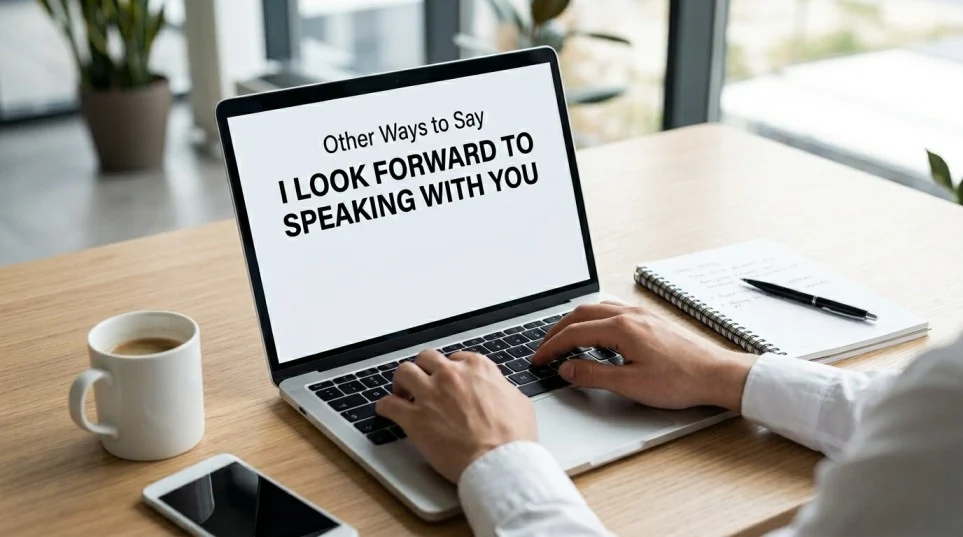
Quick Ans: If you’re looking for other ways to say “I look forward to speaking with you,” try: I look forward to our conversation, I’m eager to speak with you, I look forward to connecting, I’m excited to discuss this with you, I anticipate our discussion. These alternatives help you sound more professional, natural, and engaging.
The phrase “I look forward to speaking with you” is commonly used in emails and professional communication to express anticipation for a future conversation.
However, using the same phrase repeatedly can feel repetitive. Learning alternatives to this phrase allows you to vary your tone and sound more fluent in different situations.
These options are especially helpful when you want to express excitement in English while maintaining a professional tone.
“Professional communication improves when you vary your language thoughtfully.”
Quick Categories Section
Formal Alternatives
- I look forward to our discussion
- I anticipate our conversation
- I await our meeting
- I look forward to connecting with you
Pro Tip: Ideal for formal emails, interviews, and business communication.
Casual Alternatives
- Can’t wait to chat
- Looking forward to talking
- Excited to speak soon
- Talk to you soon
Pro Tip: Use these with colleagues you know well or informal contexts.
Professional Alternatives
- I look forward to discussing this further
- I am eager to connect
- I look forward to our meeting
- I anticipate speaking with you
Pro Tip: Keep your tone polite and confident in workplace communication.
Informal Expressions
- Catch up soon
- Let’s chat soon
- Speak soon
- Looking forward to it
Pro Tip: Best for relaxed or friendly conversations.
“The right closing line leaves a strong professional impression.”
Common Mistakes Section
- Overusing the same phrase
Incorrect: Repeating it in every email
Better: Use varied alternatives - Using overly casual tone in formal emails
Incorrect: Can’t wait to chat!
Better: I look forward to our discussion. - Incorrect grammar structure
Incorrect: I look forward to speak with you
Correct: I look forward to speaking with you - Being too vague
Incorrect: Looking forward to it
Better: I look forward to discussing the project - Using overly complex wording
Incorrect: Long formal sentence
Better: Clear and concise phrasing
What Does “I Look Forward to Speaking With You” Mean?
Definition:
It expresses anticipation and positive expectation for a future conversation.
Grammar Note:
“Look forward to” is followed by a gerund (-ing verb), not the base verb.
Example:
I look forward to speaking with you tomorrow.
When to Use This Phrase
- Email closings
- Job interview communication
- Professional follow-ups
- Scheduling meetings
Spoken vs Written: Mostly written
Formal vs Informal: Semi-formal
Is It Professional or Polite to Use This Phrase?
- Polite? ✔️ Yes
- Professional? ✔️ Yes
Business Example:
I look forward to discussing this opportunity with you.
“Clarity and tone define professional English.”
Pros and Cons of Using This Phrase
Pros
- Polite and professional
- Widely accepted
- Clear meaning
- Easy to use
Cons
- Overused
- Can feel repetitive
- Lacks personality
- Limited tone variation
Other Ways to Say “I Look Forward to Speaking With You” (With Examples)
These alternatives will help you sound more fluent, confident, and natural in different situations.
Use them based on tone, context, and audience.
1. I look forward to our conversation
Meaning: Anticipating a discussion
Explanation: Professional and clear
Example Sentence: I look forward to our conversation tomorrow.
Best Use: Emails
Worst Use: Casual chat
Tone: Professional
Context Variability: professional
2. I am eager to speak with you
Meaning: Showing enthusiasm
Explanation: Slightly more energetic tone
Example Sentence: I am eager to speak with you about this role.
Best Use: Interviews
Worst Use: Informal talk
Tone: Positive, professional
Context Variability: professional
3. I look forward to connecting with you
Meaning: Anticipating contact
Explanation: Modern business phrase
Example Sentence: I look forward to connecting with you soon.
Best Use: Networking
Worst Use: Casual
Tone: Professional
Context Variability: professional
4. I am excited to discuss this with you
Meaning: Expressing enthusiasm
Explanation: Friendly professional tone
Example Sentence: I am excited to discuss this project with you.
Best Use: Semi-formal
Worst Use: Formal reports
Tone: Friendly
Context Variability: professional
5. I anticipate our discussion
Meaning: Expecting conversation
Explanation: Formal tone
Example Sentence: I anticipate our discussion next week.
Best Use: Formal emails
Worst Use: Casual talk
Tone: Formal
Context Variability: professional
6. I look forward to our meeting
Meaning: Expecting meeting
Explanation: Very common workplace phrase
Example Sentence: I look forward to our meeting on Monday.
Best Use: Work
Worst Use: Informal
Tone: Professional
Context Variability: professional
7. I am looking forward to our chat
Meaning: Casual anticipation
Explanation: Slightly informal
Example Sentence: I am looking forward to our chat later.
Best Use: Casual work
Worst Use: Formal
Tone: Friendly
Context Variability: casual
8. I can’t wait to speak with you
Meaning: Strong excitement
Explanation: Informal expression
Example Sentence: I can’t wait to speak with you!
Best Use: Friends
Worst Use: Business
Tone: Informal
Context Variability: casual
9. I look forward to discussing this further
Meaning: Continue discussion
Explanation: Professional tone
Example Sentence: I look forward to discussing this further.
Best Use: Work emails
Worst Use: Casual
Tone: Professional
Context Variability: professional
10. I am eager to connect
Meaning: Willing to communicate
Explanation: Modern business tone
Example Sentence: I am eager to connect soon.
Best Use: Networking
Worst Use: Casual
Tone: Professional
Context Variability: professional
11. I look forward to speaking soon
Meaning: Upcoming conversation
Explanation: Simple and clear
Example Sentence: I look forward to speaking soon.
Best Use: General
Worst Use: Informal jokes
Tone: Neutral
12. I am excited to connect with you
Meaning: Positive anticipation
Example Sentence: I am excited to connect with you.
Best Use: Networking
Worst Use: Formal
Tone: Friendly
13. I look forward to our upcoming discussion
Meaning: Future meeting
Example Sentence: I look forward to our upcoming discussion.
Best Use: Business
Worst Use: Casual
Tone: Professional
14. I am keen to speak with you
Meaning: Interested in talking
Example Sentence: I am keen to speak with you soon.
Best Use: UK English/business
Worst Use: Informal
Tone: Professional
15. I look forward to our call
Meaning: Scheduled call
Example Sentence: I look forward to our call tomorrow.
Best Use: Meetings
Worst Use: Casual
Tone: Professional
16. I’m happy to discuss this with you
Meaning: Willingness
Example Sentence: I’m happy to discuss this with you.
Best Use: Work
Worst Use: Informal slang
Tone: Polite
17. I am ready to speak with you
Meaning: Prepared
Example Sentence: I am ready to speak with you at your convenience.
Best Use: Formal
Worst Use: Casual
Tone: Formal
18. I look forward to talking with you
Meaning: Anticipation
Example Sentence: I look forward to talking with you soon.
Best Use: General
Worst Use: Formal reports
Tone: Neutral
19. I would be glad to speak with you
Meaning: Polite willingness
Example Sentence: I would be glad to speak with you.
Best Use: Formal
Worst Use: Casual
Tone: Polite
20. I’m excited for our conversation
Meaning: Enthusiasm
Example Sentence: I’m excited for our conversation.
Best Use: Semi-formal
Worst Use: Formal
Tone: Friendly
21. I look forward to hearing from you soon
Meaning: Awaiting reply
Example Sentence: I look forward to hearing from you soon.
Best Use: Emails
Worst Use: Calls
Tone: Professional
22. I hope to speak with you soon
Meaning: Expectation
Example Sentence: I hope to speak with you soon.
Best Use: General
Worst Use: Formal contracts
Tone: Neutral
23. Let’s connect soon
Meaning: Suggesting contact
Example Sentence: Let’s connect soon.
Best Use: Networking
Worst Use: Formal
Tone: Informal
24. Speak with you soon
Meaning: Closing phrase
Example Sentence: Speak with you soon.
Best Use: Casual
Worst Use: Formal
Tone: Informal
25. I am looking forward to speaking
Meaning: Short version
Example Sentence: I am looking forward to speaking tomorrow.
Best Use: Emails
Worst Use: Casual
Tone: Professional
26. I am excited to talk with you
Meaning: Enthusiastic tone
Example Sentence: I am excited to talk with you about this.
Best Use: Semi-formal
Worst Use: Formal
Tone: Friendly
27. I would welcome the opportunity to speak
Meaning: Formal willingness
Example Sentence: I would welcome the opportunity to speak with you.
Best Use: Formal
Worst Use: Casual
Tone: Formal
28. I look forward to engaging with you
Meaning: Professional interaction
Example Sentence: I look forward to engaging with you soon.
Best Use: Corporate
Worst Use: Casual
Tone: Formal
29. I am pleased to arrange a conversation
Meaning: Formal arrangement
Example Sentence: I am pleased to arrange a conversation.
Best Use: Formal
Worst Use: Casual
Tone: Formal
30. I am looking forward to our discussion
Meaning: Anticipation
Example Sentence: I am looking forward to our discussion.
Best Use: Business
Worst Use: Casual
Tone: Professional
“Strong communication starts with the right closing phrase.”
Mini Quiz / Self-Check
1. Which is most formal?
A. Can’t wait to chat
B. I would welcome the opportunity to speak
C. Speak soon
Answer: B
2. Which is most casual?
A. I anticipate our discussion
B. Let’s connect soon
C. I would be glad to speak
Answer: B
3. Best for workplace email?
A. I look forward to discussing this further
B. Can’t wait to talk
C. Speak soon
Answer: A
Comparison Table: Top Alternatives
| Phrase | Tone | Best Use |
|---|---|---|
| I look forward to our conversation | Professional | |
| I am eager to speak with you | Professional | Interview |
| I look forward to connecting | Modern | Networking |
| I anticipate our discussion | Formal | Business |
| I look forward to our meeting | Professional | Work |
| Let’s connect soon | Casual | Networking |
| Speak soon | Informal | Chat |
| I would be glad to speak | Formal | Business |
| I am excited to discuss this | Friendly | Semi-formal |
| I look forward to our call | Professional | Meetings |
FAQs
1. What are alternatives to this phrase?
You can say I am eager to connect, I anticipate our discussion, or I look forward to our meeting.
2. Is the original phrase professional?
Yes, it is widely accepted in business communication.
3. What is the most formal alternative?
I would welcome the opportunity to speak with you.
4. Can I use casual phrases in emails?
Avoid casual phrases in formal emails.
5. Why learn alternatives?
It improves fluency and helps vary tone in communication.
Conclusion
Learning other ways to say I look forward to speaking with you helps you communicate more effectively and professionally. It also prevents repetition and improves tone variety.
Practice these phrases to sound more confident and natural in English.
See also: Other Ways to Say “Please Let Me Know”
See also: Professional Email Closing Phrases
CTA: Try using 3 new alternatives in your next email.
Discover More:-
- Other Ways to Say You As Well (30+ Examples)
- Other Ways to Say Thank You for Letting Me Know (30 Examples)