
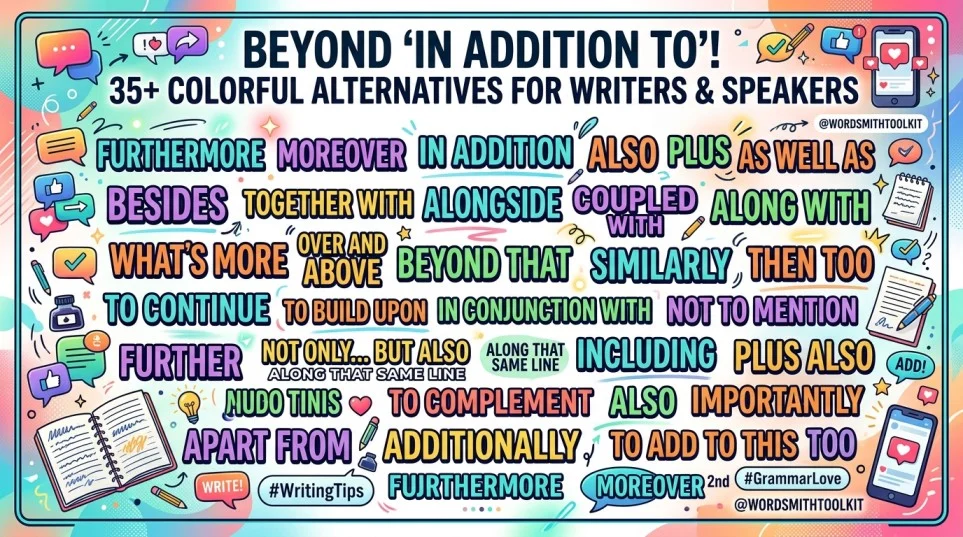
Quick Ans: Looking for better ways to say “in addition to”? Whether you’re writing emails, essays, social media captions, business reports, or everyday messages, using fresh alternatives can make your writing sound more natural, polished, and engaging.
Top alternatives: Additionally, Besides, As Well As, Along With, Furthermore
Ever find yourself using “in addition to” over and over again? You’re not alone. Whether you’re drafting a work email, writing a school assignment, posting on LinkedIn, or sending a thoughtful message, repeating the same phrase can make your writing feel a little stale.
That’s where smart alternatives come in. Finding better other ways to say in addition to helps your sentences flow more naturally while making your writing sound more professional, conversational, persuasive, or creative.
The good news? There isn’t just one replacement. Depending on the situation, you can sound formal, casual, confident, academic, friendly, or even dramatic. This guide gives you plenty of ready-to-use alternatives so you’ll never get stuck using the same phrase repeatedly. Let’s upgrade your vocabulary and make every sentence a little more interesting.
Formal Alternatives
Additionally
Example: Used in a business proposal.
Meaning: Adds another important point professionally.
Furthermore
Example: Used in a report.
Meaning: Introduces extra supporting information.
Moreover
Example: Used in academic writing.
Meaning: Strengthens the previous statement.
Likewise
Example: Used in professional correspondence.
Meaning: Adds a related idea.
As Well As
Example: Used in presentations.
Meaning: Includes another item or point.
Along With
Example: Used in formal announcements.
Meaning: Indicates something included together.
Coupled With
Example: Used in business documents.
Meaning: Combines two contributing factors.
Not To Mention
Example: Used in persuasive writing.
Meaning: Adds an extra noteworthy point.
Supplementing
Example: Used in reports.
Meaning: Provides additional support.
Complementing
Example: Used in proposals.
Meaning: Adds something that enhances another thing.
Over And Above
Example: Used in contracts.
Meaning: Indicates something extra.
Added To That
Example: Used in speeches.
Meaning: Introduces another consideration.
Together With
Example: Used in official notices.
Meaning: Combines related items.
Beyond That
Example: Used in summaries.
Meaning: Introduces further information.
What’s More
Example: Used in business presentations.
Meaning: Highlights another valuable point.
Casual Alternatives
Plus
Example: Used in everyday texting.
Meaning: Adds another reason or item.
And Also
Example: Used in friendly conversations.
Meaning: Includes an extra point.
Besides
Example: Used while chatting with friends.
Meaning: Adds another consideration.
On Top Of That
Example: Used in casual storytelling.
Meaning: Highlights an additional benefit.
Not Only That
Example: Used in social posts.
Meaning: Emphasizes another point.
Also
Example: Used in everyday writing.
Meaning: Adds information simply.
Too
Example: Used in text messages.
Meaning: Includes something else.
As Well
Example: Used in casual emails.
Meaning: Means “also.”
By The Way
Example: Used during conversations.
Meaning: Adds related information.
Then There’s
Example: Used while listing reasons.
Meaning: Introduces another item.
Don’t Forget
Example: Used in reminders.
Meaning: Adds something important.
Another Thing
Example: Used in discussions.
Meaning: Introduces a new point.
Oh, And
Example: Used in texts.
Meaning: Adds information casually.
Even Better
Example: Used in recommendations.
Meaning: Adds a positive extra point.
Plus, You Get
Example: Used in reviews.
Meaning: Highlights an added benefit.
Academic Alternatives
Furthermore
Example: Used in research papers.
Meaning: Adds supporting evidence.
Moreover
Example: Used in essays.
Meaning: Strengthens an argument.
Additionally
Example: Used in scholarly articles.
Meaning: Introduces extra information.
In Conjunction With
Example: Used in academic reports.
Meaning: Indicates something working together.
Together With
Example: Used in studies.
Meaning: Combines related elements.
Correspondingly
Example: Used in analysis.
Meaning: Adds a related point.
Similarly
Example: Used in comparisons.
Meaning: Introduces a matching idea.
Equally Important
Example: Used in essays.
Meaning: Highlights another significant point.
Coupled With
Example: Used in research findings.
Meaning: Connects contributing factors.
Supplemented By
Example: Used in case studies.
Meaning: Supported by something additional.
Accompanied By
Example: Used in reports.
Meaning: Included alongside something else.
Beyond This
Example: Used in conclusions.
Meaning: Adds another dimension.
Further To This
Example: Used in discussions.
Meaning: Expands the topic.
Added To These Findings
Example: Used in papers.
Meaning: Introduces more evidence.
In Addition
Example: Used in formal writing.
Meaning: Adds another point directly.
Professional Alternatives
Additionally
Example: Used in workplace emails.
Meaning: Adds another professional point.
Further
Example: Used in reports.
Meaning: Introduces more information.
Alongside
Example: Used in project plans.
Meaning: Indicates parallel inclusion.
Together With
Example: Used in updates.
Meaning: Combines related items.
As Well As
Example: Used in proposals.
Meaning: Includes another factor.
Complemented By
Example: Used in presentations.
Meaning: Enhanced by another element.
Paired With
Example: Used in strategies.
Meaning: Combines two components.
Supported By
Example: Used in recommendations.
Meaning: Reinforced through additional factors.
Beyond That
Example: Used in meetings.
Meaning: Introduces another point.
Further To That
Example: Used in correspondence.
Meaning: Adds information professionally.
Notably
Example: Used in summaries.
Meaning: Highlights an additional detail.
Importantly
Example: Used in reports.
Meaning: Signals another key point.
Combined With
Example: Used in business plans.
Meaning: Shows two elements together.
Added Benefit
Example: Used in sales materials.
Meaning: Introduces an extra advantage.
What’s More
Example: Used in presentations.
Meaning: Adds emphasis to a benefit.
Creative Alternatives
And The Plot Thickens
Example: Used in storytelling.
Meaning: Adds an interesting twist.
The Bonus?
Example: Used in blogs.
Meaning: Introduces extra value.
Here’s The Cherry On Top
Example: Used in lifestyle content.
Meaning: Highlights a final benefit.
As If That Wasn’t Enough
Example: Used in reviews.
Meaning: Adds another impressive point.
The Best Part?
Example: Used in marketing content.
Meaning: Introduces a standout benefit.
That’s Not All
Example: Used in promotions.
Meaning: Signals more to come.
The Fun Continues
Example: Used in event descriptions.
Meaning: Adds more exciting details.
And There’s More
Example: Used in articles.
Meaning: Continues a list.
Another Win
Example: Used in recommendations.
Meaning: Introduces another advantage.
One More Thing
Example: Used in storytelling.
Meaning: Adds an extra detail.
To Sweeten The Deal
Example: Used in promotions.
Meaning: Highlights an added benefit.
As A Bonus
Example: Used in content writing.
Meaning: Introduces something extra.
Here’s The Kicker
Example: Used in blogs.
Meaning: Adds a surprising point.
Leveling It Up
Example: Used in gaming content.
Meaning: Adds improvement or value.
The Extra Spark
Example: Used in creative writing.
Meaning: Enhances the main point.
Friendly Alternatives
Plus
Example: Used in messages.
Meaning: Adds something casually.
And Another Thing
Example: Used in chats.
Meaning: Introduces more information.
Also
Example: Used with friends.
Meaning: Adds another point.
Besides That
Example: Used in discussions.
Meaning: Adds extra reasoning.
Not To Mention
Example: Used in conversations.
Meaning: Adds a memorable detail.
Too
Example: Used in texts.
Meaning: Means “also.”
As Well
Example: Used in friendly emails.
Meaning: Includes another item.
And Hey
Example: Used casually.
Meaning: Adds something informally.
Oh, Plus
Example: Used while texting.
Meaning: Introduces another thought.
While We’re At It
Example: Used in conversations.
Meaning: Adds related information.
Let’s Not Forget
Example: Used in discussions.
Meaning: Highlights another point.
On Top Of Everything
Example: Used in storytelling.
Meaning: Adds more details.
Another Bonus
Example: Used in recommendations.
Meaning: Introduces extra value.
Even More
Example: Used casually.
Meaning: Adds additional information.
One More Perk
Example: Used in reviews.
Meaning: Highlights another advantage.
Persuasive Alternatives
Furthermore
Example: Used in arguments.
Meaning: Strengthens your position.
Moreover
Example: Used in presentations.
Meaning: Adds convincing support.
What’s More
Example: Used in marketing.
Meaning: Highlights another benefit.
Not Only That
Example: Used in sales copy.
Meaning: Builds momentum.
Beyond That
Example: Used in proposals.
Meaning: Introduces another reason.
Added To This
Example: Used in pitches.
Meaning: Expands the argument.
Equally Important
Example: Used in presentations.
Meaning: Signals significance.
Another Key Point
Example: Used in speeches.
Meaning: Highlights an important detail.
Importantly
Example: Used in reports.
Meaning: Draws attention to value.
Even Better
Example: Used in promotions.
Meaning: Introduces a stronger benefit.
To Top It Off
Example: Used in advertising.
Meaning: Adds a final advantage.
The Real Bonus
Example: Used in marketing.
Meaning: Highlights extra value.
Better Yet
Example: Used in recommendations.
Meaning: Introduces something stronger.
A Major Plus
Example: Used in reviews.
Meaning: Emphasizes a benefit.
One More Reason
Example: Used in persuasive content.
Meaning: Adds support for a decision.
Elegant Alternatives
Alongside
Example: Used in formal writing.
Meaning: Included together.
In Tandem With
Example: Used in articles.
Meaning: Working together.
Accompanied By
Example: Used in descriptions.
Meaning: Included with something else.
Complemented By
Example: Used in reviews.
Meaning: Enhanced by another element.
Coupled With
Example: Used in editorials.
Meaning: Connected with another factor.
Together With
Example: Used in reports.
Meaning: Included jointly.
Supplemented By
Example: Used in essays.
Meaning: Supported by additional information.
In Concert With
Example: Used in formal writing.
Meaning: Acting together.
United With
Example: Used in narratives.
Meaning: Joined together.
Combined With
Example: Used in analysis.
Meaning: Added together.
Paired With
Example: Used in reviews.
Meaning: Matched with another item.
Joined By
Example: Used in descriptions.
Meaning: Accompanied by something else.
Linked With
Example: Used in articles.
Meaning: Connected to another factor.
Harmonized With
Example: Used in creative writing.
Meaning: Working smoothly together.
Enhanced By
Example: Used in product reviews.
Meaning: Improved through addition.
Business Alternatives
Additionally
Example: Used in reports.
Meaning: Adds information formally.
Further To This
Example: Used in emails.
Meaning: Expands on a point.
Alongside
Example: Used in planning.
Meaning: Included together.
Combined With
Example: Used in strategy documents.
Meaning: Joins multiple elements.
Supported By
Example: Used in proposals.
Meaning: Reinforced by evidence.
Paired With
Example: Used in presentations.
Meaning: Combines two strengths.
Supplemented By
Example: Used in reports.
Meaning: Backed by extra information.
Notably
Example: Used in executive summaries.
Meaning: Highlights another point.
Importantly
Example: Used in recommendations.
Meaning: Signals significance.
Added Value
Example: Used in marketing.
Meaning: Introduces extra benefits.
Further Benefits Include
Example: Used in proposals.
Meaning: Lists additional advantages.
Complemented By
Example: Used in reviews.
Meaning: Enhanced by another feature.
Accompanied By
Example: Used in documentation.
Meaning: Included alongside.
Beyond This
Example: Used in meetings.
Meaning: Adds another consideration.
As Well As
Example: Used in correspondence.
Meaning: Includes something additional.
Conversational Alternatives
Plus
Example: Used while texting.
Meaning: Adds another thought.
And Also
Example: Used casually.
Meaning: Includes more information.
Oh, And
Example: Used in chats.
Meaning: Adds a side note.
Besides
Example: Used in discussions.
Meaning: Gives another reason.
Too
Example: Used in messages.
Meaning: Means “also.”
As Well
Example: Used casually.
Meaning: Adds inclusion.
Another Thing
Example: Used while talking.
Meaning: Introduces a new point.
Don’t Forget
Example: Used in reminders.
Meaning: Adds an important detail.
Not To Mention
Example: Used in conversations.
Meaning: Highlights something extra.
On Top Of That
Example: Used in stories.
Meaning: Adds more information.
Then There’s
Example: Used in lists.
Meaning: Introduces another item.
And Guess What
Example: Used excitedly.
Meaning: Adds surprising information.
While We’re Talking About It
Example: Used in discussions.
Meaning: Adds related information.
Even More
Example: Used casually.
Meaning: Introduces extra points.
Also Worth Mentioning
Example: Used in chats.
Meaning: Highlights another detail.
Strong Emphasis Alternatives
Moreover
Example: Used in persuasive writing.
Meaning: Strongly reinforces a point.
Furthermore
Example: Used in formal arguments.
Meaning: Adds weight to a statement.
What’s More
Example: Used in speeches.
Meaning: Emphasizes added value.
Not Only That
Example: Used in presentations.
Meaning: Builds momentum.
Even Better
Example: Used in recommendations.
Meaning: Introduces something stronger.
To Top It Off
Example: Used in reviews.
Meaning: Adds a final highlight.
Most Importantly
Example: Used in reports.
Meaning: Signals top priority.
Above All
Example: Used in speeches.
Meaning: Highlights the most significant point.
Equally Significant
Example: Used in essays.
Meaning: Marks another important factor.
The Biggest Bonus
Example: Used in marketing.
Meaning: Highlights major value.
Better Still
Example: Used in writing.
Meaning: Introduces an improvement.
The Real Advantage
Example: Used in reviews.
Meaning: Emphasizes a key benefit.
Another Major Benefit
Example: Used in proposals.
Meaning: Adds persuasive support.
Crucially
Example: Used in reports.
Meaning: Signals importance.
Just As Important
Example: Used in discussions.
Meaning: Highlights another essential point.
Simple Everyday Alternatives
Plus
Example: Used in daily conversation.
Meaning: Adds something extra.
Also
Example: Used in texts.
Meaning: Includes another point.
Too
Example: Used casually.
Meaning: Means “also.”
As Well
Example: Used in messages.
Meaning: Adds inclusion.
Besides
Example: Used with friends.
Meaning: Gives another reason.
And
Example: Used in simple writing.
Meaning: Connects ideas.
Not To Mention
Example: Used in conversations.
Meaning: Adds an extra detail.
Another Bonus
Example: Used in recommendations.
Meaning: Introduces added value.
One More Thing
Example: Used casually.
Meaning: Adds another point.
Oh, Plus
Example: Used while chatting.
Meaning: Introduces something extra.
And Then
Example: Used in storytelling.
Meaning: Continues information.
Don’t Forget
Example: Used in reminders.
Meaning: Adds an important note.
On Top Of That
Example: Used in discussions.
Meaning: Introduces more information.
Even More
Example: Used casually.
Meaning: Adds additional details.
By The Way
Example: Used in conversation.
Meaning: Adds a related thought.
Modern And Trendy Alternatives
Plus, That’s A Win
Example: Used on social media.
Meaning: Highlights an extra advantage.
Bonus Points For That
Example: Used online.
Meaning: Adds positive value.
And It Gets Better
Example: Used in content creation.
Meaning: Introduces more benefits.
That’s Not Even The Best Part
Example: Used in videos.
Meaning: Builds curiosity.
Extra Credit
Example: Used humorously.
Meaning: Adds another perk.
Another W For The List
Example: Used online.
Meaning: Highlights another success.
Big Plus
Example: Used in reviews.
Meaning: Emphasizes a benefit.
Low-Key A Bonus
Example: Used casually.
Meaning: Adds an understated advantage.
The Added Glow-Up
Example: Used in lifestyle content.
Meaning: Describes an improvement.
Stack That On Top
Example: Used online.
Meaning: Adds another factor.
And We’re Not Done Yet
Example: Used in posts.
Meaning: Suggests more to come.
That’s Extra Sauce
Example: Used humorously.
Meaning: Adds something valuable.
Another Green Flag
Example: Used in relationship content.
Meaning: Highlights a positive trait.
Plus, It’s Giving Value
Example: Used on social media.
Meaning: Emphasizes usefulness.
The Bonus Level
Example: Used in gaming or pop culture content.
Meaning: Represents an added reward.
FAQs
What Does “In Addition To” Mean?
It means something is being added alongside another thing, idea, or benefit.
What Is The Best Formal Alternative To “In Addition To”?
“Additionally,” “Furthermore,” and “Moreover” are excellent formal options.
Can I Use “Plus” Instead Of “In Addition To”?
Yes. “Plus” works well in casual conversations, texts, and social media posts.
What Should I Use In Professional Emails?
Try “Additionally,” “As Well As,” “Alongside,” or “Further To This.”
Is Humor Appropriate When Replacing “In Addition To”?
Absolutely. Creative phrases like “Here’s the cherry on top” or “That’s not all” can make content more engaging.
Conclusion
The phrase “in addition to” is useful, but relying on it too often can make your writing feel repetitive. Whether you’re crafting professional emails, academic papers, social media captions, blog posts, or everyday messages, having a variety of alternatives helps you communicate with more style and confidence.
From formal options like “Furthermore” and “Moreover” to casual favorites like “Plus” and “On Top Of That,” the right phrase can instantly improve your sentence flow and make your message more memorable. Save this list, bookmark it for later, and start mixing these alternatives into your writing today. The more variety you use, the more polished and engaging your communication becomes.
Discover More:-
- 200+ Other Ways to Say I Believe in an Essay That Sound More Academic
- 200+ Other Ways to Say Trial Master File for Clinical Research and Compliance