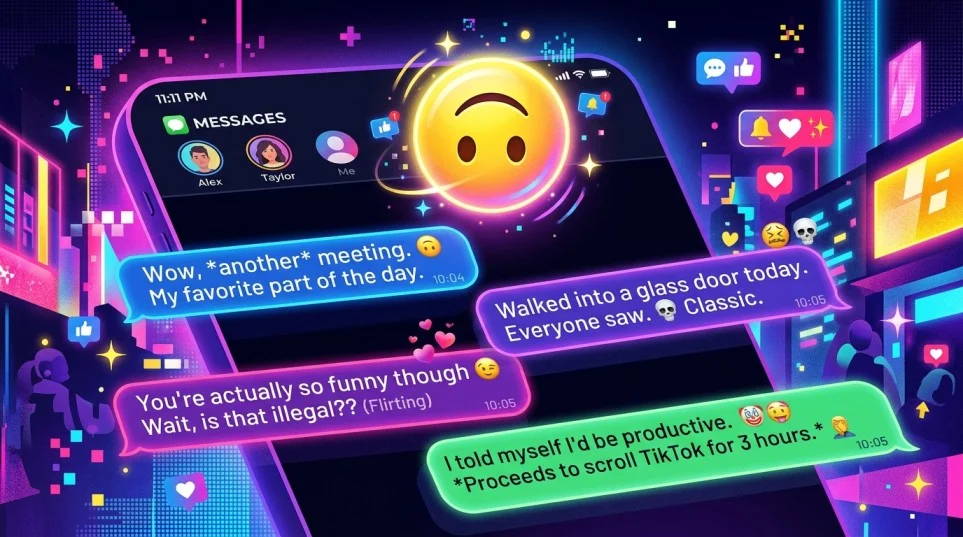
The upside down smiley emoji meaning confuses people more than almost any other emoji online. At first glance, it looks cheerful. However, the flipped face changes the emotional tone completely. Instead of pure happiness, the 🙃 emoji often carries sarcasm, awkwardness, irony, playful teasing, or hidden frustration.
That tiny upside down face has become one of the internet’s favorite emotional shortcuts. People use it when life feels chaotic. They use it after embarrassing moments. Sometimes they use it while joking with friends. Other times they use it to hide irritation behind fake positivity.
In modern texting culture, context changes everything.
For example:
“Love that for me 🙃”
That sentence can sound funny, bitter, awkward, or sarcastic depending on the situation.
The emoji became especially popular across platforms like TikTok, Snapchat, Instagram, Discord, and WhatsApp because it perfectly matches modern internet humor. It feels emotionally messy yet funny at the same time.
People rarely use 🙃 to show genuine happiness. Instead, they use it when emotions feel complicated.
This guide breaks down everything you need to know about the upside down emoji meaning, including:
- What does 🙃 mean in texting
- Sarcastic upside down emoji uses
- Upside down emoji meaning from a girl
- Upside down emoji meaning from a guy
- Flirting emoji meanings
- Passive aggressive emoji behavior
- Gen Z emoji meanings
- Emotional tone behind the upside down smiley
Let’s decode the internet’s favorite awkward little face.
What Does the Upside Down Smiley Emoji 🙃 Mean?
The upside down face emoji meaning usually falls into one of five emotional categories:
- Sarcasm
- Playfulness
- Awkwardness
- Emotional confusion
- Passive aggression
Unlike a normal smiley face, the upside down version creates emotional uncertainty. That’s exactly why people love using it.
A regular smile 🙂 feels warm and sincere.
The upside down smile 🙃 feels weird, ironic, and emotionally layered.
Sometimes it says:
“Everything is fine… but also absolutely not.”
That emotional contradiction gives the emoji its personality.
The Core Meaning of the Upside Down Emoji
The upside down emoji meaning in text often signals that someone isn’t being completely literal. They may joke about something frustrating. They may hide discomfort behind humor. Or they may tease someone playfully.
Think of the emoji like digital body language.
In real life, people use facial expressions, awkward laughs, or tone of voice to show irony. In texting, emojis replace those social signals.
The 🙃 emoji acts like:
- An awkward smile
- A sarcastic grin
- A fake cheerful reaction
- A playful eye-roll
- A “what can you do?” expression
That flexibility makes it one of the most expressive texting symbols online.
Upside Down Smiley Meaning vs Regular Smiley Meaning
The visual difference looks tiny. The emotional difference feels massive.
| Emoji | Emotional Meaning | Tone |
|---|---|---|
| 🙂 | Genuine friendliness | Warm and polite |
| 🙃 | Sarcastic friendliness | Awkward or ironic |
| 😅 | Nervous relief | Embarrassed |
| 😐 | Emotional flatness | Uncomfortable |
| 😂 | Strong laughter | Highly amused |
| 🤪 | Chaotic silliness | Wild energy |
The ironic smile emoji meaning comes entirely from the flipped expression.
Humans naturally associate upside-down visuals with disorder or emotional imbalance. That subtle psychological effect changes how the emoji feels instantly.
Why People Use the Upside Down Emoji
People use the upside down smiley because human emotions rarely stay simple.
Life gets awkward. Conversations become uncomfortable. Sometimes people laugh through stress because humor feels easier than honesty.
That’s where 🙃 shines.
Common Reasons People Use 🙃
- To soften sarcasm
- To avoid sounding rude
- To joke about bad situations
- To flirt casually
- To hide embarrassment
- To react to chaos humorously
- To express emotional confusion
- To signal fake positivity
The emoji basically says:
“I’m smiling… but something feels off.”
That emotional tension makes it relatable.
Sarcastic Upside Down Emoji Meaning
The sarcastic upside down emoji usage dominates modern texting culture.
People attach 🙃 to messages that sound technically positive but emotionally negative.
Examples of Sarcastic Emoji Meaning
- “Another amazing Monday morning 🙃”
- “Love getting ignored all day 🙃”
- “My WiFi stopped working during the meeting 🙃”
- “Totally didn’t embarrass myself 🙃”
Without the emoji, those messages might sound sincere.
With the emoji, the sarcasm becomes obvious.
Why the Emoji Works So Well for Sarcasm
Sarcasm depends on contradiction.
The words say one thing. The emotional tone says another.
The upside down smiley creates that contradiction visually.
That’s why it became one of the most recognizable emojis for sarcasm online.
Passive Aggressive Emoji Meaning
The passive aggressive emoji reputation comes from how people use fake positivity during frustrating conversations.
Sometimes 🙃 hides annoyance behind politeness.
For example:
“No worries. I’ll fix it myself 🙃”
That sentence may sound calm on the surface. Underneath, the sender probably feels irritated.
Signs the Emoji Feels Passive Aggressive
- Short replies
- Forced politeness
- Dry humor
- Tension in the conversation
- Emotional distance
- Repeated fake cheerful phrases
However, context matters enormously.
Among close friends, the emoji usually feels playful. During conflict, it can feel sharp or dismissive.
Upside Down Smiley in Texting
The upside down smiley in texting became popular because it communicates layered emotions quickly.
Text lacks facial expressions and vocal tone. Emojis help fill that emotional gap.
The upside down face works especially well when someone wants to sound:
- Funny
- Self-aware
- Casual
- Emotionally conflicted
- Slightly dramatic
- Sarcastic without sounding harsh
How People Use 🙃 in Everyday Texts
| Text Message | Likely Meaning |
|---|---|
| “Guess I’ll stay awake all night again 🙃” | Frustrated humor |
| “You forgot my birthday 🙃” | Hurt but joking |
| “I’m doing great 🙃” | Emotionally overwhelmed |
| “Sure, why not 🙃” | Reluctant agreement |
| “That was embarrassing 🙃” | Awkward self-awareness |
The emoji often softens emotional tension while still expressing it.
What Does 🙃 Mean From a Girl?
The upside down emoji meaning from a girl depends heavily on context, relationship dynamics, and conversation tone.
Most commonly, girls use 🙃 for:
- Playful teasing
- Friendly sarcasm
- Flirting
- Awkward humor
- Emotional subtlety
When It Feels Flirty
A girl may use 🙃 while joking around during playful conversations.
Examples:
- “You’re kinda annoying 🙃”
- “Maybe I missed you a little 🙃”
- “Wow, look who finally replied 🙃”
The emoji adds teasing energy without making the message feel overly serious.
When It Signals Emotional Discomfort
Sometimes the emoji hides vulnerability.
For example:
“It’s fine. I’m used to it 🙃”
That message may sound joking on the surface. Underneath, it could reflect disappointment or sadness.
Women often use the emoji as emotional cushioning. It helps soften uncomfortable feelings.
What Does 🙃 Mean From a Guy?
The upside down emoji meaning from a guy usually leans toward dry humor and casual sarcasm.
Many men use it to avoid sounding overly emotional.
Common Male Uses of 🙃
- Self-deprecating humor
- Playful teasing
- Mild embarrassment
- Flirting indirectly
- Hiding frustration with humor
Examples
- “Just failed my driving test 🙃”
- “Definitely didn’t trip in public 🙃”
- “Guess I’m surviving somehow 🙃”
The emoji helps men express emotion without making conversations feel too heavy.
Upside Down Emoji Meaning in Flirting
The upside down emoji meaning in flirting feels playful, mischievous, and low-pressure.
Unlike heart emojis, 🙃 creates teasing chemistry instead of direct romance.
That subtlety makes it popular in modern dating culture.
Why People Use 🙃 While Flirting
- It feels casual
- It avoids emotional intensity
- It creates playful tension
- It signals humor and confidence
- It keeps conversations light
Flirty Text Examples
| Message | Flirting Tone |
|---|---|
| “You’re trouble 🙃” | Playful teasing |
| “I might miss you a little 🙃” | Indirect affection |
| “Wow, someone’s popular 🙃” | Jealous teasing |
| “Guess you forgot about me 🙃” | Attention-seeking flirtation |
The emoji works because it feels emotionally indirect.
Modern flirting often relies on irony and humor rather than obvious romantic language.
Upside Down Emoji Meaning in Relationships
Inside relationships, the upside down emoji can communicate several emotions at once.
Common Relationship Uses
- Light teasing
- Mild annoyance
- Fake happiness
- Affectionate sarcasm
- Emotional awkwardness
Example
“Sure babe, take your time getting ready 🙃”
That sentence sounds playful but also impatient.
Couples often use 🙃 during emotionally complicated moments because it softens tension while still expressing emotion.
Gen Z Emoji Meanings and the Rise of Irony Culture
The upside down smiley became deeply connected to Gen Z emoji meanings and meme culture.
Younger internet users often communicate through irony layered on top of irony.
The result feels emotionally complicated but strangely relatable.
Why Gen Z Loves 🙃
Gen Z humor often includes:
- Existential jokes
- Emotional masking
- Self-aware sarcasm
- Chaotic humor
- “Smiling through pain” energy
The upside down emoji perfectly captures that emotional mix.
Instead of saying:
“I’m stressed and emotionally exhausted.”
People simply type:
“Doing amazing 🙃”
The humor becomes the coping mechanism.
Emoji Psychology Behind the Upside Down Face
The emoji psychology behind 🙃 explains why it feels emotionally different from a normal smile.
Humans instinctively recognize facial orientation.
An upside-down face appears slightly wrong. Not scary. Just emotionally off-balance.
That subtle visual discomfort creates emotional ambiguity.
Emotional Signals the Emoji Sends
- Something feels strange
- The speaker may not mean words literally
- The smile feels forced
- Humor hides discomfort
- Emotions feel mixed
That’s why the emoji works so well for awkward situations.
The Unicode History of the Upside Down Face Emoji
The Upside-Down Face Emoji officially entered Unicode in 2015.
It became part of Unicode 8.0 under the supervision of the Unicode Consortium.
Technical Details
| Detail | Information |
|---|---|
| Emoji Name | Upside-Down Face |
| Unicode Version | Unicode 8.0 |
| Release Year | 2015 |
| Unicode Code Point | U+1F643 |
Since then, nearly every major platform adopted it.
How the 🙃 Emoji Looks on Different Platforms
Different apps slightly redesign the emoji.
That subtle difference changes emotional tone.
Major Platforms Using the Upside Down Emoji
- Telegram
- Facebook Messenger
- Discord
- Snapchat
- TikTok
- X
Platform Differences
| Platform | Emoji Style |
|---|---|
| Apple | Soft and slightly awkward |
| Android | More playful |
| Neutral expression | |
| Discord | Often interpreted sarcastically |
| TikTok | Meme-heavy emotional tone |
Even tiny design changes affect interpretation.
Upside Down Emoji on Snapchat
The upside down emoji on Snapchat usually appears in playful or flirty conversations.
Snapchat culture values casual humor and teasing energy.
Common Snapchat Meanings
- Playful sarcasm
- Light flirting
- Inside jokes
- Fake dramatic reactions
- Awkward social moments
People often pair 🙃 with selfies, streak captions, or teasing replies.
Upside Down Emoji on TikTok
The upside down emoji on TikTok became part of internet irony culture.
TikTok humor often mixes:
- Depression jokes
- Chaotic humor
- Emotional exhaustion
- Fake positivity
- Self-aware memes
That emotional cocktail fits 🙃 perfectly.
Typical TikTok Caption Style
- “Mentally thriving 🙃”
- “Another sleep-deprived morning 🙃”
- “Everything’s under control 🙃”
The emoji signals that viewers should read the message ironically.
Upside Down Emoji Conversation Meaning
The upside down emoji conversation meaning changes based on emotional context.
Positive Context
- Funny
- Silly
- Playful
- Friendly
Negative Context
- Frustrated
- Passive aggressive
- Emotionally exhausted
- Bitter sarcasm
Neutral Context
- Awkward
- Emotionally uncertain
- Mildly uncomfortable
That flexibility makes the emoji difficult to interpret without reading the full conversation.
Fake Smile Emoji Text Meaning
The fake smile emoji text meaning explains one of the emoji’s most important emotional uses.
People often smile outwardly while feeling stressed internally.
The upside down face visually captures that contradiction.
Examples
- “Everything’s fine 🙃”
- “I love being ignored 🙃”
- “Another rejection email 🙃”
The smile exists. The emotional discomfort exists too.
That tension feels deeply human.
Confused But Smiling Emoji Meaning
Sometimes 🙃 reflects emotional confusion rather than sarcasm.
Emotional States Behind the Emoji
- Not knowing how to react
- Feeling awkward socially
- Processing uncomfortable news
- Laughing nervously
- Pretending to stay calm
In those moments, the upside down smile acts like emotional uncertainty in visual form.
Smiling Through Pain Emoji Culture
One reason the emoji exploded online involves “smiling through pain” humor.
People joke about stressful situations because humor creates emotional distance.
Examples of Smiling Through Pain Humor
| Situation | Example |
|---|---|
| Overwork | “Haven’t slept in 2 days 🙃” |
| Dating frustration | “Ghosted again 🙃” |
| School stress | “Three exams tomorrow 🙃” |
| Social anxiety | “Said something weird again 🙃” |
The emoji lets people acknowledge emotional discomfort without sounding overly serious.
When the Upside Down Emoji Feels Rude
Sometimes the emoji genuinely feels dismissive or rude.
Situations Where 🙃 May Feel Negative
- Arguments
- Workplace tension
- Emotional conversations
- Passive aggressive replies
- Fake polite criticism
Example
“Sure. Whatever you say 🙃”
That message can feel mocking depending on tone.
Why Misunderstandings Happen
Text strips away vocal tone.
Without facial expressions or body language, emojis carry emotional weight. Different people interpret that weight differently.
When the Upside Down Emoji Feels Friendly
Among friends, the emoji usually feels harmless.
Friendly Uses
- Goofy jokes
- Shared sarcasm
- Teasing
- Meme humor
- Self-deprecating comedy
Example
“I just walked into the wrong classroom 🙃”
That message feels funny rather than emotional.
Relationship closeness changes interpretation dramatically.
Upside Down Emoji Combinations and Their Meanings
People often combine 🙃 with other emojis to create emotional nuance.
Popular Emoji Pairings
| Emoji Combo | Meaning |
|---|---|
| 🙃😂 | Laughing through chaos |
| 🙃😭 | Emotionally overwhelmed |
| 🙃❤️ | Playful affection |
| 🙃✨ | Dramatic humor |
| 🙃😅 | Awkward embarrassment |
| 🙃👍 | Forced positivity |
| 🙃🤡 | Self-mocking humor |
| 🙃💀 | Internet-style exaggerated suffering |
Emoji combinations create layered emotional storytelling.
Difference Between 🙃 and Similar Emojis
Many emojis overlap emotionally. However, each carries a slightly different tone.
🙃 vs 🙂
| 🙂 | 🙃 |
|---|---|
| Genuine | Ironic |
| Warm | Awkward |
| Friendly | Sarcastic |
| Straightforward | Emotionally layered |
🙃 vs 🤪
| 🙃 | 🤪 |
|---|---|
| Subtle humor | Chaotic energy |
| Dry sarcasm | Wild silliness |
| Emotionally restrained | Hyperactive |
🙃 vs 😅
| 🙃 | 😅 |
|---|---|
| Irony | Nervous relief |
| Emotional contradiction | Embarrassment |
| Dry humor | Anxiety humor |
Understanding these emotional differences improves emoji interpretation.
How Different Generations Interpret 🙃
Age changes emoji interpretation dramatically.
Gen Z Interpretation
- Heavy irony
- Meme humor
- Emotional masking
- Existential jokes
Millennial Interpretation
- Sarcasm
- Awkward humor
- Playful frustration
Older Generations
Some older users interpret 🙃 literally as simple happiness.
That generational gap sometimes creates funny misunderstandings online.
When You Should Use the Upside Down Emoji
The emoji works best in casual settings.
Good Situations for 🙃
- Friendly sarcasm
- Playful teasing
- Self-deprecating jokes
- Mild frustration
- Meme humor
- Awkward situations
Situations to Avoid
- Professional complaints
- Serious emotional talks
- Sensitive arguments
- Formal work emails
- Crisis discussions
Tone confusion can create unnecessary drama.
Upside Down Emoji Examples in Real Conversations
Friendly Conversation
Friend: “Did you really forget your keys again?”
Reply: “Apparently I enjoy suffering 🙃”
Flirty Conversation
Crush: “You miss me yet?”
Reply: “Maybe a little 🙃”
Passive Aggressive Conversation
Coworker: “Can you finish my work too?”
Reply: “Sure, why not 🙃”
Awkward Conversation
Friend: “You waved at the wrong person?”
Reply: “Please erase today from existence 🙃”
Real-life context changes everything.
Why the Upside Down Emoji Became So Popular
The emoji became popular because modern communication feels emotionally layered.
People rarely express emotions directly online anymore. Instead, they use humor, irony, memes, and subtle emotional cues.
The upside down smiley captures all of that at once.
Why Internet Users Love 🙃
- It feels relatable
- It works in many situations
- It softens negativity
- It sounds emotionally intelligent
- It matches meme culture
- It expresses awkward humor naturally
The emoji basically became the mascot of:
- “I’m fine but not really.”
- “This is terrible but funny.”
- “Life feels weird.”
Frequently Asked Questions About the Upside Down Smiley Emoji Meaning
What does 🙃 mean in texting?
The emoji usually means sarcasm, awkwardness, playful teasing, emotional confusion, or ironic humor depending on context.
Is 🙃 a flirting emoji?
Yes. Many people use it during playful flirting because it feels teasing and emotionally light.
What does the upside down face emoji mean from a crush?
It often signals playful interest, teasing energy, or indirect flirting.
Is the upside down emoji passive aggressive?
Sometimes. During tense conversations, it can hide irritation behind fake positivity.
Why do people use the upside down emoji?
People use it to express layered emotions like sarcasm, awkwardness, embarrassment, or emotional contradiction.
Is 🙃 a negative emoji?
Not always. It can feel funny, playful, awkward, or sarcastic depending on context.
What does 🙃 mean on Snapchat?
Usually playful teasing, inside jokes, casual sarcasm, or flirty humor.
What does 🙃 mean on TikTok?
It often represents ironic humor, emotional exhaustion, or “smiling through pain” meme culture.
Final Thoughts on the Upside Down Smiley Emoji Meaning
The upside down smiley emoji meaning goes far beyond simple happiness.
That tiny flipped face became one of the internet’s most emotionally flexible symbols. It can express sarcasm, playful teasing, awkwardness, hidden frustration, emotional confusion, flirting, or fake positivity within seconds.
Its power comes from contradiction.
The emoji smiles while also looking emotionally off-balance. That strange mix mirrors modern internet communication perfectly.
Today, people rarely use 🙃 literally. Instead, they use it emotionally.
Sometimes it means:
- “I’m joking.”
- “I’m uncomfortable.”
- “Life is chaotic.”
- “I’m flirting.”
- “I’m frustrated but laughing anyway.”
And honestly, that emotional complexity explains why the emoji continues dominating modern texting culture.
The next time someone sends you 🙃, don’t just read the emoji.
Read the mood behind it.
Discover More:-