
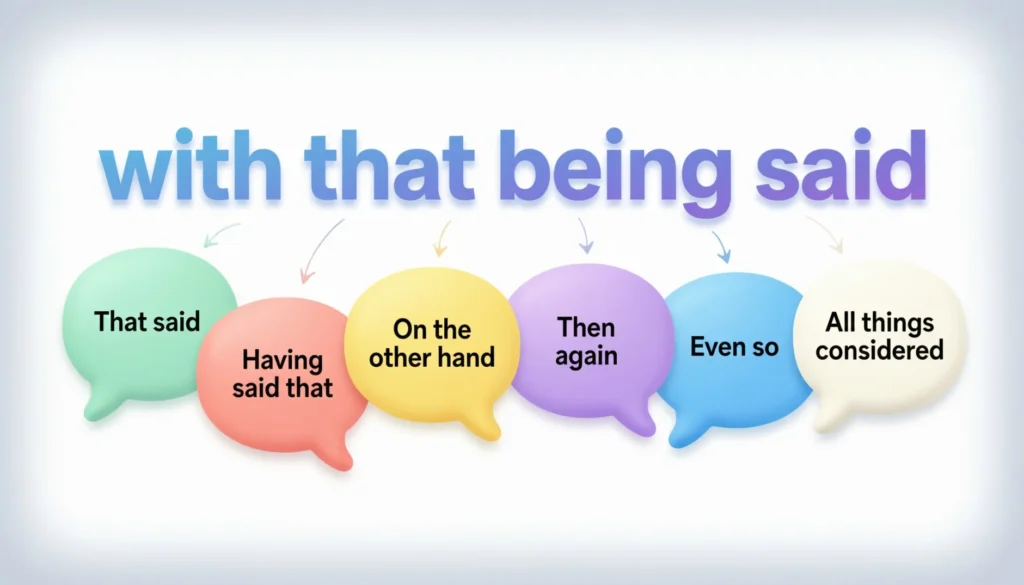
Quick Ans: Looking for other ways to say with that being said? Whether you’re writing an email, giving a presentation, posting online, or having a conversation, there are plenty of natural alternatives that sound smoother, more professional, or more casual depending on the situation.
Top alternatives: That said, Nevertheless, Even so, Having said that, All things considered
We’ve all been there. You’re writing an email, finishing a meeting, posting on LinkedIn, or making a point during a conversation, and suddenly you realize you’ve used “with that being said” for the third time in the same paragraph. It works, sure, but repeating it too often can make your writing feel stale and predictable.
The good news? There are dozens of better alternatives that can help your message sound more polished, persuasive, conversational, or professional. Whether you’re transitioning between ideas, adding a counterpoint, or wrapping up an argument, the right phrase can make your communication feel more natural and engaging.
This guide shares over 180 other ways to say with that being said, organized by tone, style, and situation so you’ll always have the perfect phrase ready to use.
Professional Alternatives
That said
Example: Used in a business report after acknowledging a challenge.
Meaning: Introduces a contrasting or balancing point professionally.
Having said that
Example: Used during a team meeting when adding another perspective.
Meaning: Softens a transition into a different viewpoint.
Nevertheless
Example: Used in workplace presentations.
Meaning: Signals persistence despite previous concerns.
Nonetheless
Example: Used in formal correspondence.
Meaning: Emphasizes that the following point still stands.
Even so
Example: Used when discussing project obstacles.
Meaning: Shows continuation despite setbacks.
With that in mind
Example: Used when moving toward a recommendation.
Meaning: Connects previous information to the next point.
In light of that
Example: Used in strategic discussions.
Meaning: References previous facts before concluding.
Considering this
Example: Used in business proposals.
Meaning: Builds on information already mentioned.
Accordingly
Example: Used in formal reports.
Meaning: Indicates a logical consequence.
As a result
Example: Used when explaining outcomes.
Meaning: Connects cause and effect.
Therefore
Example: Used in executive summaries.
Meaning: Introduces a conclusion logically.
Consequently
Example: Used in analytical writing.
Meaning: Shows a direct outcome.
On that note
Example: Used when transitioning topics during meetings.
Meaning: Moves discussion forward smoothly.
Given these points
Example: Used before summarizing findings.
Meaning: Refers back to previously discussed ideas.
Taking everything into account
Example: Used in evaluations.
Meaning: Signals a balanced conclusion.
Casual Alternatives
That being the case
Example: Used in everyday conversations.
Meaning: Refers naturally to what was just discussed.
Still
Example: Used while chatting with friends.
Meaning: Introduces a contrasting thought simply.
Even then
Example: Used during casual debates.
Meaning: Suggests the next point remains valid.
Either way
Example: Used when reaching a practical conclusion.
Meaning: Focuses on the outcome regardless.
At the same time
Example: Used while discussing pros and cons.
Meaning: Introduces another perspective.
All that said
Example: Used in social media captions.
Meaning: Summarizes before shifting direction.
Anyway
Example: Used during informal conversations.
Meaning: Smoothly changes focus.
At the end of the day
Example: Used when simplifying a discussion.
Meaning: Highlights the most important takeaway.
Still though
Example: Used in texting.
Meaning: Adds a contrasting opinion casually.
When it comes down to it
Example: Used in friendly discussions.
Meaning: Focuses on the core issue.
Bottom line
Example: Used while giving advice.
Meaning: Signals the key takeaway.
Truth be told
Example: Used in personal conversations.
Meaning: Introduces an honest perspective.
All things considered
Example: Used after reviewing options.
Meaning: Summarizes a balanced opinion.
At any rate
Example: Used while moving forward in conversation.
Meaning: Returns attention to the main point.
Regardless
Example: Used in casual decision-making.
Meaning: Indicates the outcome remains unchanged.
Formal Writing Alternatives
Be that as it may
Example: Used in academic writing.
Meaning: Introduces a contrasting point formally.
Notwithstanding
Example: Used in legal or formal documents.
Meaning: Means despite what was previously stated.
Even considering that
Example: Used in analytical articles.
Meaning: Acknowledges prior information before continuing.
Despite this
Example: Used in reports.
Meaning: Indicates opposition to the previous point.
In spite of that
Example: Used in essays.
Meaning: Shows continuation despite obstacles.
All things considered
Example: Used in conclusions.
Meaning: Weighs all relevant factors.
In conclusion
Example: Used when summarizing.
Meaning: Signals final thoughts.
Ultimately
Example: Used in formal recommendations.
Meaning: Introduces the final judgment.
To that end
Example: Used in strategic plans.
Meaning: Connects actions to goals.
Hence
Example: Used in scholarly work.
Meaning: Indicates a logical outcome.
Thus
Example: Used in academic writing.
Meaning: Presents a conclusion.
Ergo
Example: Used in highly formal contexts.
Meaning: Means therefore.
In summary
Example: Used before final remarks.
Meaning: Condenses key points.
As such
Example: Used in professional communication.
Meaning: Indicates a consequence.
For that reason
Example: Used in reports.
Meaning: Explains why a conclusion follows.
Friendly Conversation Alternatives
Fair enough
Example: Used after hearing someone’s opinion.
Meaning: Acknowledges their point before continuing.
I get that
Example: Used during discussions with friends.
Meaning: Shows understanding before adding your view.
You make a good point
Example: Used in respectful conversations.
Meaning: Recognizes the other perspective.
That’s true
Example: Used before offering another thought.
Meaning: Agrees while leaving room for discussion.
Good point
Example: Used in friendly debates.
Meaning: Shows respect for someone’s opinion.
I hear you
Example: Used in personal conversations.
Meaning: Demonstrates empathy and understanding.
At the same time
Example: Used while balancing viewpoints.
Meaning: Introduces another side of the issue.
Still
Example: Used in everyday discussions.
Meaning: Adds contrast gently.
Even so
Example: Used among friends.
Meaning: Maintains a point despite objections.
That said
Example: Used in casual advice.
Meaning: Offers another perspective.
Looking at it another way
Example: Used in discussions.
Meaning: Encourages a fresh viewpoint.
From another angle
Example: Used while brainstorming.
Meaning: Presents a different perspective.
On the flip side
Example: Used when discussing pros and cons.
Meaning: Introduces the opposite view.
Then again
Example: Used in reflective conversations.
Meaning: Adds reconsideration.
Still, I think
Example: Used when expressing personal views.
Meaning: Balances agreement with opinion.
Persuasive Alternatives
That alone isn’t the whole story
Example: Used in debates.
Meaning: Signals additional context.
Here’s the thing
Example: Used before making a key point.
Meaning: Captures attention.
What’s important is
Example: Used during presentations.
Meaning: Highlights a critical idea.
More importantly
Example: Used when emphasizing priorities.
Meaning: Draws attention to something bigger.
The key takeaway is
Example: Used while summarizing.
Meaning: Highlights the central message.
What really matters is
Example: Used in persuasive writing.
Meaning: Focuses on the most significant point.
The bigger picture is
Example: Used in strategic discussions.
Meaning: Broadens perspective.
That’s only part of it
Example: Used in arguments.
Meaning: Suggests more information follows.
Beyond that
Example: Used while building a case.
Meaning: Adds another supporting idea.
Even more
Example: Used in persuasive content.
Meaning: Strengthens a point.
Most importantly
Example: Used before a conclusion.
Meaning: Highlights the top priority.
Above all
Example: Used in speeches.
Meaning: Emphasizes what matters most.
At its core
Example: Used in thought leadership content.
Meaning: Focuses on the fundamental issue.
The reality is
Example: Used in discussions.
Meaning: Introduces a direct truth.
The fact remains
Example: Used in arguments.
Meaning: Reinforces a strong position.
Creative Alternatives
Here’s where it gets interesting
Example: Used in storytelling.
Meaning: Creates curiosity.
Now for the twist
Example: Used in engaging content.
Meaning: Introduces an unexpected perspective.
Plot twist
Example: Used in social media posts.
Meaning: Adds humor and surprise.
The other side of the coin
Example: Used in discussions.
Meaning: Introduces another viewpoint.
Let’s zoom out
Example: Used in strategy conversations.
Meaning: Encourages a broader perspective.
Now let’s look at it differently
Example: Used in presentations.
Meaning: Shifts the angle of discussion.
Here’s another layer
Example: Used in analysis.
Meaning: Adds depth.
But wait
Example: Used in engaging content.
Meaning: Builds anticipation.
There’s more to consider
Example: Used in thoughtful discussions.
Meaning: Signals added context.
Now consider this
Example: Used while persuading.
Meaning: Directs attention to a new point.
Another angle
Example: Used in brainstorming.
Meaning: Introduces a fresh perspective.
Let’s not forget
Example: Used in discussions.
Meaning: Highlights an overlooked factor.
That opens another question
Example: Used in analysis.
Meaning: Expands the discussion.
One more thing
Example: Used in presentations.
Meaning: Adds an important final point.
Here’s the catch
Example: Used in explanations.
Meaning: Introduces an important limitation.
Concise Alternatives
Still
Example: Used in quick conversations.
Meaning: Adds contrast efficiently.
Yet
Example: Used in writing.
Meaning: Indicates opposition briefly.
Though
Example: Used in texting.
Meaning: Softens a contrast.
Anyway
Example: Used casually.
Meaning: Returns to the main topic.
Regardless
Example: Used in decision-making.
Meaning: Maintains focus on the outcome.
Thus
Example: Used in formal writing.
Meaning: Indicates a conclusion.
Hence
Example: Used academically.
Meaning: Means therefore.
So
Example: Used in conversations.
Meaning: Leads naturally to a conclusion.
Then
Example: Used when progressing ideas.
Meaning: Indicates the next step.
Therefore
Example: Used in reports.
Meaning: Draws a logical conclusion.
Consequently
Example: Used in analysis.
Meaning: Shows a resulting outcome.
Still,
Example: Used in discussion.
Meaning: Adds a contrasting thought.
Either way
Example: Used casually.
Meaning: Focuses on what matters next.
Even so
Example: Used in debates.
Meaning: Maintains a position.
That said
Example: Used universally.
Meaning: Balances opposing points.
Email And Workplace Alternatives
With that in mind
Example: Used before recommendations.
Meaning: Connects previous information to next actions.
Moving forward
Example: Used in project discussions.
Meaning: Shifts focus toward the future.
Given this
Example: Used in workplace emails.
Meaning: Refers to previously stated information.
Based on that
Example: Used in planning.
Meaning: Links conclusions to evidence.
In view of this
Example: Used in professional communication.
Meaning: Introduces decisions based on context.
Accordingly
Example: Used in reports.
Meaning: Signals appropriate action.
To move ahead
Example: Used in project management.
Meaning: Focuses on next steps.
With these considerations
Example: Used in proposals.
Meaning: Acknowledges important factors.
As discussed
Example: Used in follow-up emails.
Meaning: Refers back to earlier conversations.
Building on that
Example: Used in team meetings.
Meaning: Expands on a prior idea.
For this reason
Example: Used in recommendations.
Meaning: Explains the logic behind a conclusion.
In response
Example: Used in workplace correspondence.
Meaning: Connects action to previous discussion.
As a next step
Example: Used in planning.
Meaning: Introduces future actions.
In practical terms
Example: Used in business communication.
Meaning: Focuses on real-world application.
Given the circumstances
Example: Used during decision-making.
Meaning: References the current situation.
Academic Alternatives
In light of the evidence
Example: Used in research papers.
Meaning: References supporting information.
Based on these findings
Example: Used in studies.
Meaning: Draws conclusions from results.
Considering the data
Example: Used in analysis.
Meaning: Connects evidence to conclusions.
From this perspective
Example: Used in essays.
Meaning: Introduces a particular viewpoint.
Accordingly
Example: Used in scholarly writing.
Meaning: Signals logical progression.
Thus
Example: Used in academic arguments.
Meaning: Indicates a conclusion.
Therefore
Example: Used in research papers.
Meaning: Connects evidence to outcomes.
Consequently
Example: Used in analysis.
Meaning: Highlights resulting effects.
Given these results
Example: Used in reports.
Meaning: References research outcomes.
As demonstrated
Example: Used in studies.
Meaning: Refers to established evidence.
Taking this into account
Example: Used in evaluations.
Meaning: Considers all relevant information.
It follows that
Example: Used in logical arguments.
Meaning: Introduces a reasoned conclusion.
Viewed another way
Example: Used in critical analysis.
Meaning: Explores alternative perspectives.
In summary
Example: Used in conclusions.
Meaning: Condenses key points.
Ultimately
Example: Used in final assessments.
Meaning: Presents the final judgment.
Polite Alternatives
I understand that
Example: Used in respectful discussions.
Meaning: Shows acknowledgment before continuing.
That’s understandable
Example: Used in sensitive conversations.
Meaning: Validates another viewpoint.
I appreciate that perspective
Example: Used in meetings.
Meaning: Shows respect for differing opinions.
You raise a valid point
Example: Used in professional discussions.
Meaning: Recognizes merit in another idea.
I see where you’re coming from
Example: Used during disagreements.
Meaning: Shows empathy.
At the same time
Example: Used in balanced conversations.
Meaning: Introduces another perspective gently.
That being said
Example: Used in polite discussions.
Meaning: Softly transitions to another point.
Still
Example: Used respectfully.
Meaning: Adds contrast without conflict.
Even so
Example: Used diplomatically.
Meaning: Maintains balance.
On the other hand
Example: Used in discussions.
Meaning: Introduces an alternative viewpoint.
With respect
Example: Used formally.
Meaning: Signals disagreement politely.
Taking that into consideration
Example: Used in workplace settings.
Meaning: Acknowledges previous information.
Given that
Example: Used in professional communication.
Meaning: References existing facts.
Considering that
Example: Used in discussions.
Meaning: Connects context to conclusions.
Thank you for sharing that
Example: Used in meetings.
Meaning: Shows appreciation before responding.
Social Media Alternatives
Plot twist
Example: Used in captions.
Meaning: Introduces an unexpected point.
But here’s the tea
Example: Used in TikTok content.
Meaning: Reveals the real story.
Real talk
Example: Used in personal posts.
Meaning: Signals honesty.
Low key though
Example: Used in casual content.
Meaning: Adds a subtle opinion.
Hot take
Example: Used before sharing opinions.
Meaning: Introduces a potentially controversial view.
Not gonna lie
Example: Used in posts and comments.
Meaning: Signals honesty.
The funny part is
Example: Used in storytelling content.
Meaning: Builds engagement.
Meanwhile
Example: Used in memes.
Meaning: Creates humorous contrast.
Here’s the kicker
Example: Used in viral posts.
Meaning: Highlights an important twist.
Let’s be honest
Example: Used in relatable content.
Meaning: Introduces a truthful perspective.
The wild thing is
Example: Used in storytelling.
Meaning: Adds surprise.
And yet
Example: Used in commentary.
Meaning: Introduces contrast.
Funny enough
Example: Used in posts.
Meaning: Adds irony.
The best part
Example: Used in content creation.
Meaning: Highlights a positive twist.
Still though
Example: Used in comments and captions.
Meaning: Balances viewpoints casually.
FAQs
What Does “With That Being Said” Mean?
It means you’re about to add a new point, often one that contrasts with or builds on what was just discussed.
Is “With That Being Said” Formal Or Informal?
It’s versatile and works in both professional and casual conversations, though some alternatives may fit better depending on the situation.
What Is The Best Professional Alternative?
“That said,” “With that in mind,” and “Nevertheless” are excellent professional choices.
Can I Use Humor Instead?
Absolutely. Casual phrases like “Plot twist” or “But here’s the tea” can make conversations and social media content more engaging.
What Should I Use In An Email?
Professional options like “Given this,” “Accordingly,” and “Moving forward” work especially well in emails.
Conclusion
Finding other ways to say with that being said can instantly make your writing and conversations feel more polished, engaging, and memorable. Whether you’re crafting a professional email, posting on social media, giving a presentation, or chatting with friends, using varied transitions helps keep your communication fresh and natural.
The best alternative depends on your audience and tone. Some situations call for professionalism, while others benefit from humor, creativity, or casual confidence. Experiment with different options, save your favorites, and don’t be afraid to mix things up.
Bookmark this list, share it with friends, and come back whenever you need the perfect transition phrase to keep your message flowing smoothly.
Discover More:-
- 200+ Other Ways to Say Some for Essays, Emails, Writing, and Conversations
- 200+ Other Ways to Say Critical Thinking for Resumes, Essays, and Work