
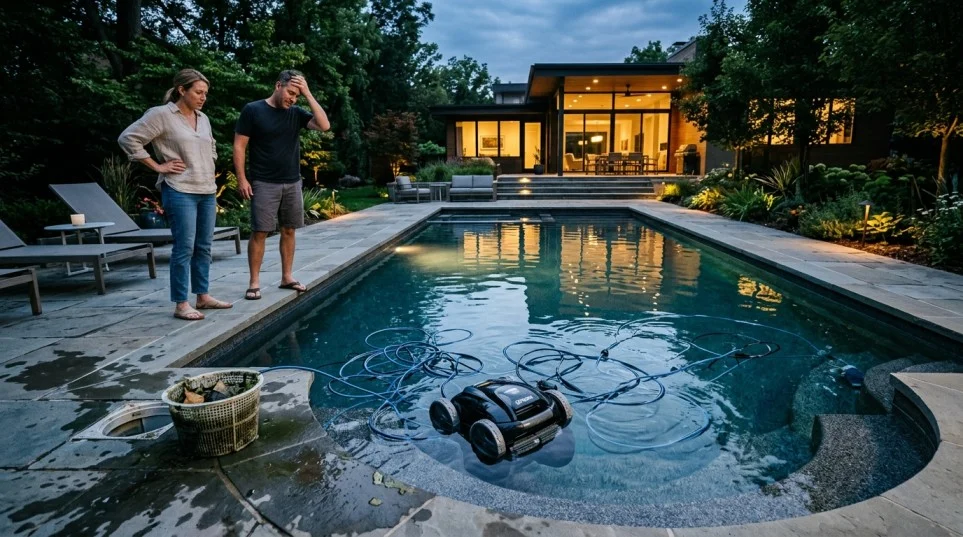

Quick Ans: Robot pool cleaners look impressive in advertisements. Drop the machine into the water, press a button, and let automation handle the dirty work. That promise attracts thousands of pool owners every year.
However, many buyers discover the reality after spending hundreds or even thousands of dollars.
A robotic pool cleaner can absolutely save time. It can reduce manual vacuuming and improve pool maintenance routines. Yet these machines also come with frustrating limitations, expensive repairs, hidden maintenance costs, and reliability concerns that manufacturers rarely highlight.
Some owners love them. Others regret the purchase after dealing with battery failures, tangled cords, clogged filters, weak wall climbing, or expensive replacement parts.
This guide breaks down the real robot pool cleaner negatives without marketing fluff. You’ll learn:
- The biggest disadvantages of robot pool cleaners
- Common robotic pool cleaner problems
- Hidden ownership costs
- Corded vs cordless issues
- Maintenance requirements
- Reliability concerns
- Lifespan expectations
- Repair headaches
- Whether robotic pool cleaners are truly worth it
If you’re considering an automatic pool cleaner, this article helps you avoid expensive mistakes.
What Is a Robot Pool Cleaner?
A robotic pool cleaner is an automated pool vacuum that cleans pool floors, walls, and sometimes waterlines without connecting directly to your pool pump system.
Unlike suction-side or pressure-side cleaners, robotic pool cleaners use their own:
- Electric motor
- Filtration basket
- Navigation system
- Drive wheels or tracks
- Internal pump
Most modern smart pool cleaners also include:
- Wi-Fi connectivity
- Mobile app controls
- Scheduled cleaning cycles
- Smart navigation mapping
- Cordless battery systems
They sound futuristic. Sometimes they work beautifully.
Still, robotic pool cleaner drawbacks become obvious after long-term use.
Robot Pool Cleaner Pros and Cons at a Glance
Before diving deep into the negatives, here’s a realistic comparison table.
| Feature | Pros | Cons |
|---|---|---|
| Cleaning Automation | Reduces manual vacuuming | Doesn’t eliminate maintenance |
| Energy Efficiency | Uses less energy than some pool systems | Still increases electricity use |
| Filtration | Captures fine debris | Filters clog quickly |
| Convenience | Scheduled cleaning cycles | Requires frequent supervision |
| Wall Climbing | Some models clean walls well | Many fail on slopes or corners |
| Smart Features | App control and automation | Wi-Fi connectivity issues are common |
| Cordless Models | No cable tangling | Short battery life |
| Cleaning Coverage | Good for regular maintenance | Misses spots in complex pools |
| Pool Debris Removal | Handles leaves and dirt well | Struggles with heavy algae |
| Long-Term Ownership | Saves labor time | Expensive repairs and replacement parts |
The table reveals the truth most advertisements skip.
Robot pool cleaners aren’t fully automatic miracle machines. They reduce effort, but they introduce a new category of maintenance headaches.
The Biggest Robot Pool Cleaner Negatives
High Upfront Cost
The first major disadvantage of robot pool cleaners is simple: they’re expensive.
A quality robotic pool cleaner often costs:
| Cleaner Type | Average Price Range |
|---|---|
| Budget Robotic Cleaner | $300–$600 |
| Mid-Range Smart Cleaner | $700–$1,200 |
| Premium Pool Robot | $1,500–$2,500+ |
That price surprises many first-time buyers.
Manual vacuums cost far less. Even pressure-side cleaners often remain cheaper long term.
Worse yet, the purchase price isn’t the end of the expense.
Pool owners later face:
- Replacement filters
- Battery replacements
- Motor repairs
- Drive belt replacements
- Wheel replacements
- Power supply failures
- App connectivity troubleshooting
The hidden costs add up quickly.
Robot Pool Cleaner Hidden Costs Most Owners Ignore
Many pool owners budget only for the initial purchase. That’s a mistake.
Replacement Filters
Filters require regular replacement because fine debris slowly damages the mesh.
Typical annual filter costs:
| Filter Type | Estimated Annual Cost |
|---|---|
| Standard Cartridge | $40–$100 |
| Ultra-Fine Filter | $70–$150 |
| Premium Nano Filters | $100–$250 |
Heavy pool usage increases those numbers.
Battery Replacement Costs
Cordless robotic pool cleaner battery problems rank among the most expensive issues.
Most lithium batteries last:
- 2–4 years on average
- Less in hot climates
- Less with frequent charging cycles
Battery replacements commonly cost:
| Cleaner Type | Battery Replacement Cost |
|---|---|
| Entry-Level Cordless | $150–$300 |
| Premium Cordless Robot | $400–$900 |
Some manufacturers make battery replacement difficult or impossible for DIY owners.
That forces you into costly service centers.
Replacement Brushes and Tracks
Brushes wear out surprisingly fast in rough pools.
Common replacement intervals:
- Every 12–24 months
- Faster in concrete pools
- Faster with frequent cleaning cycles
Track systems and drive wheels also fail over time.
Robotic Pool Cleaner Maintenance Is Constant
Advertisements make robotic cleaners look maintenance-free.
Reality feels very different.
Frequent Filter Cleaning
One of the most common robot pool cleaner complaints involves filter cleaning frequency.
After almost every cleaning cycle, owners often need to:
- Remove the cleaner
- Open the housing
- Remove filter baskets
- Wash debris manually
- Clean fine sediment
- Reassemble the unit
Pools with heavy leaves require even more attention.
Small debris creates another issue.
Fine sand and silt clog filters quickly, which reduces suction power and cleaning efficiency.
Many pool owners underestimate how repetitive this process becomes.
Robotic Pool Cleaner Maintenance Requirements
Here’s what long-term ownership usually involves.
| Maintenance Task | Frequency |
|---|---|
| Filter Cleaning | After nearly every cycle |
| Brush Inspection | Monthly |
| Cable Untangling | Weekly |
| Wheel Cleaning | Monthly |
| Battery Monitoring | Ongoing |
| Software Updates | Occasionally |
| Impeller Cleaning | Every few weeks |
| Storage Maintenance | Seasonal |
That’s far from “drop and forget.”
Robot Pool Cleaner Problems With Navigation
Smart navigation systems sound impressive until the robot starts behaving like a confused shopping cart.
Navigation failures happen often in:
- Freeform pools
- Deep slopes
- Pools with ledges
- Pools with tanning shelves
- Pools with drains
- Pools with unusual corners
Common complaints include:
- Repeated cleaning in the same area
- Missed debris sections
- Random movement patterns
- Stuck cleaning cycles
- Incomplete pool coverage
Some cleaners advertise AI-powered mapping. In reality, many still bounce randomly around the pool.
Pool Robot Cable Tangling Problems
Corded robotic pool cleaners introduce a frustrating issue: tangled cables.
The floating power cable twists over time because the cleaner constantly changes direction underwater.
That leads to:
- Reduced mobility
- Cleaning interruptions
- Knotted cords
- Uneven coverage
- Premature cable wear
Some manufacturers include anti-tangle swivels. They help, but they don’t completely solve the issue.
Longer pools often make tangling worse.
Many owners spend time untwisting cables before every cleaning session.
That’s hardly convenient.
Cordless Robotic Pool Cleaner Battery Problems
Cordless pool robots eliminate cable tangling. Unfortunately, they create another set of headaches.
Short Battery Life
Battery runtime becomes a major frustration in large pools.
Typical cordless runtime:
| Cleaner Category | Average Runtime |
|---|---|
| Budget Cordless Models | 60–90 minutes |
| Mid-Range Models | 90–150 minutes |
| Premium Cordless Units | 150–240 minutes |
Large pools often require multiple cleaning sessions.
The robot may stop halfway through cleaning, leaving debris behind.
Battery Degradation
Lithium-ion batteries naturally degrade.
Over time, owners notice:
- Shorter runtimes
- Weak climbing ability
- Slower movement
- Charging inconsistencies
Extreme heat speeds up battery deterioration significantly.
Robot Pool Cleaner Issues With Wall Climbing
Manufacturers love showing robots climbing pool walls effortlessly.
Real-world performance varies dramatically.
Robotic Pool Cleaner Not Climbing Properly
Wall climbing failures happen because of:
- Weak suction
- Worn tracks
- Smooth tile surfaces
- Heavy algae buildup
- Battery weakness
- Poor traction design
Common complaints include:
- Sliding down walls
- Falling before reaching waterline
- Ignoring deep ends
- Cleaning only the floor
Some pool finishes create even bigger problems.
Pebble surfaces, vinyl liners, and slippery fiberglass pools may confuse certain robots.
Robot Pool Cleaner Getting Stuck
This issue frustrates countless owners.
Pool cleaning robots commonly get stuck:
- On drains
- Near ladders
- Around steps
- On pool lights
- Against corners
- On raised drains
Once stuck, the cleaner may:
- Shut down completely
- Drain battery power
- Repeat useless movements
- Leave sections dirty
Many robotic cleaners lack advanced obstacle detection.
That limitation becomes obvious in complex pool layouts.
Robotic Pool Cleaner Cleaning Limitations
Despite the marketing hype, robotic pool cleaners have clear limitations.
Robotic Cleaner Missed Spots
Even premium units sometimes miss:
- Tight corners
- Steps
- Waterline buildup
- Fine algae dust
- Pool edges
- Around fittings
Owners still need manual brushing and vacuuming occasionally.
That defeats the idea of total automation.
Heavy Debris Struggles
Large debris creates additional problems.
Some robots struggle with:
- Large leaves
- Acorns
- Twigs
- Pine needles
- Heavy algae
The intake ports clog quickly under heavy debris loads.
Robotic Pool Cleaner Algae Cleaning Problems
Many buyers expect robotic cleaners to solve algae problems.
They don’t.
A robotic pool cleaner works best for maintenance cleaning, not algae recovery.
Heavy algae often causes:
- Filter clogging
- Weak suction
- Slippery wheel traction
- Poor wall climbing
- Motor strain
You still need:
- Chemical balancing
- Pool shocking
- Manual brushing
- Filtration support
Pool robots help maintain clean water. They rarely fix neglected pools alone.
Robot Pool Cleaner Reliability Concerns
Reliability varies wildly between brands and models.
Some units last many years. Others develop issues surprisingly fast.
Common Robotic Pool Cleaner Failures
Frequent failure points include:
| Component | Common Failure |
|---|---|
| Drive Motor | Stops spinning |
| Power Supply | Electrical failure |
| Tracks/Wheels | Cracking or slipping |
| Battery | Charging failure |
| Impeller | Debris jams |
| Cable | Internal wire break |
| Wi-Fi Module | Connectivity failure |
| Sensors | Navigation errors |
Water and electronics don’t always cooperate long term.
Even waterproof engineering has limits.
Robotic Pool Cleaner Repair Issues
Repairs often become more complicated than buyers expect.
Expensive Repair Costs
Average repair pricing can shock pool owners.
| Repair Type | Estimated Cost |
|---|---|
| Motor Replacement | $200–$700 |
| Power Supply Repair | $150–$400 |
| Battery Replacement | $200–$900 |
| Cable Replacement | $150–$500 |
| Sensor Repair | $100–$300 |
| Wheel or Track Repair | $80–$250 |
Premium robotic pool cleaners often require proprietary parts.
That increases repair costs substantially.
Limited Repair Availability
Some manufacturers offer poor repair networks.
Owners sometimes struggle to:
- Find authorized service centers
- Obtain replacement parts
- Receive warranty support
- Access technical assistance
Repair turnaround can also take weeks during peak pool season.
Robotic Pool Cleaner Warranty Complaints
Warranty coverage often sounds better than it actually is.
Common complaints include:
- Limited battery coverage
- Short warranty periods
- Excluded wear items
- Denied water damage claims
- High shipping fees
Some warranties cover only specific components.
Others prorate coverage after the first year.
Always read warranty details carefully before buying.
Smart Pool Cleaner Connectivity Issues
Modern robotic cleaners increasingly rely on apps and Wi-Fi features.
That creates another category of problems.
Robot Pool Cleaner App Issues
Common smart cleaner frustrations include:
- App crashes
- Failed firmware updates
- Bluetooth pairing failures
- Wi-Fi disconnects
- Lost scheduling settings
- Delayed controls
Ironically, some owners prefer older non-smart robots because they’re simpler and more reliable.
Sometimes basic technology works best.
Robotic Pool Cleaner Energy Consumption
Manufacturers often market robotic cleaners as energy efficient.
Compared to running a full pool pump system, that’s partially true.
However, robotic cleaners still consume noticeable electricity over time.
Electricity Usage Adds Up
Average power usage:
| Cleaner Type | Estimated Energy Use |
|---|---|
| Small Robot | 100–150 watts |
| Mid-Size Robot | 150–250 watts |
| Large Premium Robot | 250–400 watts |
Frequent cleaning cycles increase utility costs gradually.
For pools requiring daily cleaning, annual energy use becomes noticeable.
Robotic Pool Cleaner Durability Concerns
Pool environments are brutal on electronics.
Heat, chemicals, UV rays, moisture, and debris slowly wear down components.
How Long Do Robotic Pool Cleaners Last?
Typical lifespan expectations:
| Cleaner Quality | Average Lifespan |
|---|---|
| Budget Models | 2–4 years |
| Mid-Range Models | 4–6 years |
| Premium Models | 5–8 years |
Heavy usage shortens lifespan dramatically.
Poor maintenance also accelerates wear.
Many owners expect a decade of use. Few robots actually reach that milestone without major repairs.
Do Robotic Pool Cleaners Damage Pool Liners?
Usually no, but risks exist.
Damaged brushes or rough wheel systems may:
- Scuff vinyl liners
- Create surface marks
- Catch weak liner seams
Cheap robotic cleaners create the biggest concerns.
Poor-quality wheels sometimes leave abrasion marks on delicate surfaces.
Always verify compatibility with:
- Vinyl pools
- Fiberglass pools
- Pebble finishes
- Tile surfaces
Robotic Pool Cleaner vs Suction Cleaner
Understanding alternatives helps buyers decide whether robotic cleaners are worth it.
Key Differences
| Feature | Robotic Cleaner | Suction Cleaner |
|---|---|---|
| Power Source | Electric motor | Pool pump suction |
| Cleaning Efficiency | Better overall | Basic cleaning |
| Upfront Cost | Higher | Lower |
| Maintenance | Complex | Simpler |
| Repairs | Expensive | Usually cheaper |
| Energy Usage | Separate electricity | Uses pool pump |
| Smart Features | Often included | Rare |
Suction cleaners lack advanced automation. However, they usually contain fewer expensive electronics.
That means fewer repair headaches.
Robotic Pool Cleaner vs Pressure Cleaner
Pressure-side cleaners offer another alternative.
| Feature | Robotic Cleaner | Pressure Cleaner |
|---|---|---|
| Debris Handling | Good fine filtration | Better for large debris |
| Installation | Plug-and-play | Often requires booster pump |
| Maintenance | High | Moderate |
| Smart Features | Yes | Rare |
| Repair Complexity | High | Moderate |
| Cleaning Speed | Moderate | Faster in some pools |
Pressure cleaners sometimes outperform robots in heavily wooded areas.
Large leaf loads overwhelm many robotic systems.
Are Robotic Pool Cleaners Hard to Maintain?
For many owners, yes.
Not because the tasks are physically difficult. Instead, maintenance becomes repetitive and time-consuming.
Typical Maintenance Frustrations
Owners commonly complain about:
- Cleaning dirty filters constantly
- Untangling cables
- Carrying heavy units
- Drying the robot after use
- Storing the unit properly
- Troubleshooting software issues
Large robotic cleaners often weigh:
- 15–30 pounds wet
Pulling them from deep pools daily gets tiring fast.
Robot Pool Cleaner Troubleshooting Guide
Most owners eventually face troubleshooting issues.
Why Does My Robot Pool Cleaner Stop Working?
Common causes include:
Dirty Filters
Clogged filters reduce water flow and trigger shutdown protection.
Cable Problems
Damaged cables interrupt power delivery.
Overheated Motor
Blocked impellers strain the motor.
Battery Failure
Cordless models may suddenly stop mid-cycle.
Sensor Errors
Navigation systems sometimes freeze or malfunction.
Worn Tracks
The robot loses movement traction underwater.
Basic Troubleshooting Checklist
| Problem | Possible Cause | Quick Fix |
|---|---|---|
| Weak suction | Dirty filter | Clean filter basket |
| Won’t climb walls | Worn brushes | Replace brushes |
| Stops randomly | Overheating | Cool and inspect motor |
| Misses spots | Sensor issue | Reset cleaning cycle |
| Won’t charge | Battery issue | Check charging dock |
| Tangled cable | Twisted cord | Untangle manually |
| App not connecting | Wi-Fi failure | Reconnect network |
Unfortunately, not all issues have simple fixes.
Why Robot Pool Cleaners Are Bad for Some Pool Owners
Robotic pool cleaners aren’t bad for everyone.
However, they become poor investments in certain situations.
They May Not Be Worth It If:
- Your pool gets heavy debris constantly
- You hate frequent maintenance
- You want zero manual cleaning
- Your budget is limited
- Your pool has unusual shapes
- You expect maintenance-free automation
- You dislike troubleshooting electronics
Many buyers expect a “set it and forget it” experience.
That’s rarely reality.
Best Robotic Pool Cleaner With Fewer Problems
No robotic pool cleaner is perfect.
Still, some qualities reduce long-term headaches.
What to Look For
Simple Design
Complex smart features increase failure risks.
Strong Warranty
Longer warranties usually indicate better manufacturer confidence.
Readily Available Parts
Easy access to filters, tracks, and batteries matters long term.
Strong Customer Support
Good support saves enormous frustration later.
Proven Reliability Reviews
Focus on long-term owner feedback instead of influencer marketing.
Corded vs Cordless Robot Pool Cleaner Issues
Both styles involve tradeoffs.
Corded Cleaner Problems
Common corded issues include:
- Cable tangling
- Limited movement
- Heavy handling
- Power supply failures
Cordless Cleaner Problems
Common cordless issues include:
- Short runtime
- Battery degradation
- Charging failures
- Reduced suction over time
Neither design fully solves every problem.
Common Robot Pool Cleaner Complaints From Real Owners
Across thousands of owner reviews, the same complaints appear repeatedly.
Most Frequent Complaints
- “The cable constantly tangles.”
- “Battery life dropped after one season.”
- “It gets stuck near the drain.”
- “The filters clog too fast.”
- “The app barely works.”
- “Replacement parts cost too much.”
- “It misses corners.”
- “Wall climbing stopped working.”
- “Customer service was terrible.”
- “The motor failed early.”
Those complaints don’t mean every robot is bad.
Still, they reveal patterns buyers should understand.
Pool Robot Cleaning Efficiency: Expectations vs Reality
Marketing videos often exaggerate robotic cleaner performance.
In reality:
| Marketing Claim | Real-World Reality |
|---|---|
| Fully automatic | Still requires supervision |
| Cleans entire pool perfectly | Misses spots occasionally |
| Maintenance-free | Frequent cleaning needed |
| Smart navigation | Sometimes random movement |
| Saves money long term | Repairs can become expensive |
| Works in all pools | Some surfaces cause problems |
That gap between expectation and reality drives many negative reviews.
Are Robotic Pool Cleaners Worth It?
The answer depends on your expectations.
They Are Worth It If:
- You want reduced manual vacuuming
- Your pool gets moderate debris
- You don’t mind routine maintenance
- You value automation convenience
- You accept occasional repairs
They May Not Be Worth It If:
- You expect zero maintenance
- Your pool gets heavy debris daily
- You want maximum reliability
- You dislike electronic troubleshooting
- You want the cheapest long-term solution
A robotic cleaner works best as a maintenance assistant, not a magical replacement for pool care.
The Real Truth About Robot Pool Cleaner Negatives
Robotic pool cleaners can absolutely improve pool maintenance.
However, they also introduce:
- Mechanical complexity
- Expensive repairs
- Battery concerns
- Navigation failures
- Maintenance work
- Reliability risks
Many homeowners buy one expecting perfection.
Then reality hits after the honeymoon phase ends.
The best approach is realistic expectations.
A good robotic cleaner can save time and reduce manual labor. It just won’t eliminate pool maintenance completely.
Think of it like a robot vacuum inside a house. Helpful? Absolutely.
Perfect? Not even close.
Choose carefully, maintain it properly, and understand the tradeoffs before investing heavily.
That mindset prevents disappointment later.
Disocver More:-
- What Makes a Wagering Strategy Profitable? The Complete Guide to Long-Term Betting Profit
- Orange in Spanish Meaning: Complete Guide to “Naranja,” Pronunciation, Colors, and Everyday Usage